
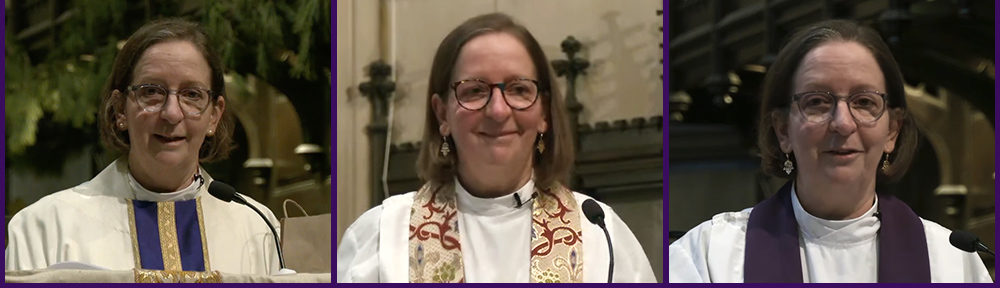
Advent 2C, 8 December 2024. The Very Rev. Pamela L. Werntz
Baruch 5:1-9. Put on the robe of righteousness that comes from God.
Philippians 1:1-11. And this is my prayer, that your love may overflow more and more with knowledge and full insight to help you to determine what is best.
Luke 3:1-6. Prepare the way of the Lord.
O disturbing God, grant us the strength, the wisdom and the courage to seek always and everywhere after truth, come when it may, and cost what it will.
This Advent, like most every Advent, I find myself wishing for some pre-holiday quiet; but John the Baptist is always loud. It’s hard to get a sense of just what kind of loud he is from the first six verses of Luke, Chapter 3, when, in many of our heads, the prophet Isaiah’s words are accompanied by beautiful music from Handel’s Messiah. But in verse seven, which we will hear next week, John the Baptist shouts to folks who have come out to be baptized by him (mind you, they have come to receive the very baptism of repentance that he was calling for), and he yells at them, “You brood of vipers! Who warned you to flee from the wrath to come? Bear fruits worthy of repentance. If you don’t, you are like a tree that is cut down and thrown into the fire.” John the Baptist is loud, and he’s in a very bad mood. He’s wild-eyed and hopping mad. H is not the patron saint of sitting quietly sipping cocoa through a peppermint stick for a straw, dreaming of a white Christmas.
And so, liturgically, we are deliberately setting the context for our celebration of the Nativity in two weeks and two days, not with quiet reflection, but with disturbing visions from the Gospel of Luke. We began last week looking through Luke’s lens at the brink of the Passion. This week and next week we look back a little further at John the Baptist. Luke draws a picture of him as a cousin to Jesus. Perhaps they were blood relatives, but none of the other Gospels mention it; and I don’t think Luke is trying to portray a familial connection. I think, for Luke, John’s and Jesus’ work were closely related, their purposes were so akin to one another, that it was as if they had known one another since before they were even born.
Luke’s audience would have immediately recognized John the Baptist as a prophet who was using words from Isaiah. And Luke’s audience would have immediately recognized him as a prophet just like Jeremiah. Both consecrated before birth, they predicted judgment at the end of the age, proclaimed God’s saving grace, and announced that God’s new covenant was available to everyone who repented. The books of Isaiah and Jeremiah are set in the contexts of specific points in history with references to the reigns of particular kings. So Luke dates the moment of this story of John the Baptist: It was in the fifteenth year of the domination of Emperor Tiberius, when the notoriously cruel Pontius Pilate was governor of Judea, treasonous and insecure Herod ruled Galilee, Herod’s rival and brother Philip ruled Ituraea and Trachonitis, and Lysanias ruled Abilene. If that’s not enough, Luke adds to the context the corrupt and complicit high priesthood of the retired Annas and his son-in-law Caiaphas. Into this period of deepest despair a word of God came to John, son of Zechariah.
A word of God came to John in the wilderness (not the word; there’s no definite article here). Notably, a word of God didn’t come to anyone on the Who’s Who list of rulers of government or temple, but to John, out in the middle of nowhere in the year 26 or 27 CE . Isaiah heard a word of God in something like 738 BCE, which the compiler of the book of Isaiah put on a scroll more than a century after that, a word that Luke recorded two generations after John’s ministry, a word coming to us nearly two millennia later! Here is a word of God for all people for all time.
John was in a particular middle of nowhere at the mighty Jordan River; and he was in every place that is wilderness. Wilderness is the place of formation for God’s people, a place of disorganization and dispute, of loss and grief, of surprising beauty and even intermittent joy, of vulnerability and dependence on God (in other words, a long spiritual journey). Here is a word of God for our particular place on our particular spiritual journey. Here is a word of God for all people for all time in all places, all kinds of nobodies in all kinds of nowheres, all flesh.
Rather than being a claim in the literal meaning of the term, that all flesh will see the salvation of God, this word of hope is echoed in a voice in every situation of despair. Commentator Mark Davis writes, “Its meaning may lie not so much in how it is fulfilled in any given moment in time, but in how true it is in every moment in time.”[1] A word of hope, a word of love is always and eternally being spoken by the Holy One. A word of hope, a word of love, is without limits to those who can hear.
It seems to me that being able to hear a word of hope, a word of love, has to do with immersing ourselves in repentance. Baptism is about immersion. The words baptize and immerse are synonymous in the New Testament. What does it mean to immerse ourselves in repentance, to bathe in repentance? It means to change. Repentance is not about being sincerely sorry, regretful or ashamed. Repentance is about changing thinking, direction, and action: returning to God, returning from alienation to reintegration, from estrangement to reconciliation with God, remembering our citizenship in the realm of God. What does it mean to immerse ourselves in repentance for the forgiveness of sin? Forgiveness of sin here literally means to divorce sin, to send sin away. It means to give ourselves and others a future. It means freeing ourselves and freeing others to move forward in a new direction toward God, which is the direction of Love. It’s not easy, and we need help (a lot of help), but the cost of not doing it is so much greater than the cost of immersing ourselves in repentance, and turning again toward Love.
If you’ve heard me preach before, you know I’m drawn to the practice of weaving together strands of theology, scripture, liturgy, and parish ministry in ways that provoke and motivate us to live out our mission in the world. I recently read about Gus Speth, an environmental lawyer who co-founded the Natural Resources Defense Council. Speth has said he used to think the most pressing environmental problems were the loss of biodiversity, the collapse of ecosystems, and climate change. He thought 30 years of good science could address and even solve those problems. Now he believes the most pressing environmental problems are selfishness, greed, and apathy; and to deal with those, he says, we need a spiritual and cultural transformation. Scientific methods don’t know how to address that, but people of faith do. Our scriptures and ethical teachings know about cultivating community where people learn to practice loving others, even complete strangers, to give with an open hand rather than grasp with a clenched fist, and to cultivate empathic and compassionate actions.
A few weeks ago I mentioned novelist and essayist Cara Hoffman. Her latest piece in the New York Times yesterday responds to the voices of people who want to flee this country rather than live under the coming administration. She cautions that she knows from her own experience that it’s nearly impossible to live somewhere in the world where the US doesn’t have influence, positive or negative. Also, the far right is on the rise in many parts of the world. Hoffman’s advice is, “Don’t let the politics of fear displace you. It’s much more important to find your compatriots and to create a life worth living, no matter where that is…imagining what it is [you] want instead of reacting to what [you] fear.” That is the message of the whole Gospel. That is what we are doing here this morning, imagining what it is we want instead of reacting to what we fear, and not just imagining, but enacting. We are building a beloved community right now.
In light of our scripture, this compels me to ask, what repentance, what particular change, are we being called to on this December morning? What repentance for forgiveness of sin might we be immersed in today? What direct ways or level paths are we being called to prepare? What needs to be cleared or smoothed out so that all flesh will see the salvation of God? What joy can be a quiet subversion in the face of despair? This Advent, let us once again immerse ourselves in repentance, change our direction, and head again towards Love. Let us immerse ourselves because we have work to do. We have work to do to bear fruits worthy of repentance. Once again, the final chorale of today’s cantata sums it up beautifully, so I’m paraphrasing: we will succeed if (and whenever) we believe (and behave) in Love from and with the depths of our hearts.
- D. Mark Davis, “All Flesh Shall See the Salvation of God,” Left Behind and Loving It, 1 Dec. 2024.