
Author Archives: Elizabeth Richardson
Reading the Signs
Lent 5A, April 2, 2017
Ezekiel 37:1-14 O my people.
Romans 8:6-11 To set the mind on the Spirit is life and peace.
John 11:1-45 Jesus began to weep… . he cried with a loud voice, ‘Lazarus, come out!’… . Jesus said to them, ‘Unbind him, and let him go.’
O God of love, grant us the strength, the wisdom and the courage to seek always and everywhere after truth, come when it may, and cost what it will.
It’s funny to me to have a few verses from Paul’s letter to the Romans warning against setting one’s mind on the flesh rather than the spirit, sandwiched between Ezekiel’s vision or dream of the re-embodiment of a valley full of dry bones and John’s vision or dream of the resurrection or rising of Lazarus after he had been dead for four days. It’s hard not to think of bodies when these dreams are so vivid in their descriptions of sinews, flesh, skin and smell! Continue reading
Demanding & Exhilarating
Lent 4A, March 26, 2017; The Rev. Pamela L. Werntz
1 Samuel 16:1-13 But the LORD looks on the heart.
Ephesians 5:8-14 Live as children of light.
John 9:1-13, 28-38 So that God’s works might be revealed in him, we must work the works of [the One] who sent me while it is day; night is coming when no one can work.
O God of our vision, grant us the strength, the wisdom and the courage to seek always and everywhere after truth, come when it may, and cost what it will.
Today is an anniversary of sorts. Nine years ago, on the Fourth Sunday in Lent (Laetare Sunday, aka Mothering Sunday), I began my service to Emmanuel Church as your priest with these readings from the lectionary. I brought a basket of red pencils with me that first morning for Steve Babcock, our trusty head usher, to hand out with the bulletins. His eyebrows went up just a little bit when I handed him the basket, but he was a great sport about the odd request. (It was the first of many.) I had collected the red pencils from art supplies from my prison ministry program, raided my kids’ colored pencil sets, and I probably bought two boxes or so. I’m so happy to report that nine years later, that I would need more than twice the number of pencils that we used in 2008 and I did not have the time on my hands to collect the additional pencils needed this week!
Continue reading
Holding
Thirst
Lent 3A, March 19, 2017; The Rev. Pamela L. Werntz
Exodus 17:1-7 The people thirsted there.
Romans 5:1-11 God’s love has been poured into our hearts through the Holy Spirit.
John 4:5-42 Give me a drink.
Romans 5:1-11 God’s love has been poured into our hearts through the Holy Spirit.
John 4:5-42 Give me a drink.
O God of water and thirst, grant us the strength, the wisdom and the courage to seek always and everywhere after truth, come when it may and cost what it will.
I just want to note that in our first reading this morning, I added the translation for the place names because to transliterate the Hebrew word “seen” as Sin just seems wrong. I should have added that the word Nile doesn’t appear in the Hebrew text – it’s just the river, and Horeb means “desert.” Perhaps the place names are not important to translate, but I couldn’t get past the distraction of calling the place in the Sinai, “Sin,” and I didn’t want you to either, particularly because our cantata text is all about sin. When you hear it, listen remembering that sin, according to the Bible, is separation from Love from neighbor. Sin is what we do or fail to do that keeps us apart from Love of neighbor and of God who is Love. Our scripture readings for today are not directly addressing sin, but are reflections on thirst, the physical and spiritual desire for wellsprings. Continue reading
Go!
Lent 2A, March 12, 2017; The Rev. Pamela L. Werntz
Genesis 12:1-4a Go from your country and your kindred and your father’s house.
Romans 4:1-5, 13-17 Blessed are those whose iniquities are forgiven, and whose sins are covered.
John 3:1-17 How can these things be?
O God of grace, grant us the strength, the wisdom and the courage to seek always and everywhere after truth, come when it may, and cost what it will.
This is one of those Sundays when I have a harder time giving thanks and praise to God in response to the scripture readings when I first hear them, because it’s hard for me to hear them read without thinking about the damage humans do to one another using these passages as weapons. The recent and dramatic rise of hateful words and actions against Jews and Muslims (or people mistaken for Muslims) is fueled by arrogance and ignorance of “Christian” teachings. The fighting happens within Christianity as well, between Catholics and protestants, between different kinds of protestants, and within our own Anglican traditions. Perhaps you have a similar experience of knowing these lessons from a standpoint of in and out, us and them, ours and not yours. Perhaps you’ve heard these lessons as being about tests about who measures up because of what they think or don’t think. If not, just wait for today’s cantata! All this makes many flee religious practice, and for good reason. Continue reading
Grief at Common Art
Training for Easter
The Rev. Pamela L. Werntz
Genesis 2:15-17, 3:1-7. You will not die.
Romans 5:12-21. But where sin increased, grace abounded all the more.
Matthew 4:1-11 Away with you, Satan!
O God of Grace, grant us the strength, the wisdom and the courage to seek always and everywhere after truth, come when it may, and cost what it will.
The season of Lent has begun in the Church and so I want to talk to you a little bit about temptation and about sin! (It seems only right.) It’s not something we like to talk much about so much in The Episcopal Church. Temptation is what leads to sin and sin – well… a parishioner told me once that she doesn’t really like the word sin because it’s such a strong word. “Couldn’t we just use the word mistake?” she asked. But I don’t think “mistake” completely covers it.
Continue reading
Q&A Book for Cafe Emmanuel
Kate Solow is compiling a book with questions like, “What would you want to tell LGBT youth today?”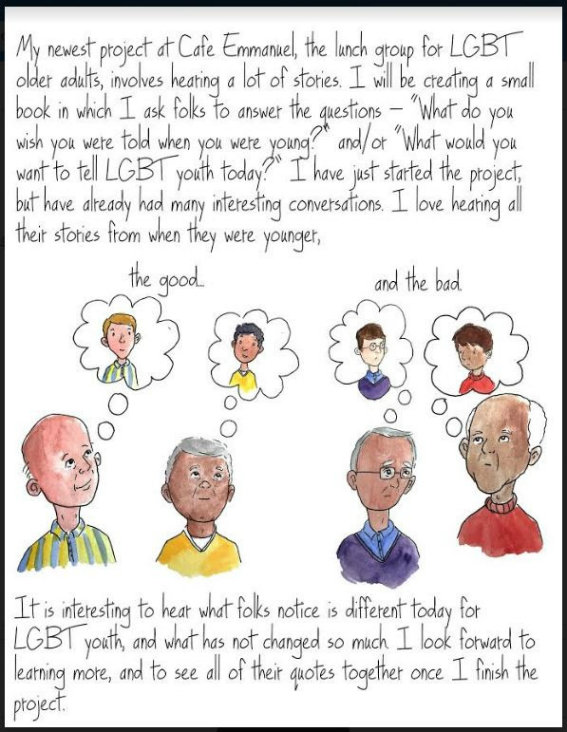
Coming Clean (with audio)
Epiphany 7A, February 19, 2017; The Rev. Pamela L. Werntz
Leviticus 19:1-2, 9-18 You shall be holy, for I the LORD your God am holy.
1 Corinthians 3:10-11, 16-23 Do you not know that you are God’s temple?
Matthew 5:38-48 Give to everyone who begs from you.
1 Corinthians 3:10-11, 16-23 Do you not know that you are God’s temple?
Matthew 5:38-48 Give to everyone who begs from you.
O Holy God, grant us the strength, the wisdom and the courage to seek always and everywhere after truth, come when it may, and cost what it will.
Today seems like a good day to make sure you know some things about the Book of Leviticus, the third book of the Torah, because we just heard the only passage that ever gets read in our three-year lectionary cycle. Chapter 19 of Leviticus is sometimes called the mini-Torah because of how comprehensive it is in its summary of what it will look like to be the people of God. In a three-year cycle of readings, this lesson gets read on the 7th Sunday of Epiphany in Year A, when the calendar permits seven Sundays in Epiphany, which is to say almost never.
Continue reading