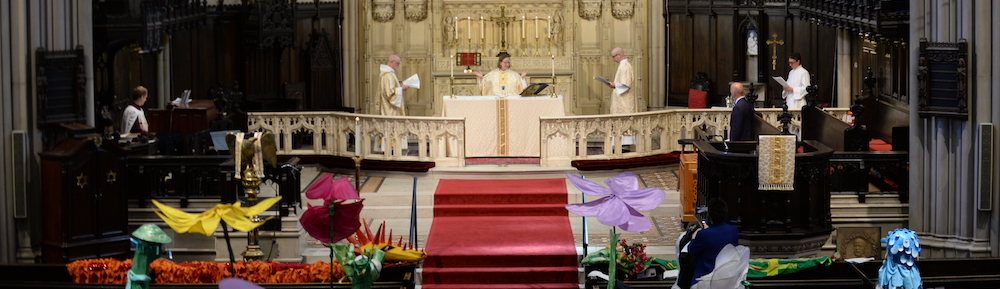
“What is your hand in this?”

Commemorative concerts for America’s 250th anniversary will be dotting the musical landscape in 2026. An inventive program that may prove to be one of the most challenging for audiences has been launched by Davóne Tines and Ruckus, “a shapeshifting, collaborative, baroque ensemble with a visceral and playful approach to early music.” Sanders Theater hosted them on January 31, 2026, as part of their ten-cities tour.
Created by bass-baritone Davóne Tines, bassist Douglas Adam August Balliett, and Clay Zeller-Townson, founder of Ruckus, the program called “What is your hand in this?” recasts “Colonial and Revolutionary-era hymns, ballads, and Baroque compositions, on a musical journey that weaves through the pre-Civil War period, the Civil Rights era, and into the present day.” (Everyone 250 Continue reading

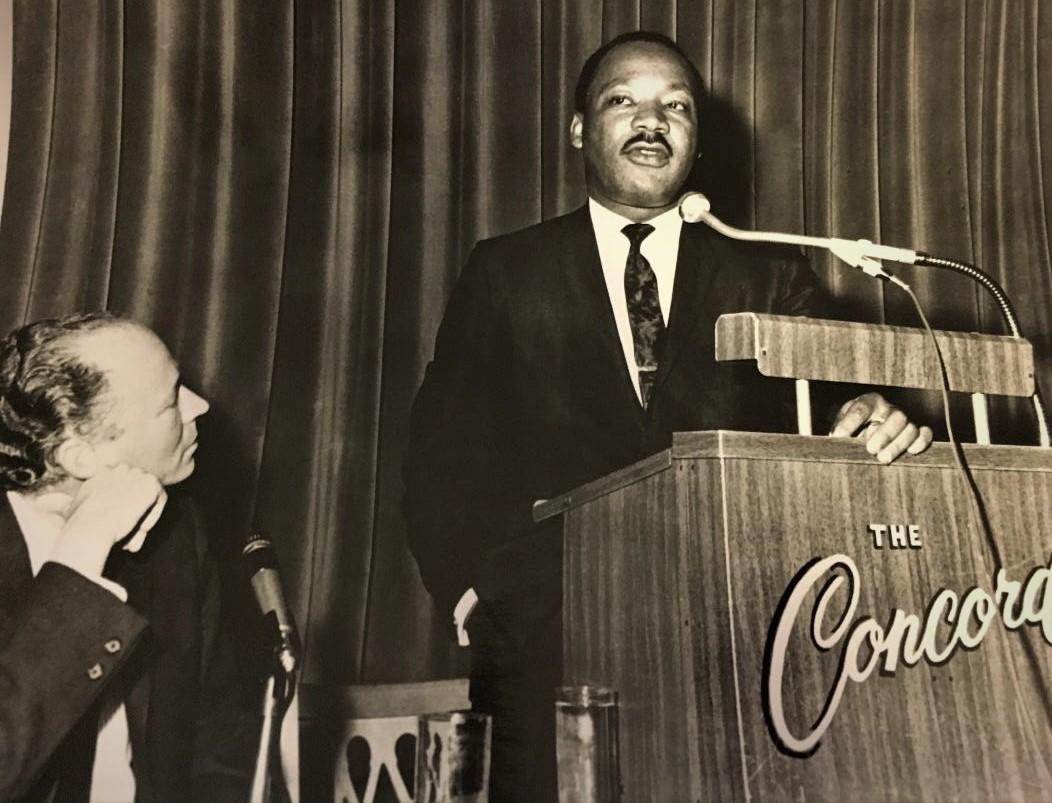
The Fierce Urgency of Now

On Monday, January 19th, 2026, the 56th Annual Martin Luther King Jr. Memorial Breakfast will be held in Boston.

The MLK Breakfast Memorial Committee is comprised of representatives from St. Cyprian’s Episcopal Church and Union United Methodist Church. The event is the longest-running celebration of its kind in the U.S.; scholarships are provided each year to students from nine Boston public high schools.

Continue reading

Boston’s Home for Aged Colored Women

March 3, 2025

To honor women’s history this month, we turn to a story of little seen women in Boston at the time Emmanuel was being founded. The Boston Globe published an article about the discovery of a marker for the Home for Aged Colored Women (1860-1944) in Dorchester’s Cedar Grove Cemetery (From a mass grave in Boston, unearthing Black women’s lives” by Karilyn Crockett (February 3, 2025)

The Home, founded in 1860, was among the Boston institutions that offered shelter and support to women who did not have financial or other family support. In the case of the Home for Aged Colored Women, historical news accounts and the organization’s records (located at the Massachusetts Historical Society) state that women of color applied to the Home after not being welcomed at almshouses and other benevolent institutions.

We discovered that Emmanuel parishioners were benefactors of the Home from the 1860s onward (among them was Susan Coombs Dana (Mrs. Wiliam R. Lawrence).

We invite you to explore these sites which explore the Home’s history in more detail

The West End Museum site.

The National Park Service’s page about the Home.

–Mary Beth Clack, Mary Blocher, Cindy Coldren, Pat Krol, Liz Levin

For the Next Generation

February 17, 2025

During Black History Month, we invite you to read some of the works written by authors speaking to the next generation. Our suggestions include:

–Langston Hughes’s poem, “Mother to Son” (first published in 1922 in The Crisis, the official magazine of the National Association for the Advancement of Colored People (NAACP); in 1926, the poem was included in his Hughes’s poetry collection, The Weary Blues)

–James Baldwin’s “A Letter to My Nephew” (published as “My Dungeon Shook: Letter to My Nephew on the One Hundredth Anniversary of the Emancipation,” in The Fire Next Time (New York: Knopf Doubleday, 2013)

–Imani Perry’s Breathe: A Letter to My Sons (Boston: Beacon Press, 2019). Perry offers a layered meditation.

–Ta-Nehisi Coates’s Between the World and Me (New York: Random House, 2015)

–Mary Beth Clack, Mary Blocher, Cindy Coldren, Pat Krol, Liz Levin

A Reflection on Reparations for Holocaust Remembrance Day

February 3, 2025

We met Constance Holmes when we participated in the last fall’s Stolen Beam program.

Connie is a founding member of the Reparations Interfaith Coalition and serves on the Episcopal City Mission Reparations leadership team. Here is Connie’s meditation for us on Holocaust Remembrance Day, January 28, 2025. Continue reading

Small World(s): Emmanuel & Church of the Holy Spirit, Mattapan

January 7, 2025

Last Juneteenth some Emmanuelites attended the celebration at the Church of the Holy Spirit (CHS), Mattapan. Since that time, we discovered an essential connection between our church and CHS. In 1886, a generous gift of Annie Lawrence Lamb (1857-1950) enabled the founding of CHS which was dedicated to her father, Benjamin Smith Rotch (1817-1882). Benjamin Rotch was co-founder of the New Bedford Cordage Company and one of our church’s founding proprietors. He was a member of Emmanuel’s first vestry, one of the first convention delegates, and warden from 1880-1882. Appointed to the committee to obtain subscriptions for the building of the church in the 1860s, Rotch also served on the committee considering the enlargement of the church during the same period. Our Emmanuel website has wonderful descriptions of the family’s gifts, in particular, the Rotch reredos and communion table. Continue reading

The Work of Christmas: A Season of Darkness & Light

December 26, 2024

At our exquisite Christmas Eve service, a service of dark and light, love and grace, concern and care, Reverend Pam recalled the words of Howard Thurman, minister of, and to, the disinherited:  “When the song of the angel is still, when the star in the sky is gone, when kings and princes are home, when the shepherds are back with their sheep, the work of Christmas begins: to find the lost, to heal the broken, to feed the hungry, to release the prisoner, to rebuild the nations, to bring peace among people, to make music in the heart.” Continue reading

Nikki Giovanni, Poet of Joy

December 16, 2024

With poet Nikki Giovanni’s passing, the tributes continue to flow. Kevin Young, poet, essayist, and Director of the Smithsonian’s National Museum of African American History and Culture paid tribute in a recent New Yorker article, “Nikki Giovanni’s Legacy of Black Love.”

Young observes that often contrarian Giovanni wrote “across the decades” about ecopoetics, family, and justice. She also “preferred to remind readers that ‘Black love is Black wealth,’” and her love spread throughout the Black Arts Movement and beyond.

The Guardian’s article emphasizes her accessible poetry about liberation, gender, love, and the small pleasures of daily life.

We send greetings for the season with a perhaps lesser-known poem, “Christmas Laughter,” a glimpse of her family’s enjoyment of the varied “senses” of the holiday.

–Mary Beth Clack, Mary Blocher, Cindy Coldren, Pat Krol, Liz Levin
–Published in This Week @Emmanuel Church December 16, 2024

Thanksgiving Revisited

December 2, 2024

On Thanksgiving Day, people gathered on Cole’s Hill in Plymouth for the annual Day of Mourning. This tradition was established in 1970, spearheaded by Wamsutta (Frank) James, a Wampanoag and activist. James’s son, Moonanum James, now organizes the event.

Prayers for this day often include remembering the losses of Indigenous communities, and praying for healing, truth-telling, and the capacity to be instruments of justice during our lives.

More recently scholars in religious studies have advocated for the study of “living religion” or religion as practiced. The practice of praying for Indigenous peoples was often the first step in a journey of contact with Christianity. Conversion narratives by John Eliot and Thomas Mayhew illustrate the co-existence of traditional and Christian thought and practice as they engaged with missionaries.

In this vein, we recommend David Silverman’s This Land is Their Land: The Wampanoag Indians, Plymouth Colony, and the Troubled History of Thanksgiving (New York: Bloomsbury, 2019). Silverman notes that in early times, Wampanoags “turned the missionaries religion into a new way to express indigenous truths by melding Wampanoag religious concepts and truths with their rough Christian equivalents…some Wampanoags found Christianity to be a means of reinvigorating old religious ideas to meet the stresses of a new era.” (p. 243) There were other practical reasons, of course, to engage with missionaries, and over time, relationships between the two cultures became increasingly strained. By 1677, 10 of the 14 praying towns in Massachusetts were disbanded.

–Mary Beth Clack, Mary Blocher, Cindy Coldren, Pat Krol, Liz Levin
–Published in This Week @Emmanuel Church, December 5, 2024.