
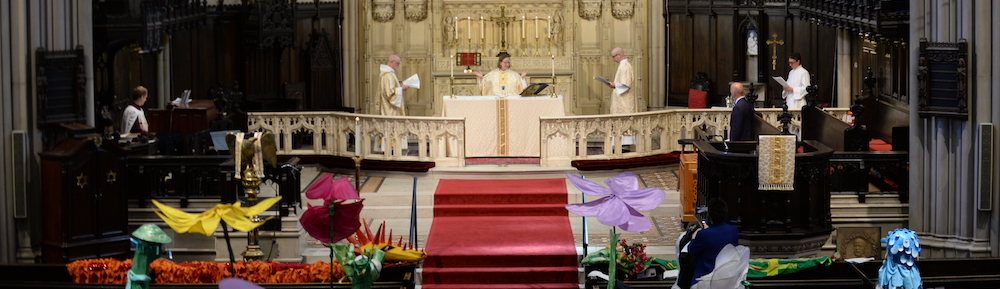
Third Sunday of Advent (A), December 15, 2019. The Rev. Pamela L. Wermtz
James 5:7-10. Beloved, do not grumble against one another.
Matthew 11:2-11. Are you the one who is to come, or are we to wait for another?
O God of mercy, grant us the strength, the wisdom and the courage to seek always and everywhere after truth, come when it may, and cost what it will.
Today is the Sunday in Advent called Gaudete Sunday. (Gaudete means rejoice.) Our liturgical color for the third Sunday is rose; that’s why we have a rose-colored candle in our Advent wreath and rose in our vestments. It is a Sunday set aside to fill our imaginations with joyful anticipation of what God might be up to in creating new heavens and a new earth. It is a Sunday to pick our heads up and rejoice in the faithfulness of God, in the midst of everything that grieves us, in the midst of oppression and violence, in the midst of hunger and illness and imprisonment, even in the midst of destruction and death. I’ve spent considerable time this week wondering how to rejoice always in spite of wide-spread violence and hate crimes, the rise of fascism, and the wanton disregard for the well-being of our planet. It’s a hard choice, I think, not to give in to despair; it’s hard, even scandalous, to choose to rejoice. Rejoicing, however, is not the same as “holiday frolicking”, as William Stringfellow once wrote; and rejoicing certainly doesn’t mean letting up on our non-violent resistance and our actions to end oppression of all kinds.
 Two weeks ago, I wrote about my “silliness” skill and my ability to make others feel comfortable being goofballs. Then I spoke to a friend of mine who also has this skill. From her perspective, the skill isn’t just about making others feel comfortable being playful, but also about making others feel more comfortable about their insecurities. She explained that when we heighten and exaggerate our own insecurities, bringing them to a “ten,” the insecurities become a lot less intimidating and a lot more ridiculous, evoking more laughter and less anxiety. For example, I tend to be a perfectionist, a behavior rooted in my insecurity of not being good enough. When I notice I’m feeling perfectionistic, I exaggerate the statement—“If I don’t have straight A’s, I’m not trying hard enough” becomes “I MUST score an ‘A’ on EVERY assignment or else I don’t deserve to be in school at all!” This statement is accompanied by a deep, scratchy, commanding voice and dramatic, clutching hand gestures. With this insecurity externalized and heightened, I’m able to see what parts of it are ridiculous and illogical; I can see how these perfectionistic thoughts, which are so natural and constant in my mind, don’t actually serve me. It was empowering for me to recognize that my “silliness” skill has broader implications than I thought. It’s not only about helping others feel comfortable being playful; it’s also about helping others feel comfortable and safe enough to confront their insecurities, hopefully to then view them with a fresh and less anxious perspective.