1971

Rosemary Dodge Hutcheson became our first woman officer.  Former president of the Junior League of Boston, she served as Clerk of the Vestry for two years.  See also 1931.

“Start your day with Robert J.”  says Priscilla Young’s T-shirt.

Robert J. Lurtsema took over Morning Pro Musica on WGBH’s FM station.  On Sunday mornings he often broadcast a Bach cantata from Emmanuel.  Our benefactor Priscilla Rawson Young supported not only our cantatas but also GBH and the Boston Symphony Orchestra.

For more about PR Young, see: 19091939, 19421973, 1994 & 2000.


1969

EllingtonConcert_of_Sacred_Music

Thanks to Radio Corporation of America for use of this image.

  • J. Barkev Kassarjian joined our vestry.  His wife Mary Catherine Bateson gave birth to their daughter Savanne (Vanni) Margaret, who was baptized here.
  • April 20.  Edward Kennedy “Duke” Ellington‘s Second Concert of Sacred Music, sponsored by the Episcopal Chaplaincy at Harvard and Radcliffe, was performed for a large audience in our Sanctuary with our ninth rector, The Rev. Al Kershaw presiding.  Please see Wikipedia for information about this and Ellington’s other sacred concerts.

See also Timeline entries about Kershaw: 1956, 19631966.

1966

Jan. 14.  The Rev. Alvin L. Kershaw served as master of ceremonies for the first  Boston Globe Jazz and Blues Festival, held at the Boston War Memorial Auditorium (now the Hynes Convention Center).

April 24.  More than 500 people attended a jazz service with Al Kershaw presiding.  Trumpeter Herb Pomeroy and his sextet played saxophonist Edgar (Ed) Summerlin‘s “Liturgy of the Holy Spirit”, with text based on the Eucharistic Prayer of Hippolytus (c. 217 CE) and adapted by the New York poet William Robert Miller.

See also Timeline of Jazz @ Emmanuel & this Timeline’s entries about Kershaw: 1956, 19631969.

The Rev. Al Kershaw & Dizzie Gillespie. Thanks to MetroWest Daily News for this image.

1963

The Rev. Alvin L. Kershaw became our ninth rector. He had previously served as  rector of Christ Church Episcopal Church in Bowling Green, Kentucky (1944 – 1947); Holy Trinity Episcopal Church in Oxford, Ohio (1947 – 1956); and All Saints Episcopal Church in Peterborough, New Hampshire (1956 – 1963).

See his biography & papers.

See also our Timeline entries:  195619661969.

1959

The Business & Professional Women’s Guild (formerly Club) had 98 members.  Its officers were Miss Lydia LeBaron Walker, President; Miss Caroline G. Whitney, Vice-President and Recording Secretary; Miss Margaret A. Cooke, Corresponding Secretary; Maude D. Gowen; Treasurer.  Our archives has its membership directory for that church year. The Guild was active for another decade.

Oct. 18-20. A series of five Healing Services were held with the Rev. Canon Alfred W. Price presiding, assisted by Rector Harold Sedgwick, the Rev. Dr.  Rollin J. Fairbanks,  and other clergy.  Their hands were laid upon more than 3600 heads.  After a nationwide outbreak of polio in 1955, the Salk vaccine had been widely administered.  People in the Commonwealth became alarmed by a recurrence of paralytic poliomyelitis, which peaked here in September. Since about half of the patients had been properly vaccinated, the vaccine’s effectiveness was called into question.  When the Sabin attenuated vaccine was distributed in oral form in 1961, the nation heaved a sigh of relief.

Dr. Fairbanks (1908-1983) was the Robert Treat Paine Professor of Pastoral Theology at Episcopal Divinity School.  Canon Price (1899–1992), who had been awarded a Purple Heart for his service in WWII, was for many years an international warden of the Episcopal Church’s Order of St. Luke the Physician. His works include:  Healing:  The Gift of God (1955), Religion & Health (1962), and a God’s Health:  Handbook for the Practice of the Church’s Ministry of Healing (1976).

Left to right: Rector Sedgwick, Dr. Fairbanks, the Rev. Don Hargrove Gross, the Rev. Canon Alfred W. Price & ?

1956

  • Feb 15.  “Ole Miss” invited the Rev. Alvin Louis Kershaw to speak

on the subject of jazz, an area in which he was considered something of an expert. In the meantime, [he had become] a contestant on the television quiz show The $64,000 Question, where his expertise in the field of jazz helped him to win $32,000. In an interview after the program, he alluded to the possibility of donating a portion of his winnings to the National Association for the Advancement of Colored People (NAACP) to aid in the battle against segregation. When word of this reached Mississippi, the Rev. Kershaw became the target of a firestorm of criticism, which eventually led to cancellation of his scheduled visit to Ole Miss.

–Guide to his papers donated by his widow Doris to U. of Southern Mississippi, McCain Library and Archives.

  • His album Introduction to Jazz was released by Decca Records.  Our archive has a copy of the record, which contains “Selected recordings of great jazz stylists, with historical data and musical analyses” and these tunes:
      1. Snag it (King Oliver’s Savannah Syncopators)
      2. Wild man blues (Johnny Dodds’ Black Bottom Stompers)
      3. I’ve found a new baby (Chicago Rhythm Kings)
      4. Tin roof blues (New Orleans Rhythm Kings)
      5. Davenport blues (Adrian Rollini’s Orchestra)
      6. The blues jumped a rabbit (Jimmy Noone’s New Orleans Band)
      7. Five point blues (Bob Crosby’s Bob Cats)
      8. Perdido Street blues (Louis Armstrong)
      9. Georgia cake walk (Art Hodes and his band)
      10. Impromptu ensemble no. 1 (Bobby Hackett et al.)
      11. Tishomingo blues (Bunk Johnson)
      12. Chimes blues (George Lewis and his Ragtime Band).

See also Timeline entries:  1963, 1966, 1969.

Introduction to Jazz


  • March. Rector R.G. Metters in his annual report summarized the decade of his tenure, including:
    • Growth in communicants
    • Growth of investments by more than a quarter
    • Increase in pledges from $22K to almost $43K
    • Renovation of the church and parish house  at a cost of more than $115K
  • Oct. 1. Rector Metters resigned and later became headmaster of St. George’s School in Spokane WA.  The vestry appointed the Rev. David Siegenthaler priest-in-charge.

1954

Emma Louise Gildersleeve Lane died.  Born in 1872 in Charlottesville, Virginia, to Emma Louisa Lanneau and Professor Basil Gildersleeve, later of Johns Hopkins University.  As founding editor of The American Journal of Philology, he became a colleague of Harvard Professor George Martin Lane, father of her husband-to-be Gardiner Martin Lane, an Emmanuelite and banker who became chairman of the board of the Boston Museum of Fine Arts.  In their memory, their daughter Katharine Lane Weems gave an endowment and a pair of Spanish candelabra for our baptistry.

1952

The General Convention of The Episcopal Church was held in Boston.  Thanks to Roger Lovejoy at our diocesan headquarters for this image of some of the attending bishops in our parish hall.

Front row, left to right:  Wallace Conkling, 7th Bishop of Chicago; Benjamin Ivins, VII of Milwaukee; Charles Boynton, III of Puerto Rico; Spence Burton, SSJE, IX of Nassau, Bahamas; James DeWolfe, IV of Long Island; Donald Campbell, Suffragan of Los Angeles; and Reginald Mallett, III of Northern Indiana.

Back row Henry Daniels, V of Montana; Donald Hallock, VIII of Milwaukee; Jonathan Sherman, V of Long Island; Edward Demby, Suffragan Bishop of Arkansas.

Bishops of The Episcopal Church gathered in our Parish Hall. Photo credit: Diocese of MA

1951

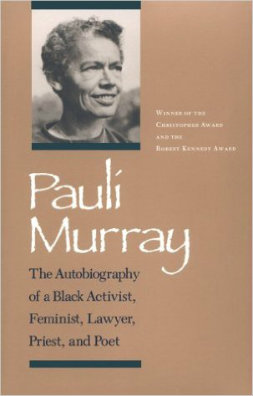
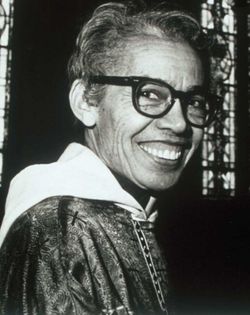
Pauli Murray, whom Emmanuel would eventually sponsor for the priesthood, compiled and edited a seminal work for the civil rights cases:  Stateslaws on race and color: and appendices containing international documents, federal laws and regulations, local ordinances and charts (Cincinnati: Women’s Division of Christian Service, Board of Missions and Church Extension, Methodist Church, 1951).  Her fight for civil rights had begun in 1938, when the NAACP unsuccessfully sponsored her for admission to the University of NC.  In 1940 she was arrested in Virginia for refusing to sit in back of a bus.  For a timeline of her struggles and achievements, see Duke Human Rights Center’s Pauli Murray Project.

See also our guide to her legacy and Timeline entries about her: 19701973, 19741977, 1985, 1987, 2012 & 2015.