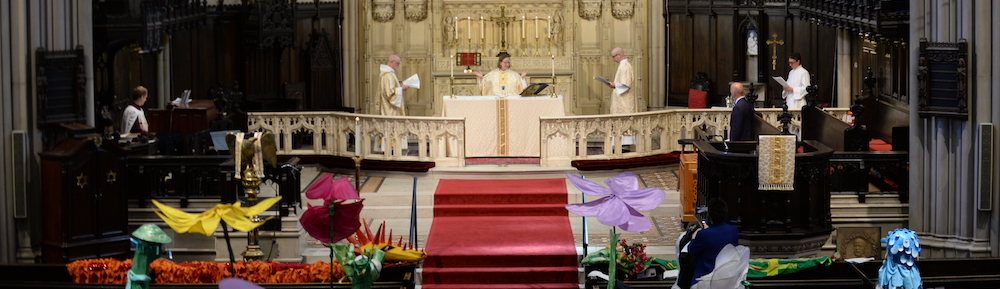
We are all one.

Proper 5C, May 18, 2025.  The Very Rev. Pamela L. Werntz

Acts 11:1-18. The spirit told me…not to make a distinction between them and us.
Revelation 21:1-6. I am making all things new…to the thirsty I will give water as a gift.
John 13:31-35. I give you a new commandment, [in order] that you love one another.

O God of all, grant us the wisdom, the strength and the courage to seek always and everywhere after truth, come when it may, and cost what it will.


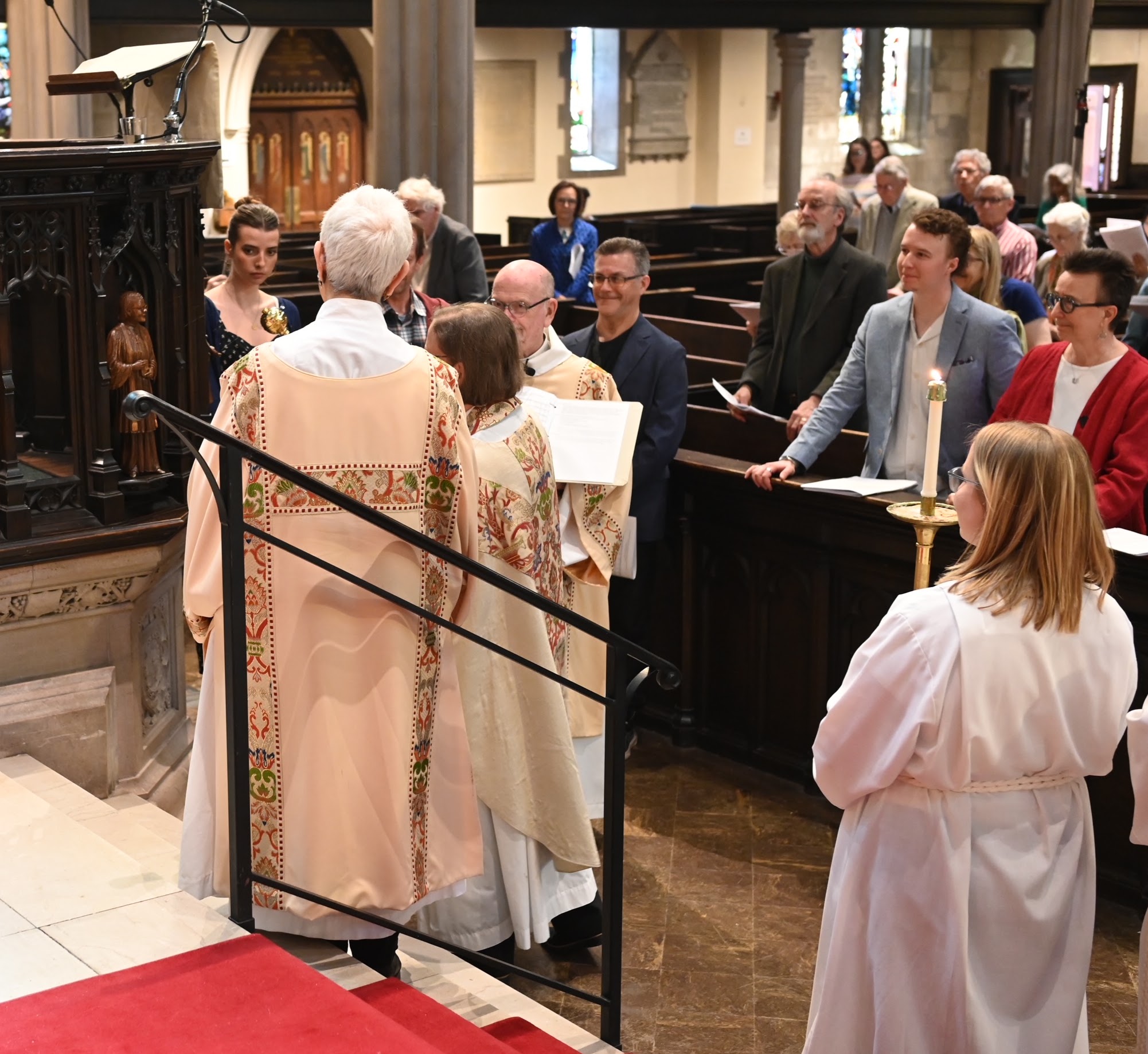
We are celebrating the baptism of Bodie Richard Coulon this morning, so we’ll all be invited to review what our Church teaches about baptism and we’ll be invited to renew our own baptismal vows. Today is a great day for a baptism because our scripture lessons describe beautiful visions of well-being. 

The book of Acts says that while Peter was in a trance of prayer, he had a life-changing dream that revealed to him that there is no distinction between “them” and “us.” In other words, he came to understand that when it comes to the redeeming urge or work of the Holy One, (also known as Jesus Christ for Christians), there is no Jew or Gentile, no free or slave, no male and female, no gender binary; no insiders and outsiders, all people are one. While there are always those in the center and those on the margins, those with more power and those with less, those of us who have and use more than our fair share of the world’s resources and those who do not have their basic needs met, we are all one. Peter realized that he should not be hindering the work of God by deciding who is inside and who is outside of God’s reach. Here’s where Christians often get tripped up, deciding what is godly and what is not. The measure of godliness is love. As our former Presiding Bishop Michael Curry is fond of saying, “if it’s not about love, it’s not about God.” Of course it gets complicated, but that’s where we start. If it looks like there are competing interests that all have to do with love, we might need to enlarge or expand our view. We might need to look at the situation from 30,000 feet where differences between us become imperceptible, because we are all one.

The Revelation to John of Patmos also came through meditation, during which he experienced a vision of the Divine, setting right everything the Roman Empire was getting completely wrong. Exiled on the Island of Patmos, John visualized the Holy One at home among mortals — the Eternal dwelling secure among them. John saw grief and weeping and pain ending – his own and his people’s — and everyone who is thirsty having enough to drink. Sometimes I think that our own vision of the realm of God is limited, constrained by our own lack of thirst for water from the spring of the water of life. John of Patmos’ vision was of God with us (which is what Emmanuel means) – and, building on Peter’s insight, “us” means everyone. There is no them. We are all one.

The Gospel of John envisions a time when Jesus’ followers are known by and known for their love. These few verses are sandwiched between a hard place of Judas leaving to arrange for Jesus’ arrest, and a rock (Peter) whom Jesus predicts will deny even knowing him three times before the rooster signals the dawn. The glory and love Jesus is talking about are set right in the midst of the most painful betrayal and agonizing denial described in all of Christian scripture.

What do glory and love mean here in this dreadful spot? The root of the word “glory” (dox – as in doxology) means appearance as in manifestation. Doxology is language of manifestation. [2] Our word paradox means different from or in contrast to (para) how something seems or appears (dox).

Orthodox means right or correct appearance or manifestation. So the beginning of our Gospel lesson could be translated, “Now the Son of Humanity has appeared and God has appeared in him. If God has been made manifest in him, Gods-very-self will also appear in him and will appear in him right away.” Glorification is an appearance or manifestation of the Holy One in this case, here in the midst of the worst scenario imaginable to Jesus’ followers. 

There are other translation issues. “Children,” Jesus says. (The word “little” isn’t there in the Greek–just children – maybe in the sense of tender and naïve, not fully matured or wizened?) “I am with you only a little,” Jesus says. He says, “You will look for me, and where I am going you cannot come.” In the verse just following our reading, Jesus clarifies – you can’t follow me now, but you will follow afterwards – so it’s sad, but not permanently sad.

Then John the Evangelist’s account has Jesus talking about how he has previously said something to “the Judayoi” – rendered “Jews” in our NRSV. (That has become permanently sad, because, of course they were all Jews. I say permanently sad because our scripture translations continue to incite violence against Jews.) Judayoi here could either be translated Judeans (in contrast with Galileans) or understood as anachronistic and antithetical to Jesus’ life and witness. For our reading today, I translated it “people” to distinguish between Jesus’ public preaching and his teaching in this intimate setting the evening he was arrested. Whenever I encounter this passage, I trip over the line about “a new commandment, that you love one another.” And I always think, that’s not a new commandment. The Torah teaches that we must love our neighbors as ourselves and we must provide tangible care for the strangers or aliens in our midst. Why is loving being called a new commandment? My answer is, it’s not. 

The command here is not “to love one another.” A closer translation is, “A new command I am giving to you in order that you may love one another, just as I loved you in order that or so that you may love one another.” The word “should” is another  translator’s opinion. The new commandment that Jesus has given in the portion just before this reading is to wash one another’s feet. Serve one another, care for one another. Get your hands dirty – risk contamination, risk becoming unclean in service to one another. As far as I know, the command to wash one another’s feet, assuming a posture of kindness, of presence, of service, behaving as if we are all servants of one another, is a new command. There are Torah instructions to wash one’s own hands and feet. There is customary hospitality to offer water and a place to wash, and when available, servants to help. But Jesus takes a towel and kneels down and washes his followers’ feet and then tells them to do that for one another. Wash the muck off of one another’s feet. That’s the new commandment. 

The purpose is to demonstrate your love for one another. Just as I have loved you, in order that you have love for one another. This is how people will know that you’re Jesus followers – when you demonstrate your presence, your kindness, your service for one another. Jesus says, “in order that, or so that, you love one another” three times. That’s how we know he really means it. It also means it probably wasn’t happening. If it had been happening, there wouldn’t be any need to write it down and to emphasize it by saying it three times. I mean, no one says three times “I’m giving you this new mop so that you will wash the floor” if the floor is already washed, right? And of course, it’s hard enough to do this for our family and friends. Jesus teaches that we must perform humble acts of presence, kindness and service for our enemies as well. Jesus has just washed the feet of the one who would betray him and the one who would deny even knowing him.

There are times in the history of Christianity when Christians have been known for our works of presence, kindness, and service. There are times when Emmanuel Church is and has been known for our works of presence, kindness, and service. But building a beloved and beloving

community doesn’t happen without intentionality and work, especially in difficult times. Listen to Tertullian’s description of church practice in the good old days of the early second century of the common era: “On the monthly day… each puts in a small donation; but … only if he [or she] be able: for there is no compulsion; all is voluntary. These gifts are…piety’s deposit fund. For [funds] are not taken thence and spent on feasts, and drinking-bouts, and eating-houses, but to support and bury poor people, to supply the wants of [those] destitute of means and parents, and of old persons confined now to the house; such, too, as have suffered shipwreck; and if there happen to be any [slaving] in the mines, or banished,…or shut up in the prisons…. it is mainly the deeds of a love so noble that lead many to put a brand upon us. [“Christian” was a derogatory name.] See, they say, how they love one another, …they… do not hesitate to share …earthly goods with one another. All things are common among us but our wives. [it really says that]…. Whatever it costs, our outlay in the name of piety is gain, since with the good things of the feast we benefit th[ose who are] needy.” Tertullian didn’t quite get the lack of distinction between us and them (which can be encouraging for us!), but he beautifully described what it means to act like a Jesus follower. His vision is true to my experience when we are functioning well. 

When we are functioning well, we are actively engaged in behaviors that are encouraging those who are afraid, nourishing those who are hungry, healing those who are suffering, forgiving those who are guilty, redeeming those who have been undervalued, freeing those who are stuck or imprisoned, inspiring those who are dispirited, protecting those who are most vulnerable, reviving those who are tired. When we are functioning well, our service is mutually beneficial; we are both giving and receiving, and we are trustworthy people in a trustworthy community. [4] The work of Christian community, as Brother Curtis Almquist has said, is the three-step work of moving from “judgment of others to compassion for others to identification with others.” When we are functioning well, we are practicing radical empathy as our flag outside says. When we are functioning well, we are all one.

You know, baptism is a ritual of identification with others, others who are not necessarily of our own choosing, a bigger community than our own families and friends. Baptism is not only for or about the person being baptized; it’s for and about the whole church represented by this gathering today. This morning Bodie’s baptism means he will be identified as Christian, and as he grows up, I pray that he will join in the work of serving others as well as appreciatively receiving the service of others as gifts and signs of love. I pray that love will always animate his life. I pray that whenever he finds himself between a hard place and a rock, in the midst of betrayals or failures, ignorances or misunderstandings, he will have a community of people who will help him to turn away from cynicism, sarcasm, and fear, and move toward authentic and deeply respectful relationship with the Divine and with others. I pray that love will always show him that we are all one.


  1. Galatians 3:28.
  2. Leftbehindandlovingit.blogspot.com, April 18, 2016.
  3.  Tertullian, Apologeticus, Ch. XXXIX (http://www.ccel.org/ccel/schaff/anf03.toc.html#P253_53158)
  4.  Jesse A. Zink, Faithful, Creative, Hopeful (New York: Church Publishing, 2024), p.162.

Appreciating Superpowers

Another common art production in the books: the Easter Play was a huge success. I am so proud of all my cast members for their hard work. I think the most gratifying part was not the performance itself, but the process:  getting to see everyone become more comfortable being expressive and dramatic, and seeing the unique ways in which they each related to their characters. I did a “talkback” after the play, where I asked each cast member to share something they had learned from the experience.  It was beautiful to hear everyone’s unique take-aways. Whether it was about sharing a message of stopping violence, appreciating small joys, embracing skepticism, making oneself heard, or having faith, it seems as if everyone got what they needed out of it.  That’s the whole point of drama therapy: that people will project the healing experience they need into the dramatic work. Continue reading

Happy Easter!

This week is our Easter Play! Woohoo! It has been such an honor to lead its rehearsal sessions and watch these cast members bloom into dedicated actors. I am sure the performance will be a hit; but regardless of the outcome, I am immensely proud of all of them for showing up, investing their beautiful creative energy, and humoring my weird, drama-therapy, acting exercises. Continue reading

Rehearsing Our Easter Play

Over the past couple weeks, our Easter Play rehearsals have taken on a new rhythm.  It’s been such a joy to watch the group grow more connected—to each other and to the characters they’re embodying.

We’ve been starting each session with playful physical warm-ups to get everyone moving and loosened up. Prompts like “walk as if you’re being chased by bees” or “walk in slow motion” usually get a few laughs, but they also help folks get out of their heads and into their bodies. From there, we transition into “walk as your character,” which invites people to begin stepping into their roles in a physical, intuitive way. Continue reading

2025

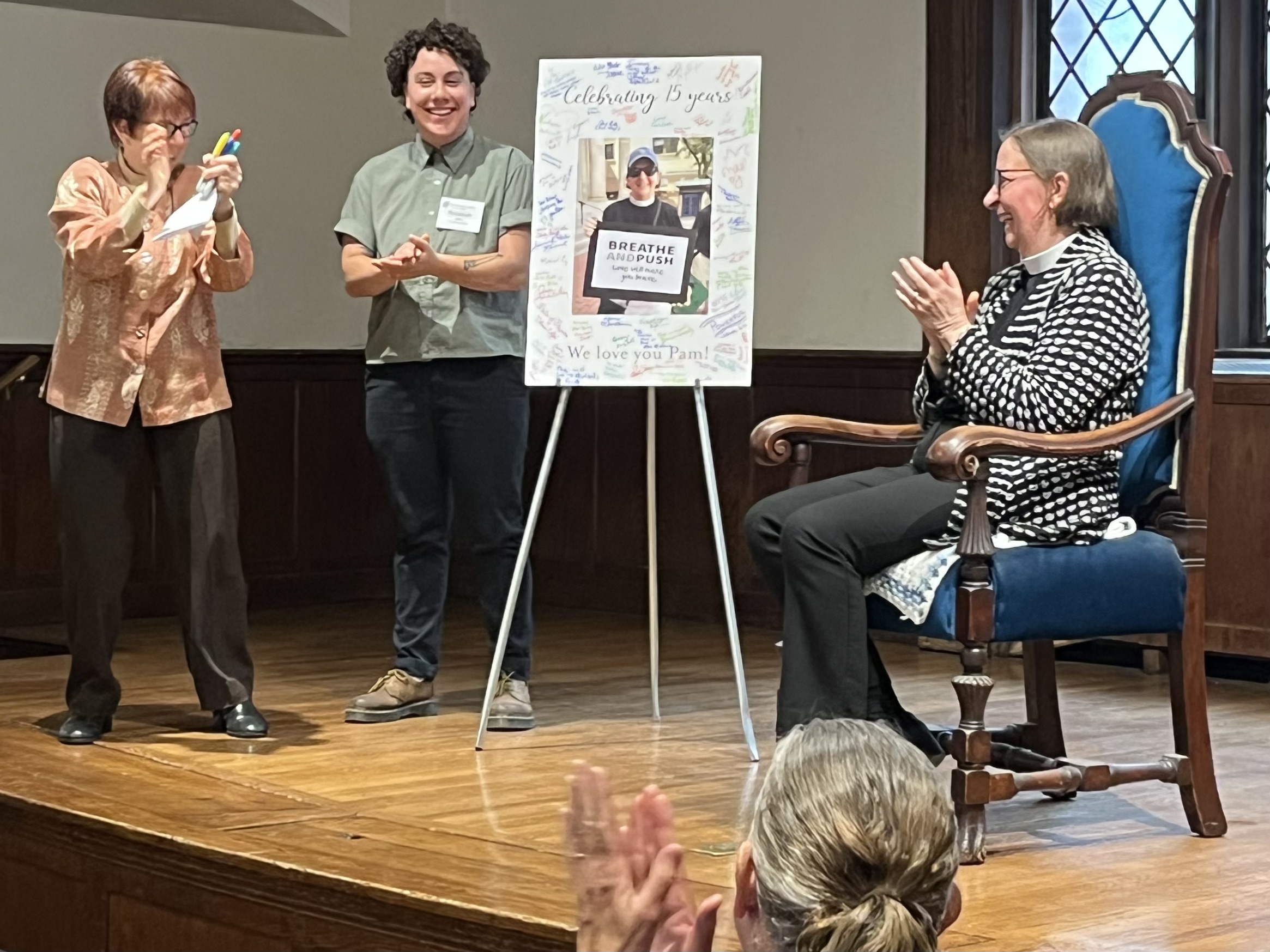
March 30.  We continued our annual meeting, which had begun in February via Zoom due to a snowstorm, with a celebration of the 15th anniversary of our rector’s installation. Actually Pam came to us as priest-in-charge 17 years ago and preached her first sermon on March 2, 2008.

Wardens Pat Krol & Rebekah Shore were joined by Jill Silverstein of Central Reform Temple in congratulating our rector Pam Werntz.

May 4.  Our rector presided at a memorial service in Lindsey Chapel for benefactor James Theodore Bartlett (2/13/1937 – 11/7/2024).  A beloved member of our congregation, Jim served for years as chair of our Finance Commission.

May 11.We dedicated our third pulpit statue to the Rev. Dr. Suzanne Radley Hiatt: theologian, prophet, priest, professor, and advocate.

Ordained as one of the Philadelphia 11 on July 29, 1974, this “bishop to the women” served as an inspirational mentor to many, including our rector, whose dedicatory sermon can be watched about 28 minutes into our recorded service.   For Dr. Hiatt’s connection to Pauli Murray, please see We’ve Come This Far by Faith.  We thank Ted Southwick and the friends of the late Dr. Hiatt for supporting this project.

Sculptor Ted Southwick smiled while our rector asperged his figure of the Rev. Dr. Suzanne Hiatt. Photo: JG Bullitt

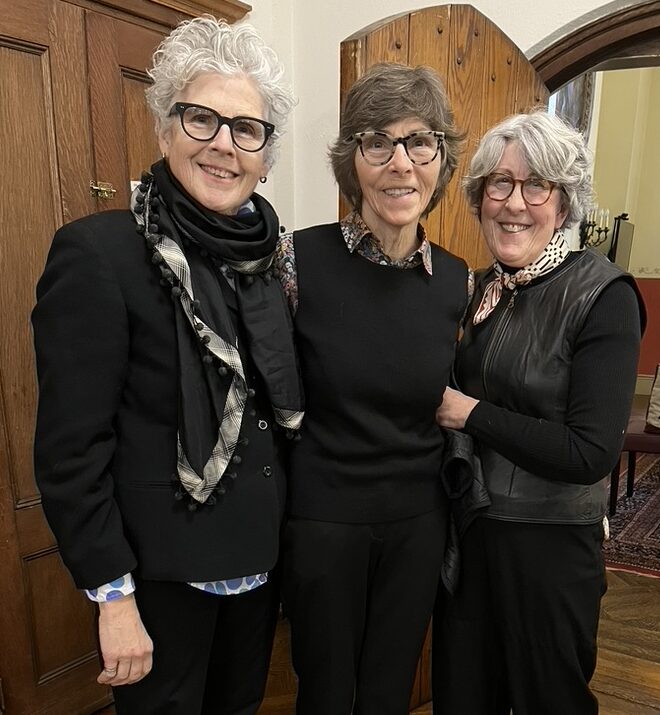
Marianne Iaucco, vestry member (2007-08), Clerk of Vestry (2009-10); Mary Blocher, Treasurer (1995), vestry member (2007-11); Anna Pauline Zeusler, vestry member (1990-93)

Dec 21.  We bade farewell to Mary Blocher and Marianne Iauco as they joined our diaspora in order to be closer to family after their four decades of service on our vestry and Worship Commission. Pauli Zeusler, who had known them when she served on our troubled vestry in the early 1990s, came to the luncheon they gave the parish before their departure.


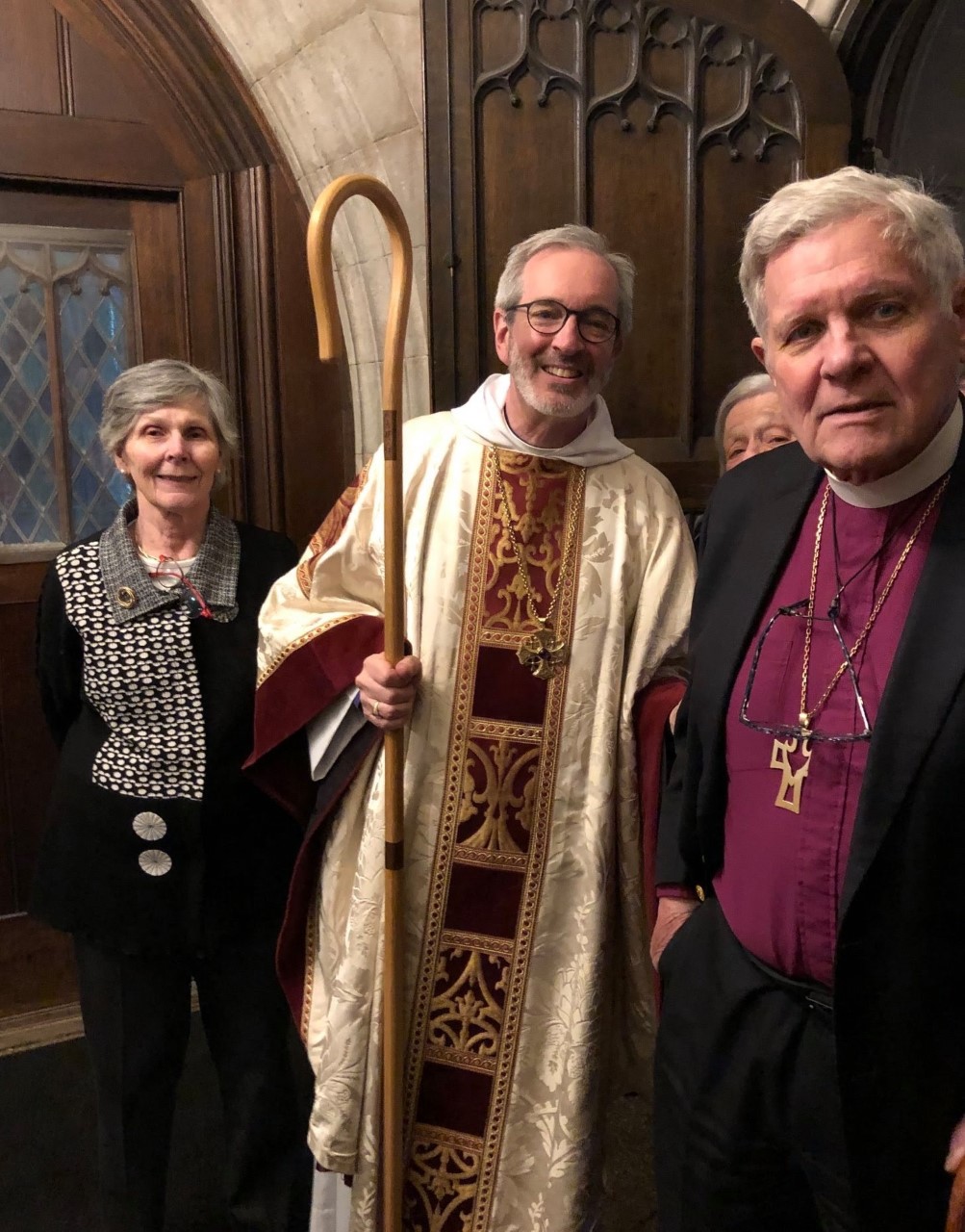
Dec. 22.   The Rt. Rev. J. Clark Grew II, Bishop of Ohio (1994-2004) and our Associate Priest for many years, died in Boston. Born 20 Dec. 1939, he was the namesake of his great uncle J.C. Grew, US Envoy to Denmark & Switzerland, Ambassador to Turkey & Japan, then Undersecretary of State during WWII. The Grew family held Pew 62 from the foundation of Emmanuel, and Annie Clark (Mrs. Henry) Grew held the deed for Pew 51 from 1897-1925. 

Improvisation

This week, we’re continuing rehearsals for the Easter Play, and I’m excited to incorporate some drama-therapy-based character work into the process. Through a series of movements and prompts, participants will step into their characters to explore their desires, motivations, and challenges through light improvisation.

This will be my first time facilitating exercises like these, so I’ll admit I’m a bit nervous.   I know, however, that the only way to improve is by practicing; and honestly, I couldn’t think of a better group to practice with.

If time allows, I’ll continue with my superhero interviews, but otherwise I’m taking it easy this week. Looking forward to seeing where all of this leads!

– Mary Schwabenland

Preparation for Our Easter Play

This week, back from my spring break, I’m feeling refreshed and ready to dive back into creative collaboration here at common art.

First up is the kickoff meeting for our Easter Play! My plan is to start with a warm-up activity to break the ice and get everyone engaged before we do a read-through of the script, written by our beloved community member Richie Berman.  Since this script is shorter than our December play, I’m hoping we can spend more time having fun with it rather than getting too caught up in staging logistics.

Over the next few weeks, I’d love to incorporate more character work and acting exercises (with a therapeutic lens, of course), which you might see in a traditional theatre group.

Beyond that, I’m still continuing with the superhero interviews; and people are coming up with some truly creative responses. Last time, we had one superhero whose power came from sandwiches and another whose strength was fueled by friendship bracelets.  I loved seeing how much fun everyone was having with it.

That’s all for this week.  I’m excited to see where these projects take us!

Spectrogram

Last Wednesday, I decided to do a performance-based workshop with my common art poetry group, using Dylan Thomas’s “Do Not Go Gentle Into That Good Night”. We mixed things up with some acting exercises, which had everyone laughing and really brought the poem to life. It was such a great reminder of how performance can transform poetry into something so dynamic and engaging. The energy in the room was contagious! Continue reading

Interviews with Superheros

Last week, I had the chance to try out my superhero interviews, and I’m happy to report that they went really well! I ended up conducting four interviews, which felt like a great way to explore and practice my therapeutic skills in this setting. Since each person interprets the questions differently this format really gives me an opportunity to guide them through the conversation. It’s a mix of reflecting back what they’ve shared, offering new words or ways to summarize their experiences, and asking for clarification or digging deeper into certain themes. It feels like a collaborative process in which we’re both learning and discovering.

One of the things I loved most was that every superhero I spoke to had a power that was rooted in helping or healing others—whether through music, seeing people’s truths, transforming darkness into light, or offering protection through faith.  Considering how much passion, kindness, and community-mindedness I’ve witnessed in this space, I’m not surprised but still find myself awed and inspired.

Since I find the superhero theme naturally lends itself to storytelling,  I can’t help but feel creative potentials percolating in my mind. Imagine an Avengers-style crossover of common art superheroes, here to bring the world towards healing and wholeness. That’s a story I could get invested in.

As for this week, I’m diving back into my poetry group. While it’s not superhero-themed, I’m hoping some of the creative energy from the interviews will carry over. I’ve planned some fun acting exercises to incorporate.  I’m excited to see whether they spark creativity and engagement in the group.

This Friday is Boston Warm’s first movie day of the year!  I’ll be leading a discussion after we watch “West Side Story”, which offers  so much to unpack.  I’m looking forward to exploring themes that feel especially relevant to our community, such as division and unity, discrimination and belonging, hope and despair, and more. The movie will begin at 9:00am, so feel free to join us if you can!

-– Mary Schwabenland, 26 Feb. 2025

Superheroic Personae

This week, in addition to my poetry group, I’m announcing a new project I’m starting with common art. I was inspired by our play last December, “Fix the Damn Sidewalk,” written by our beloved Richie Berman, to do something with superheroes. I’ve never been a superhero person, but I realized that there’s something about superheroes that makes for a great analogous tool when one tries to get to know people.  What are your strengths, your superhuman abilities, your weaknesses, your kryptonite? In drama therapy we would call this a projective device, something fictional or separate from oneself, which allows one to discover aspects of oneself within it.

Since I wanted to bring more intention to my one-to-one conversations with common art members this semester, I thought I would add some structure and creativity to it. So I decided to start a project wherein I would interview members as if they were superheroes. My goal is to have this be a long-term thing, where members would hopefully get inspired to create their own superhero personas and create art around them. There are lots of different directions we could take it, depending on how people respond. For now, I’m just testing the waters to see who’s interested. I may begin asking people some of my questions. I don’t think it would be hard to identify the superpowers in this community. Excuse my corniness, but I am blown away by their powers and talents every week. I have no idea how they would feel about this idea, but maybe that’s my superpower: trying things and finding out. Stay tuned!

–Mary Schwabenland