
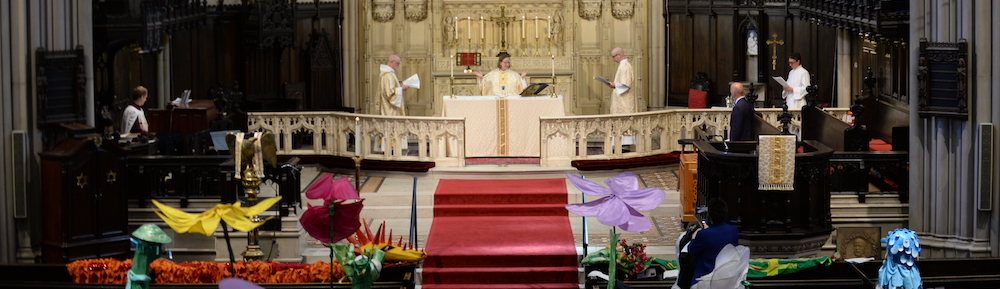
This Wednesday is the first cast meeting for common art’s fall play, which I have the honor of co-directing alongside our fabulous playwright, Richard Berman! The plan is to start with a warm-up activity to break the ice and create a comfortable and welcoming meeting environment. Then, Richie will introduce the play by giving a quick overview of the plot and his vision for the performance, which will take place at noon on December 16 in the Parish Hall. Continue reading
Author Archives: Elizabeth Richardson
Super Angel & the Divine Sidekicks
I have a shorter blog for you all this week just to report on the current happenings at common art and Boston Warm.
Preparation for longtime member Richard Berman’s play, “Super Angel and the Divine Sidekicks Battle the Government”, is in full swing! This past week we had our casting sign-ups, which was met with a lot of excitement. Many members were eager to sign-up, not only for character roles, but also to offer help with costumes, makeup, tech, and set design. Though I have not been at common art for one of Richie’s plays before, I can already tell that the coordination and performance of these plays bring a lot of joy and meaning into the space. Continue reading
Quilting
We had a great Halloween here at common art and Boston Warm. We were fortunate that Halloween fell on Friday this year, which meant that we got to have a Halloween party of sorts during Boston Warm! We watched “Nightmare before Christmas”, played some board games, and ate some candy, cookies, and popcorn! Continue reading
Happy Halloween to those who celebrate!
We had a fun week here at common art and Boston Warm. Let me catch you up with an encouraging story from this week:
Two Fridays ago, one of our members found a Notre Dame class ring on the street. He came to me wondering how we could track down the owner of the ring. He told me that he could easily pawn the ring and get the money for it, but wanted to return the ring to the rightful owner because he knew they would be hurting over the loss of such a sentimental and valuable ring. Because the ring was engraved with the owner’s initials and graduation date, we decided it might be worth a shot to call the Notre Dame alumni office to see if they could track this person down. Low and behold, it worked! The alumni office was able to find the owner, so I was able to return the ring to her this past Wednesday before common art. Continue reading
Loving-Kindness Meditation
We’ve had another great week here at common art and Boston Warm. Wednesday we had our October meeting for Can We Talk? — a time for members to openly share their stories without feedback or judgement. One of our members shared a couple of his poems, while another member shared a speech she’s working on for a city council meeting in a few weeks. This hour is always a great time to hear what is on people’s hearts and hold what is said in community with one another. Like last month, I was able to lead the closing exercise and chose to do another mindfulness meditation, which I will share with you all. Continue reading
Welcome, Alex Shoemaker!
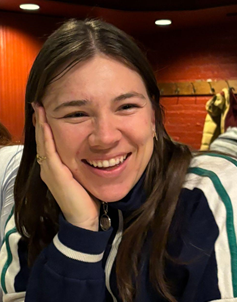 Hello! I am Alex Shoemaker, the new intern for common art, Boston Warm, and the Art & Spirituality Prison Program. Let me introduce myself a bit here so that you all will know the “girl behind the blog posts” for the next eight-or-so months. I am originally from San Diego, California, and moved to Boston in July 2024 to attend Lesley University’s M.A. program in Art Therapy and Clinical Counseling. I love all things visual and the expressive arts, so I am excited to accompany the members of common cathedral in their art making. I am particularly interested in the intersection of community building and the healing power of art making, which is exactly what common art is all about. My hope for my time at Emmanuel is that I may help encourage restorative community and connection through therapeutic witnessing and accompaniment… and of course, art!
My first two weeks at common cathedral were spent getting to know many of its members and learning about their experience in the program. I have been met with such a warm welcome from the members, for which I am immensely grateful. There seems to be an energy of hope and excitement for the coming months. I am honored to be even a small part in the events that are about to take place this fall and winter. Among the upcoming events is the common cathedral Art Show, which is taking place in Beverly this Sunday, September 28. Members will be exhibiting and selling their artwork made during common art. Longtime member Dennis shared with me that many members are fundraising for the Poor People’s Campaign and their upcoming trip to Washington D.C. to march alongside activists from across the nation. The art show will be a wonderful opportunity for common art members to showcase their work (and by extension themselves) in a space that prioritizes dignity, respect, and care. Additionally, longtime member Richard Berman has written another play for common cathedral. I am honored and excited to be asked to help him bring it to life this fall. It’s gonna be good, you won’t want to miss it! Production date and other details about the play will be announced soon.
The Realm of God is coming.
Proper 14C, 10 August 2025. The Rev. Dr. John D. Golenski.
Luke 12:32. Jesus said to his disciples, “Do not be afraid, little flock.”
The very first time I consciously witnessed a death was the day my dog Jet was fatally injured while chasing a car. We called him Jet because he was jet black, a fiercely loyal Cocker Spaniel, whom I had cared for since my parents brought him home in a basket. He was protective of our family in general, but he was truly my dog, patrolling our large yard and garden whenever I went out. Once in a while, when I opened the gate, he would fool me and zip through into the street. For some reason he was convinced that moving car tires posed an existential threat, so he had to chase them away. One summer day when I was eleven, Jet snuck out. I ran after him trying to distract him from the street traffic, but he must have slipped; somehow he was pulled under the moving tire. I watched in horror as the car rolled over him. The driver, a local mother with her infant in the car, ran up to me as Jet limped back to me, collapsed at my feet, and expired. Continue reading
Younger Than We Expected
- 1 Kings 19:1-15a. “What are you doing here Elijah?”
- Galatians 3:23-29. There is no longer Jew or Greek, there is no longer slave or free, there is no longer male and female for all of you are one.
- Luke 8:26-39. Return to your home and declare how much God has done for you.
O God of our future, grant us the strength, the wisdom and the courage to seek always and everywhere after truth, come when it may, and cost what it will.
Some days there is just too much to preach about, and I’m not just talking about the terrible news reports from last night or this past week. This is one of those days that makes me think there should be a rule about not having too many great readings from scripture on the same day: the story of Elijah hearing the still, small voice of God; Paul’s letter to the Galatians asserting that in Christ, there is no Jew or Greek, no slave or free, no male and female, because all are one; and then the Gerasene demoniac story. I mean, come on; what preacher can resist that? And we are celebrating the baptism of Hudson Grey Meinero, whose parents were married at Emmanuel and whose mother and uncle were baptized here, too. Hudson will embody hope for the future today as his baptism calls us to recommit ourselves to peace with justice. Continue reading
Conspiring with God
Trinity C, June 15, 2025. The Very Rev. Pamela L. Werntz
Proverbs 8:1-4,22-31. Does not wisdom call, and does not understanding raise her voice? ….”To you, O people, I call, and my cry is to all that live.”
Romans 5:1-11. We boast in our hope of sharing the glory of God…because God’s love has been poured into our hearts through the Holy Spirit that has been given to us.
John 16:12-15. I still have many things to say to you, but you cannot bear them now.
O indescribable Holy One, grant us the strength, the wisdom and the courage to seek always and everywhere after truth, come when it may, and cost what it will.
For any who struggle with the Gospel of John, today’s Gospel reading is for you. It begins with an acknowledgement that, while there is much more to say, Jesus knows that you cannot bear it now. Perhaps this is recognition of saturation, of exhaustion, of grief, of the lack of additional capacity among Jesus’ followers. It seems like it might be compassionate or parental; or perhaps it was the confession or projection of a tired scribe. Whatever the case, I like to imagine it is a true statement in every age, that there are more things than we can hear or bear. (Just keep up with the news, and you’ll know what I mean.) I find it to be a hopeful idea that there is more wisdom and truth than are recorded in the scriptures. Wisdom and truth were not fully revealed in Jesus’ time; they are not completely revealed even yet. The revelation of the Divine is ongoing, continuing. “God is still speaking,” as the United Church of Christ’s banners proclaimed some years ago; and we are still listening. Continue reading
Godsend
Pentecost C, June 8, 2025. The Very Rev. Pamela L. Werntz
- Genesis 11:1-9. And from there the Lord scattered them abroad over the face of all the earth.
- Acts 2:1-21. All of them were filled with the Holy Spirit.
- John 14:8-17. This is the Spirit of truth…[who] will be among you.
O God of our glorious diversity, grant us the strength, the wisdom and the courage to seek always and everywhere after truth, come when it may, and cost what it will.
A couple of Friday evenings ago, I had the honor and delight to preach at Central Reform Temple’s Shabbat service. I preached about how the Jewish and Christian liturgical calendars are so similar (like cousins) when it comes to the observances of Passover and Easter and the 50th day after each, which is the celebration of Pentecost (or in Hebrew, Shavuot). After the service I was having a conversation with one of the members of the Temple, who was asking me about the Christian story of Pentecost. I said that the traditional teaching for Christians is that the story in Act 2 is understood to be a reversal of what happened at the Tower of Babel. We heard the two stories a few minutes ago, about how the Holy One confused (or mixed or mingled) the language of the ancient Hebrew people, but on the 50th day after the resurrection brought people of all languages together to unite them. Continue reading