
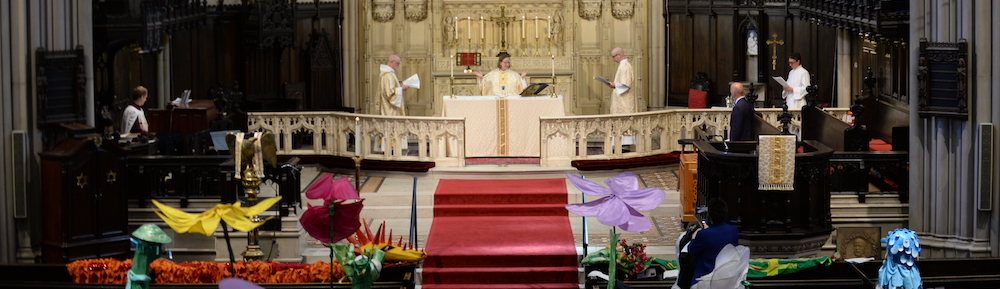
A Light You Have Carried

Last Sunday After the Epiphany (A)
February 23, 2020

Exodus 24:12-18 Come up to me on the mountain.
2 Peter 1:16-21 You will do well to be attentive to this as to a lamp shining in a dark place …until the morning star rises in your hearts.
Matthew 17:1-9 Jesus came and touched them, saying “Get up and do not be afraid.

O God of majesty, mercy and mystery,[1] grant us the strength, the wisdom and the courage to seek always and everywhere after truth, come when it may, and cost what it will.

We have come to the last Sunday after the Epiphany – the Sunday we tell the story of the Transfiguration, the story of Jesus and his friends and their mystical and mystifying mountaintop experience. But if you heard the Gospel lesson last week, you, like me, might still be stuck in the weeds of a different mountain, pondering Jesus’ hard teachings, even after our Deacon Bob’s marvelous sermon. Last week, we heard Jesus teaching things like – it’s not only murder that violates God’s law, it’s being angry with another, or insulting another, that will make one liable to the flaming trash heap called Gehenna, also known as hell. It’s not only adultery that violates God’s law, it’s looking at another person with lust in one’s heart. It’s not just swearing falsely, it’s swearing at all. And, though we didn’t hear it last week, what follows is the instruction of turning the other cheek, giving away one’s cloak, going the second mile, giving to everyone who begs from us, and loving our enemies.  These are all rendered as examples of Jesus’ assertion to his followers that he did not come to abolish the law or the prophets, not one letter, not one stroke of a letter. Just for the record, I don’t think he was kidding, and I don’t know any translation tricks that offer wiggle room. It’s a wonder that Jesus had any followers left by the time he got to the mountain with Peter and James and John.  

Continue reading

Come to the party!

Proper 19C
September 15, 2019

Jeremiah 4:11-12, 22-28 Skilled in doing evil but do not know how to do good.
1 Timothy 1:12-17 But I received mercy.
Luke 15:1-10 This fellow welcomes sinners and eats with them.

O God of mercy, grant us the strength, the wisdom and the courage to seek always and everywhere after truth, come when it may, and cost what it will.

Oh I have so much I want to say to you this morning about the ancient scriptures we’ve heard just now: Jeremiah, Psalm 14, 1 Timothy, the Gospel of Luke, and we haven’t even heard Psalm 42 yet – that will come after communion. Our oldest reading today is about 3000 years old, and the newest is about 1900 years old, give or take. Old. They tell us that in ancient times there were foolish people who said in their hearts, “There is no God.” By the way, this is not a critique of individual philosophical or theoretical atheism; this is an ethical critique of a people who did not think it mattered how the most vulnerable in society were treated: widows, orphans, and aliens. In ancient times people thought that prosperity and power and security and status were all that mattered; they were corrupt and committed abominable acts. In ancient times, there were people who profaned what was sacred, who pursued others in order to oppress them, who engaged in violence, who cheated and mistreated people, who were serving wealth instead of fidelity to love. In ancient times, people who believed that doing justice and loving kindness and walking with humility were not the ones in power very often. Maybe not ever. The staying power that these ancient texts have, the wisdom that they contain, is staggering to me.

Continue reading

Resist!

Proper 11C
July 21, 2019

Amos 8:1-12  A famine…of hearing the words of the Lord.
Colossians 1:15-28  Christ Jesus is the image of the invisible God.
Luke 10:38-42  She had a sister named Mary, who [ALSO] sat at the Lord’s feet

O God of mercy, grant us the strength, the wisdom and the courage to seek always and everywhere after truth, come when it may, and cost what it will.

  • I have an exercise for you. Choir and altar party, you too.
    If you love the heat of the summer because you can finally get warm, stand on the lectern side of the chapel.
  • If you feel wiped out by the heat, stand on the pulpit side. (and thank you very much for being here, in spite of the heat). Now to the Gospel story we just heard.
  • If you identify as more of a Martha, stand on the pulpit side of the chapel. If you identify as more of a Mary, stand on the lectern side of the chapel.
  • If you sympathize more with Martha, move to the pulpit side of the chapel. If you sympathize more with Mary, stand on the lectern side of the chapel.
  • If you really dislike this story of Jesus with Martha and Mary, stand on the pulpit side of the chapel. If you love this story, stand on the lectern side. How many of you really want to stand in the middle but there’s not enough room? Okay – you can return to your seats.

Thank you – I wanted to see how divided you are when it comes to this Gospel story, which is wedged between the story of the Good Samaritan and the story of Jesus’ teaching about how to pray, and it is trouble with a capital T packed into five short verses. I could have also asked you to stand on one side if you are aware of the divisiveness of this story and on the other side if you, prior to now, have been blissfully unaware of any conflict! This is a story that always reminds me that whenever two or three are gathered in Jesus’ name, there will be a disagreement! This particular story pits women against each other and invariably fuels resentment and division in groups that study it together, no matter what the participants’ gender identities. And since it is a story about two sisters, through the ages, it has had the powerful effect of stopping and shutting up women – scolding Marthas and making sure Marys stay quiet.

Continue reading

Love the one who shows mercy!

Proper 10C
July 15 2019

Amos 7:7-17 The Lord said to me, ‘Go prophesy to my people Israel.’
Colossians 1:1-14 Grace to you and peace from God.
Luke 10:25-37 But wanting to justify himself.

O God of mercy, grant us the strength, the wisdom and the courage to seek always and everywhere after truth, come when it may, and cost what it will.

Following my sermon last week about Galatians, I thought I might do some teaching about the letter to the Colossians, but I just couldn’t let the story called “The Good Samaritan” go unaddressed. It’s such an iconic story that one doesn’t have to be a church goer to know it. You don’t have to be a Christian to have heard of it or understand something about it. Hospitals, emergency services, counseling services, rules of law about limits of liability, award programs, all get called Good Samaritan. This parable called “The Good Samaritan,” found only in Luke, might be the most famous parable of them all. And with its fame comes the enormous and crushing weight of Protestant Moral Theology, Sunday School lessons, and a hefty dose of Christian anti-Jewish bias. The preaching challenge for me seems formidable because of what we all think we already know about this story, and the guilt that has been wired into most of us about seeing people in life’s various ditches and not doing enough or not doing anything at all to help. In my time as a priest, this bible story has provoked more confessions and more defensive attempts at self-justification than any other I know.

Continue reading

Sabbath Delight

Second Sunday after Pentecost (4B), June 3, 2018; The Rev. Pamela L. Werntz

1 Samuel 3:1-20 The word of the Lord was rare in those days; visions were not widespread.
2 Corinthians 4:5-12 We have this treasure in clay jars…so that the life of Jesus may also be made visible in our bodies…in our mortal flesh.
Mark 2:23-3:6 The sabbath was made for humankind, and not humankind for the sabbath.

O God of our delight, grant us the strength, the wisdom and the courage to seek always and everywhere after truth, come when it may, and cost what it will.

Today Emmanuel Church is celebrating an abundant harvest, the ordinations yesterday of Helen McKinney to the permanent diaconate and Tamra Tucker to the transitional diaconate. Helen and Tamra were both sponsored for ordination by Emmanuel Church and so we are blessed and thrilled that they’re both able to be here today to worship with us in their new roles in the Episcopal Church. Following our service and a bit of refreshment, I invite those of you who are able and interested, to join in a conversation about the ordination process. Helen and her sweetheart, Rebecca are going to have to dash to catch a plane back to Albuquerque, but Tamra will have time to stay and talk – she’s staying in Boston!
Continue reading

Inheriting Love’s Blessing (with audio)

First Sunday in Lent, Year B, February 18, 2018; The Rev. Pamela L. Werntz

Genesis 9:8-17 I will remember my covenant.
1 Peter 3:18-22 An appeal to God for a good conscience.
Mark 1:9-15 The Spirit immediately drove him out into the wilderness.

O God of love, grant us the wisdom, the strength and the courage to seek always and everywhere after truth, come when it may, and cost what it will.

We began our service for this first Sunday in Lent, as is our practice, with The Great Litany sung in solemn procession. The first liturgy published in English, The Great Litany is intended to be used during times of great distress or danger or devastation. I think what is going on in our nation right now qualifies, don’t you? Sixteenth century Anglican theologian Richard Hooker’s defended praying the Great Litany even when a particular community is not suffering. He wrote: “if we for ourselves had a privilege of immunity, doth not true Christian charity require that whatsoever any part of the world, yea, any one … elsewhere doth either suffer or fear, the same we account as our own burden? What one petition is there found in the whole Litany, whereof we shall ever be able to say at any time that no [one] living needeth the grace or benefit therein craved at God’s hands?” [1} The Great Litany serves to remind us that we belong to one another. We share one another’s joys and we bear each other’s burdens. Continue reading

Made by God

Sixteenth Sunday after Pentecost, Proper 20A, September 24, 2017; The Rev. Pamela L. Werntz

Exodus 16:2-15. In the evening you shall know that it was the LORD who brought you out of the land of Egypt.
Philippians 1:21-30. Live your life in a manner worthy of the gospel of Christ.
Matthew 20:1-16. Are you envious because I am generous?

O God of Our Priceless Sacrament, grant us the wisdom, the strength and the courage to seek always and everywhere after truth, come when it may, and cost what it will.


It is becoming something of a tradition to begin the Emmanuel Church cantata season with Anton Bruckner’s Locus Iste. This place was made by God, a priceless sacrament; it is without reproach. The Emmanuel Music choir always makes it sound to me like the piece was written for this worship space. Anticipating today, I had the words stuck in my head all week. Is it true? What does it mean that this place was made by God? What does it mean that it is a priceless sacrament, profoundly sacred? What does it mean that it is without reproach? Continue reading

Endless Mercy

Fifteenth Sunday after Pentecost, Proper 19A, September 17, 2017; The Rev. Pamela L. Werntz

Exodus 14:19-31 The Israelites went into the sea on dry ground.
Romans 14:1-12 Welcome.
Matthew 18:21-35 Have…mercy on your fellow slave, as I had mercy on you?

O God of mercy, grant us the wisdom, the strength and the courage to seek always and everywhere after truth, come when it may, and cost what it will.

Did any of you see the pictures of the strong east wind that blew the water right out of Tampa Bay during Hurricane Irma? The opposite of a storm surge, Tampa Bay was emptied as the hurricane advanced north. For a few hours, parts of Tampa Bay were six feet below sea level and people could walk across the floor of the bay. Meteorologists speculate that the receding water saved Tampa, because by the time the eye of the hurricane arrived, the storm was weaker and the predicted storm surge just filled the bay back in rather than swamping the entire city. The water never came over the city’s barriers. Whatever the explanation, it was a miracle for the residents of Tampa. Continue reading

Brave, Foolish & Extravagant

Sixth Sunday after Pentecost, Proper 10A, July 16, 2017; The Rev. Pamela L. Werntz

Genesis 25:19-34 If it is going to be this way, why do I live?
Romans 8:1-11 You are in the Spirit, since the Spirit of God dwells in you.
Matthew 13:1-23 Listen.

O God of grace, grant us the wisdom, the strength and the courage to seek always and everywhere after truth, come when it may, and cost what it will.

In the Gospel of Matthew, we’ve gone from the weeds to the water. Jesus began his third course of instruction in the Gospel of Matthew, by getting into a boat and speaking to the crowds from the edge of the Sea of Galilee, which is really a small lake, using the hills behind the crowd for natural amplification (surround sound).  I’m sorry that our lectionary doesn’t include reading chapter 12 of Matthew, because it is all about Jesus reminding his colleagues in leadership about God’s strong desire for mercy, God’s character of tenderness, God’s deep concern for all who are oppressed, and God’s hopefulness that people will turn and return to Love and to loving. Quoting material from the prophets Hosea, Isaiah, and Jonah, Jesus was reminding his colleagues about God’s extravagant faith in people, God’s great faithfulness. That is the literary mixer or equalizer for this next course of instruction, the way Matthew has composed his Gospel. (I’ve got sound systems on my mind because we’re trying out an extra speaker in Lindsey Chapel today.) Continue reading

Weeds or No Weeds

Fifth Sunday after Pentecost, Proper 9A, July 9, 2017; The Rev. Pamela L. Werntz

Genesis 24:34-38, 42-49; 58-67. Please give me a little water from your jar to drink.
Romans 7:15-25a. For I do not do the good I want, but the evil I do not want is what I do.
Matthew 11:16-19, 25-30. Take my yoke upon you and learn from me.

O God with us, grant us the wisdom, the strength and the courage to seek always and everywhere after truth, come when it may, and cost what it will.


Some of the earliest Sunday School lessons I remember learning were from a class taught sitting in the weeds when I was about six years old. (When we sat down in a little circle, the weeds were over our heads.) The first scripture verse I learned was Psalm 122: “I was glad when they said unto me, let us go into the house of the Lord,” and my teacher told us that we were sitting in the house of the Lord. My dad was the pastor of a congregation that worshipped outdoors at a farm in the summer, which was a welcome respite from the gritty urban ministry that characterized the rest of the year. I remember the weather being steamy and hot and I remember being struck by how many bugs there were in the house of the Lord. That’s what came to me as I reflected on our Gospel lesson for this morning. It’s summertime and we’re in the weeds, and I’m still struck by how many things bug us in the house of the Lord. Continue reading