Bear witness to the goodness of Love!

Easter 3B, 14 April 2024. The Very Rev. Pamela L. Werntz

  • Acts 3: 12-19.  You Israelites.
  • 1 John 3: 1-7.  We should be called children of God, and that is what we are.
  • Luke 24: 36b-48. And the psalms must be fulfilled.

God of hope, grant us the wisdom, the strength and the courage to seek always and everywhere after truth, come when it may, and cost what it will.


The Gospel of Luke is often viewed as kinder and gentler than the Gospel of John, when it comes to anti-Jewish or anti-Judean rhetoric about the life and death of Jesus. Written for Gentile audiences, Luke’s rhetoric seeks to prove Jesus as one who can stand up to and prevail against other Gentile deities or semi-deities, including Caesar. Luke insists that every claim made by Caesar was also true of Jesus, and even more so: miraculously born, son of God, Savior, God from God, Redeemer, Liberator, Prince of Peace.  Continue reading

Be brave!

Proper 25B. 27 October 2024. The Very Rev. Pamela L. Werntz

Job 42:1-6, 10-17. Now my eyes see you.
Hebrews 7:23-28. Prevented by death from continuing in office.
Mark 10:46-52. What do you want me to do for you?

O God of our wildest dreams, grant us the strength, the wisdom and the courage to seek always and everywhere after truth, come when it may, and cost what it will.


We are living in a dangerous time right now – a time of high uncertainty and high anxiety, a time of dis-integration, dis-placement, and dis-ease. And our readings have something to say to us because they were written in periods of great dis-integration, dis-placement, and dis-ease, with visions of a better future. This morning, we heard the conclusion of the tale of Job. The Book of Job was probably written in the midst of the Babylonian exile – a time of great calamity for the ancient Israelites. The Psalm appointed for today, that we heard in our motet, is Psalm 126, was probably written about the same time. The Psalmist writes of restoration as if it has already happened: when the Lord restored the fortunes of Zion, then were we like those who dream. Then was our mouth filled with laughter, and our tongue with shouts of joy.” But when Job and this Psalm were written, the restoration hasn’t happened yet. They were writing their vision of shalom. The writer of Job imagines that Job’s eyes are finally opened, and at last, he sees what he was previously unable to perceive –that Divine works of beauty are all around him the whole time. Did it really happen? Were his eyes ever opened?

“Now my eyes see you,” Job says to the Holy One in this vision of the future. “Now my eyes see your beautiful handiwork all around me, in me and through me. Now my suffering is no longer all I can think about!” In the verses that are unfortunately omitted from our lectionary, God accepts the prayers of Job on behalf of his three friends who had completely misunderstood suffering as divine justice. Then the book concludes with how Job and his family lived happily ever after. (Well, as happy as one could be with 6,000 camels. Camels are nasty!) The words of the fairy tale ending are a later addition to the older story and are definitely not the point of being faithful. The oldest ending of this story did not tie things up in a neat bow at all. To read this as a lesson on how to get rich is also to completely misunderstand divine justice. The moral of this unsettling story is about maintaining one’s integrity in the midst of profound suffering, and about the vision of the Holy One as merciful, generous, and unpredictable.

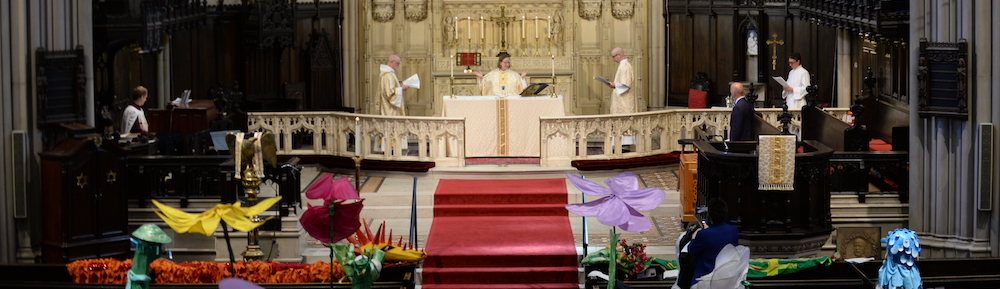
 In the portion of the Letter to the Hebrews, we heard that the priesthood of Jesus did not end with his death, which prevented the continuation in office of other priests. The peace and justice work of Jesus, by comparison, is for evermore, eternal, because he lives. The writer of the Letter to the Hebrews is asserting that the delivery of bread and wine and blessing of the priesthood of Jesus are ongoing even in the midst of persecution. I guess that’s true enough, isn’t it? Because here we are – receiving bread and wine and blessing week after week in front of a permanent gesture of welcome and invitation. 

In our Gospel lesson from Mark, written at a devastating time in history, we have the last scene before Jesus’ entry into Jerusalem. According to Mark, the folks following Jesus were both amazed and afraid. If our schedule of sequential readings coincided with our liturgical year, next week we would be observing Palm Sunday instead of All Saints’ Day. The story of Bartimaeus is the concluding piece in Mark before Jesus’ passion begins. That’s a signal to us that it was a very important story to Mark. The text says, they came to Jericho and right away Jesus and his disciples and a large crowd were leaving Jericho. We might miss the significance of that, the emphasis on Jericho, but Mark’s audience knew that Jericho was best known as the site that Israel first conquered in their entrance into the promised land. The last time in the Bible that someone was shouting outside the walls of Jericho, the walls came tumbling down! <[1] Then, during the time of Elijah, there was a school of prophets (seers) in Jericho. When the Babylonians captured the city of Jericho, the last reigning king of Judah, Zedekiah, tried to escape. He was captured and his eyes were put out – he was blinded. Jericho is a place heavy with symbolic significance in the vision of the people of God. (Jericho was a place where an abundance of beautiful roses and medicinal plants were grown.)

The contemporary context of this story in Jesus’ time also seems significant to me. Jericho was where Herod the Great had built a resort to take a break from the cold and wet Jerusalem winter weather. Jericho, the city of palms, built near a large spring of fresh water, had become a luxury oasis for the Jerusalem aristocracy, with swimming pools, villas, parks, palaces, music halls, theaters, a racetrack, you name it. And with that kind of luxury, there comes a certain cultivated blindness to others who are suffering. So. Bartimaeus (son of Timaeus) was sitting along the way just outside a resort on the road that went up to Jerusalem, his cloak spread out for receiving whatever his begging might bring in and he heard that Jesus of Nazareth was going by. He began to croak like a raven, saying, “Jesus, Son of David have mercy on me!” 

This blind man seems to be able see something about Jesus as a healer. Often when we want to signal that we understand something, we say, “I see.” That means, “I get it.” That’s true in English and it was true in ancient Greek and ancient Hebrew. “Seeing” in ancient times meant the physical ability to distinguish light and dark and recognize people and objects using ones eyes; and it also meant understanding, comprehending, and being able to discern the truth about a situation. Remember Job’s blindness before he proclaimed, “now I see God.” Bartimaeus might have had eyes that didn’t function physically, but when Jesus passed by, he, in fact, could see very well. His vision was very clear in a figurative sense.

The first blind person I ever knew well was the father of my best friend in junior high. Brad Burson had lost his eyesight in an accident that happened when he was 15. He and a friend were playing with a gun that they were sure wasn’t loaded. The friend put the gun up to Brad’s temple and pulled the trigger and a bullet went through his head, severing both of his optic nerves. He miraculously survived the gunshot wound to his head, but lost his eyesight. By the time I met him, he was a Ph.D. nuclear physicist with a law degree. He used to explain that no-one can see atoms – so it doesn’t matter whether a nuclear physicist’s eyes work or not. And no-one can see the law, so it doesn’t matter whether a lawyer’s eyes work or not. He went on to found the American Council of the Blind. This was a man who had suffered a tragic loss. And this was a man who had great vision even though he did not have eyesight. In fact, his vision was so clear that I had a hard time believing he was really blind.

Sometimes sighted people think that, in ancient times, if people were blind, they automatically were beggars, but there are plenty of references in ancient literature to people who were blind and very accomplished. Bartimaeus was blind and a beggar, but one did not necessarily cause the other. Bartimaeus started shouting out that he wants Jesus to have mercy on him and everyone told him to be quiet. And they don’t tell him nicely. A more literal translation

of the Greek would say, “And many kept yelling at him to shut up.”[2] They rebuked him. (One biblical commentary notices the similarity of the Greek word for rebuke and the name Bartimaeus and suggests that his name might literally be, Son of Rebuke.) [3]

I don’t know about you, but I have a hard time speaking up, especially to beg for mercy, even when it’s just the voices in my own head telling me to shut up. It’s very rare that I get loud enough for other people to tell me to shut up. In the few cases where someone else has indicated that they wish I would be quiet, I get so mad or ashamed or whatever, that I often don’t say another word. So Bartimaeus is one of my Bible heroes. Bartimaeus reminds me to shout out, when I need mercy, that is, when I need compassion, kindness, sympathy, understanding for myself or for others. The word mercy here is often how the Hebrew word chesed is translated – chesed is the steadfast love of God experienced and expressed in the covenantal community. Bartimaeus is begging for welcome and restoration to and of the beloved community. [4]

When Jesus stood still and then said, “Call him here,” the crowd called Bartimaeus and said, (in a more literal translation) “Be brave, get up, he’s calling you!” [5] That’s an ironic and surprising thing for the crowd to say, I think, because Bartimaeus has actually already been quite brave. It’s the crowd who has been afraid. So there’s a way in which the crowd is really talking to themselves when they tell Bartimaeus to be brave, projecting, as crowds often do, their own fear onto the guy begging along the way.

Did Bartimaeus’ sight get restored immediately? Did his trust make him well? Are we to understand this metaphorically or literally? (My answers to those questions are both Yes and I don’t know.) Did Bartimaeus regain his vision only to see Jesus crucified a week later? As you may remember, the question I’m always more interested in is not, “did this really happen?” but “is this really happening?” Where in our lives are we in situations in which we could be calling for full restoration in God’s beloved community over the yelling voices (inside or outside of our own heads) that warn us to keep quiet? In what situations are we in the crowd, wanting someone else to shut up because their demands for attention, for mercy, for compassion, for full inclusion are bothering us? What might it mean for each of us to “Be brave, get up, because Jesus is calling,” to throw off our cloaks and spring up! When Jesus says, “Go,” the word is more like “Go lead! Your trust has restored you. Your trust has restored your vision.” Where might trust lead us into greater wellness, restored vision, so that we can spring up as leaders to encourage others to follow Jesus on the way, rather than sitting on the sidelines along the way? 

We are going to need the church that we are to be brave in the coming weeks, months, even years. Our wider communities are going to need the church that we are to be brave in the coming weeks, months, even years. I think we can only do that if we stick together, reminding one another that if we want to go far, (and the vision of shalom is far right now), if we want to go far, we must go together. As we continue to breathe and continue push for the vision of well-being, it is love that will make us brave. “Be brave, get up, he’s calling us!”


  1. Mark Davis in his blog Leftbehindandlovingit.blogspot.com/2012_10_01_archive
  2. Robert Miller, ed., The Complete Gospels: Annotated Scholars Version (San Francisco: HarperSanFrancisco, 1994), p. 39.
  3. Mark Davis.
  4.  Ronald J. Allen & Clark M. Williamson, Preaching the Gospels without Blaming the Jews (Louisville: Westminster John Knox Press, 2004), p. 160.
  5.  Miller, p 39.

Shomrei Adamah

Proper 24B. 20 October 2024. The Very Rev. Pamela L. Werntz

Job 38:1-7, 34-41.  Who.
Hebrews 5:1-10. Jesus offered up prayers and supplications, with loud cries and tears.
Mark 10:35-45. What is it you want me to do for you?

O God of all creation, grant us the strength, the wisdom and the courage to seek always and everywhere after truth, come when it may, and cost what it will.


This morning I’m going to do something a little bit different (for me, anyway). Rather than preaching on our lectionary readings, I’m going to spend some time talking about our sacred duty of serving as guardians of the earth, or in Hebrew, shomrei adamah, which is the theme of our Emmanuel Center programs running from this past Wednesday through this coming Tuesday for the Jewish festival of Sukkot. I want to extend a special welcome to Rabbi Shire and our cousins from Central Reform Temple who are joining us for worship this morning. Together with the Temple, we are hosting a week of programs that explore our responsibility to care for the earth. Today, after our service, we will move into the parish hall for a bite to eat and a presentation by Jennifer’s daughter, Gina Coplon-Newfield, Managing Director of Sunstone Strategies, a communications consulting firm working to end fossil fuel pollution by advocating for strong climate-friendly, healthy communities. Then we will go out to the Sukkah for a tour of its symbols and meanings led by Gina’s mother and CRT member, Jennifer Coplon. I hope you will stay for as much of the program as possible!

In the very first chapters of Genesis, we find the two stories of creation— powerful narratives that frame our understanding of humanity’s sacred relationship to the natural world. God creates the heavens and the earth, the seas and the skies, the plants and animals, and finally, God creates an earthling (adam) from the earth (adamah). Genesis 2:15 says, “The Lord God took the earthling and put the earthling in the Garden of Eden to work it and to keep it.” In Hebrew, the word used here for “to keep” is l’shomrah, from the root shamar, meaning “to guard” or “to protect.” In this simple yet profound verse, we come to understand that earthlings are entrusted with a sacred task: to be shomrei adamah, guardians or protectors of the earth.

This idea of environmental stewardship is not a peripheral theme in Judaism and Christianity, but rather, it is woven into the fabric of our understanding of our identities as humans, as earthlings. It is an obligation, an ethical and spiritual calling that requires us to care for the earth and all its inhabitants. Yet as environmental degradation, climate change, and pollution threaten the well-being of our planet, this ancient mandate feels more urgent than ever.

But what about the earlier creation story in Genesis 1:28 which says that God blessed Adam and Eve, saying, “Be fruitful and multiply, fill the earth and subdue it; and have dominion over the fish of the sea, the birds of the air, and every living thing that moves on the earth.” At first glance, this verse seems to suggest that humanity has an unbridled right to exploit the natural world for its own benefit. And indeed, some have interpreted this passage to justify environmental destruction, arguing that the earth’s resources exist solely for human use. But a closer reading of the Hebrew reveals a more nuanced understanding. The word for “dominion,” radah, can also mean “to guide” or “to lead,” and it implies responsibility, not tyranny. We are not granted carte blanche to abuse the earth; rather, we are called to be its caretakers, using our power to sustain, nurture, and protect the natural world.

When paired with the command in Genesis 2:15 to “keep” the garden, it becomes clear that our proper role is one of stewardship. We are entrusted with a treasure, a divine gift, and we must preserve it for future generations. This is the essence of shomrei adamah—to guard the earth with reverence, to honor its beauty and its fragility, and to ensure that it continues to thrive long after we are gone. The concept of shomrei adamah is not just about environmentalism; it is about recognizing the interconnectedness of all life. In Jewish and Christian traditions, the earth is seen as a living organism, created by God with intrinsic value. Psalm 24:1 declares, “The earth is the Lord’s, and everything in it.” This means that the land, the seas, the animals, and even the air we breathe do not belong to us—they belong to God. We are merely temporary dwellers, entrusted with the care of God’s creation. 

Our relationship to the earth is not transactional; it is covenantal. Just as God made a covenant with the people of God, God also made a covenant with all of the inhabitants of the earth itself. After the flood, God says to Noah, “I establish my covenant with you and with your descendants after you, and with every living creature that is with you… Never again will all life be destroyed by the waters of a flood” (Genesis 9:9-11). This covenant is a promise of protection, not just for humanity, but for every living creature. Therefore, to be a shomer adamah, a guardian of the earth, is to live in alignment with this covenant, understanding that our well-being is inextricably linked to the health of the planet. When we pollute the air, we pollute our lungs. When we destroy forests, we destroy the lungs of the earth. When we harm animals and ecosystems, we harm ourselves. As Rabbi Abraham Joshua Heschel famously said, “In a free society, some are guilty, but all are responsible.” We are responsible for the welfare of the earth, and we must act accordingly.

The Jewish concept of tikkun olam, “repairing the world,” is often invoked in discussions of social justice, but it also applies to environmental justice. Whenever the earth is broken—scarred by pollution, deforestation, and climate change—it is our duty to heal it. In the same way that we strive to bring justice to human communities, we must bring justice to the earth.

This is not an easy task, and it requires both individual and collective action. On a personal level, we can make changes in our daily lives—reducing waste, conserving energy, and making sustainable choices. But individual action is not enough. We must also advocate for institutional and systemic change, pushing relentlessly for policies that protect the environment and hold corporations accountable for their impact on the planet.

Judaism and Christianity both teach that we are partners with God in the ongoing work of creation. In the Midrash (Kohelet Rabbah 7:13), there is this powerful story: “When God created Adam, the earthling, God led the earthling around all the trees of the Garden of Eden and said to him, ‘Look at My works! See how beautiful and praiseworthy they are! Everything I have created, I created for you. Be mindful that you do not spoil and destroy my world, for if you spoil it, there is no one after you to repair it.’” This is a profound reminder that we are not passive observers in the story of creation; we are active participants, co-creators with God. Our choices matter, and they have lasting consequences.

One of the important environmental principles in the Torah is bal tashchit, the prohibition against waste and destruction. This commandment comes from Deuteronomy (20:19-20), where the Torah instructs the Israelites not to cut down any fruit trees during a war or siege against enemies. Over time, this principle was expanded to prohibit any despoliation or plundering of natural resources or material goods. Bal tashchit teaches us to be mindful of our consumption, to avoid wastefulness, and to use the earth’s resources with care and respect. In a world of consumerism and excess, this is a radical and countercultural message. It challenges us to ask ourselves: Do I really need this? Is this the best use of the earth’s resources? How can I reduce my negative impact on the environment? This principle can be applied in countless ways, from reducing food waste to choosing energy-efficient machines to supporting sustainable agriculture, finding and acting on ways to reduce our carbon footprint. But beyond these practical actions, bal tashchit calls us to adopt a mindset of humility and gratitude. We are not entitled to the earth’s resources; they are a gift for the whole world, and we must treat them as such.

Caring for creation also reflects Jesus’ commandment to love and serve. Just because Jesus’ teachings the Second or New Testament don’t address creation care directly, Christians are not free to disregard the teachings of the Torah and the Prophets. Jesus taught that he had not come to abolish the Law or the Prophets; rather he said, “I have not come to abolish them but to fulfill them.” (Matthew 5:17-20) When we protect the earth, we show compassion to the poor, who often suffer most from environmental degradation. Christians live out a Christ-like humility when we recognize that the earth does not belong to us, but to God. Our obligation to care for creation is a sacred trust, a reflection of our love for God and our neighbor. Early church theologians such as Augustine, John Chrysostom, and Aquinus taught that humans are tasked with caring for creation as a way to reflect God’s love and justice. 

The signs of environmental degradation are all around us: rising sea levels, extreme weather events, mass extinction of species, and the rapid depletion of natural resources, affecting millions of lives, particularly the most vulnerable among us. In the Episcopal Church, we include creation care in one of our six baptismal vows, promising to cherish the wondrous works of God and protect the beauty and integrity of all creation.”

As peoples of faith, both Jews and Christians are called to be a light unto the nations, and part of that calling is to model responsible stewardship of the earth. We must lead by example, showing the world that it is possible to live in harmony with nature, to balance human needs with the needs of the planet, and to care for creation as God intended.

In the face of such overwhelming challenges, it can be easy to feel despair. But we are also called to be peoples of hope. And where hope is waning, we are called to create hope, as Rabbi Shire said in his Rosh Hashanah sermon. We are inheritors of the vision of redemption, not only for humanity but for the entire world. The prophet Isaiah envisioned a future where “the wolf will dwell with the lamb, the leopard will lie down with the young goat… and the earth will be full of the knowledge of the Lord” (Isaiah 11:6-9). Likewise, John the Divine envisioned heaven on earth, a vision of peace, not only among peoples but among all creatures, a vision of a world restored to its original harmony. To achieve this vision, we must take seriously our role as shomrei adamah. We must embrace the responsibility that God has given us and commit to being guardians of the earth. This is not just an environmental issue; it is a spiritual issue, a moral issue, and a Jewish issue and a Christian issue. Let us rise to the challenge, for the sake of the earth and for the sake of those who are coming after us. Together we can do more to be shomrei adamah.

 

All things are possible.

Proper 23B. 13 October 2024. The Very Rev. Pamela L. Werntz

Job 23:1-9. Today my complaint is bitter.
Hebrews 4:12-16. Let us therefore approach the throne of grace with boldness.
Mark 10:17-31. For God all things are possible.

O God of possibility, grant us the strength, the wisdom and the courage to seek always and everywhere after truth, come when it may, and cost what it will.


Our Gospel readings from Mark have been getting increasingly difficult for followers of Jesus as he journeys toward the cross. As we just heard in Hebrews, “indeed, the word of God is living and active, sharper than any two-edged sword, piercing until it divides soul from spirit, joints from marrow; it is able to judge the thoughts and intentions of the heart. And before God no creature is hidden, but all are naked and laid bare to the eyes of the one to whom we must render an account.” What account will we render? What do we who are unwilling to sell all that we have to benefit those who are poor, do with this Gospel lesson? Maybe the better question is, “what will this Gospel lesson do with us?” Will it inspire us to follow Jesus or offend us? 

Indeed, the word of God is living and active. It’s sharp and in the wrong hands and mouths, it does a lot of damage. My awareness of that is particularly heightened because tomorrow is Indigenous People’s Day, a day in which we acknowledge the devastation wrought by Bible-toting, mission-driven European “Christians” whose guns and germs enabled their land and labor grabs. The colonists and later the United States government displaced and killed millions of people who were living here first, with the express blessing or tacit consent of the Anglican and later Episcopal Church. The devastation is ongoing, both for Indigenous Peoples and for the rest of us. The intergenerational trauma is collective and communal. It affects us all whether we are conscious of it or not. If and whenever, in the words of our Rite I confession, “We acknowledge and bewail our manifold sins and wickedness…against [God’s] divine Majesty …the remembrance [of our misdoings] is grievous unto us, the burden of them is intolerable.”

Yes, the burden is intolerable, so we need help. And help is available in the Most Gracious, the Most Merciful spirit of Love, incarnation of Love and creator of Love. The Most Gracious and the Most Merciful has a response throughout scripture. The arc of the narrative, the compilation of many voices that are still speaking to us says: “Turn away from whatever separates you from the most gracious, the most merciful Love of God.” I think that’s what today’s Gospel lesson is about, at least in part. 

As Jesus was setting off on a journey, a man ran up and knelt in front of him and asked what he had to do to inherit eternal life. Remember that Biblically speaking, eternal life always includes life before death. Jesus said, “you know the commandments.” Then Jesus does a curious thing and lists six: you will not murder; you will not violate marriage; you will not take what belongs to another; you will not lie; you will not defraud, honor your father and mother.” (Two intriguing things to me about this list: defrauding was not listed on Moses’ two tablets; and Jesus includes honoring father and mother even when his disciples have left their fathers and mothers.) <[2] But even before that, I wonder about the man’s use of the word “inherit,” which carries a certain entitlement by virtue of position or election or lineage and birth order.

The man replied that he had been careful about those commandments since he was a child. Jesus, looking at him, loved him. This is the only time the Gospel of Mark says that Jesus loved someone. (So don’t miss that – that is good news!) Jesus replied that he should spend some time selling his possessions, giving the money to those who are poor, and then follow Jesus in the life of a wandering beggar who will have a large family made from Love, but also persecutions – literally hounding. (That’s the bad news.)

I like to point out that this is a Jesus who could never get a job in the Episcopal Church. <[1] The note in his file would say, “turned away wealthy prospect!” And I do wonder why, if anything is possible with God, Jesus didn’t say to the man, come along, we’ll figure out meaningful things to do with all of your wealth! Sometimes preachers teach that the issue is more about detachment or indifference to wealth, or about being careful not to be conspicuous about one’s consumption. But Jesus was not talking about being detached or inconspicuous here. Jesus was demanding relief for those who are poor through the redistribution of wealth. Both Torah and Gospel are abundantly clear about the sacred obligation of people who have more to care for and share with people who have less, and the prophets are clear about the dangers of wealth.

Now this is a fundamental, literal interpretation of a scriptural command (and not one, I might add, that I have ever seen Biblical literalists putting on signs at marches and rallies). Jesus’ instructions are extreme – actually against the grain of rabbinical teaching of the time, which held that a man should not give away more than one fifth of his possessions during his lifetime lest he become a public charge. <[3] This is still our concern about the risk of giving too much, but we’re usually hovering around 4-5% rather than 20%. We don’t want to risk giving away too much and becoming needy ourselves. Heaven forbid? Well maybe not. According to Jesus, heaven requires.

Was Jesus using hyperbole? Or was he really serious? If he was serious, does his instruction only apply to that rich man or to all rich people? Can those of us who are not rich men relax? No, I don’t think so. This teaching of Jesus is amplifying the inherent conflict between wealth and discipleship, and we should take it seriously. Although we have a wide range of incomes and other resources at Emmanuel Church, I’m quite confident that I’m not preaching right now to many who are very rich – they tend to go to the parishes on your right and on your left. At the same time, I know that most of us are rich by the world’s standards even if we are not very rich by Boston’s Back Bay standards. The late Lamar Williamson wrote, “after we have done our best to make this text say something less upsetting to our system of values, Jesus looks intently at us and continues quietly to affirm that [eternal] life is to be [entered] not by accumulating things, but by disencumbering ourselves.” <[4] We cannot inherit it; we may enter it.

You know, the Bible is full of instructions and examples to follow – in fact, a lot of conflicting instructions and examples. One of the ways I discern which instructions and examples are binding and which ones are not, is to look through the lens of the love ethic exemplified for us by Jesus. Back to Hebrews, “Since, then, we have a great high priest…Jesus, the Child of God, let us hold fast to our confession. For we do not have a high priest who is unable to sympathize with our weaknesses.” If we look through the lens of love to try to figure out which commandments we should follow, what do we see? Looking through the lens of love requires that we look for whether it is responsible, caring, mutual, non-exploitative, honest, with genuine concern for the best interests of the other and of society as a whole.

The Gospel of Mark tells us that Jesus loved this rich guy – and that when Jesus told him to sell all his stuff, give the money to poor people and then follow him, the guy walked away. Mark tells us the rich guy was shocked and grieving because he had many possessions. One of the things that I notice is that he didn’t respond, like the Syro-Phoenician woman, when Jesus’ response to her question was inadequate. She argued, “Yes, Lord, but,” but the rich man didn’t argue. He just walked away, maybe ashamed, maybe angry, or shocked and deeply sad. When I look at this story through the lens of Love, I see what Jesus says next differently than I used to see it. I used to see that part about the camel and the eye of a needle as a judgmental reproach. Now I see it as a lament — Jesus’ own grief – his own deep sadness that the rich man who he loved just walked away. I have this sense that Jesus showed the rich man that the gates of heaven are so wide you can’t even see the sides of the opening – and all he had to do was put his stuff down and walk in, but he didn’t want to. He didn’t even want to continue the conversation – and I think that made Jesus so sad. The wide gates might as well be as narrow as an eye of a needle. The lens of Love makes it clear to me that Jesus was expressing his own grief.

What I think Jesus knew then, and what I know now, is that the more achievements, affluences, and appearances we are trying to keep up, the less we think we need God, and the less we think we need others. Oh I can worship God, do my best to follow the commandments, even give my life over to the priesthood – but when I behave as if I don’t need the love of God the way someone who has nothing needs the love of God, I am not entering or experiencing eternal life, which is not an inheritance, but an ongoing invitation to all who are in need.

I also know that I am wealthy by the world’s standards. I don’t like thinking about that, but I know it’s true. But I’ll tell you this – I’m not walking away. I want to follow Jesus. I want to participate in redistributing wealth – my personal wealth, the wealth of this parish, and the wealth of the wider Episcopal Church. I want to alleviate poverty and provide relief to people who lack dignified shelter, who search for food in the trashcans on Newbury Street and sleep on flattened cardboard boxes in our garden and on our steps, whose jackets are too thin for the cool fall days, and the coming winter. I also want to offer reparations to those whose people were mistreated and whose land and labor was stolen. I want to be a part of healing our collective traumas. I want to encourage you to do these things also.

So what does that mean? It means for me, that every year my own giving is increasingly intentional, proportional and sacrificial. I spend more time thinking and praying about my own access to resources – and figuring out how to use less and give away more. Every year, I give away a higher proportion of my income. Sometimes the increase is in baby steps – like a half a percent more than the year before. Sometimes it’s a bigger step. I’ve lived through the very humbling experience of taking big steps and then falling short – that is, making a pledge for giving to the church that represented a significant stretch and not being able to meet it. I can tell you, that’s not the end of the world. And my giving is increasingly sacrificial. What I mean by that is, if I can give away money and possessions and not even miss them, I’m sure that it wasn’t enough. Giving should change one’s life. It should matter. It’s both difficult and rewarding.

I know I want to follow Jesus and so I’m not walking away – I’m arguing with him sometimes, and I’m asking for help, but I’m not walking away. Furthermore, I know that as your priest, it’s my work to be concerned for your spiritual health which includes your financial giving, and it’s my work to encourage you to not walk away. As your priest, I’ve got to tell you that I believe Jesus really meant it when he sadly observed how hard it is for how it will be for those of us who have many possessions to enter into and fully experience the realm of God. But I don’t think it’s because the realm God doesn’t want or welcome us – I think rather, that the more we have – that is, the less needy we are, the less likely we are to want to enter the realm of God, which is open to all without exception. I also believe that Jesus really meant it when he said that for God, with God, in God, all things are possible. And for today, that news is good enough for me. May Jesus be our joy, our hearts’ delight, and our treasure.


  1. Stephanie Spellers, The Church Cracked Open (New York: Church Publishing, Inc., 2021), p. 59.
  2.  Instead, see Exodus 20:17 and Deuteronomy 24:14.
  3. Samuel Tobias Lachs, A Rabbinic Commentary on the New Testament: The Gospels of Matthew, Mark and Luke. KTAV Publishing House, Inc., 1987, p. 331.
  4.  Lamar Williamson, Jr., “Mark” in Interpretation: A Bible Commentary for Teaching and Preaching, (Louisville: Fort Knox Press, 1983), p. 188.

Heart Softeners

Proper 22B. 6 October 2024. The Very Rev. Pamela L. Werntz

Job 1:1, 2:1-10.  Do you still persist in your integrity?
Hebrews 1:1-4, 2:5-12. Someone has testified somewhere.
Mark 10:2-16. Receive the kingdom of God as a little child.

O God of the Pharisees, grant us the strength, the wisdom and the courage to seek always and everywhere after truth, come when it may, and cost what it will.


My first instinct when I saw the Gospel reading assigned for today was to think about preaching on Job or Hebrews. Just because I’m trained to address the hard teachings of Jesus, doesn’t mean I want to do it! What do we make of Jesus’ teaching on divorce and why do we have reminders about the value of little ones for the third week in a row? Clearly Jesus’ disciples still didn’t get it, and my guess is that neither do we. So here we go. Take 3.

This morning our Gospel lesson gives us another opportunity to remember that many Christians have been trained to distain the Pharisees when they appear in our Christian testament. (Episcopalians usually hiss silently, of course.) The word Pharisee, in many people’s minds has come to be synonymous with hypocrite. I want to make sure that you know that synonyms for hypocrisy are deceit, sanctimoniousness, insincerity, duplicity, but Pharisee is not, I repeat not, a synonym for hypocrisy. What many Christians don’t understand is that Jesus’s body of teaching, both in content and in style was Pharisaic. In Jesus’ time, Pharisees weren’t the bad guys any more than Episcopal priests today are the bad guys. Maybe I should say Pharisees weren’t any worse than Episcopal priests, since results may vary!

In the first century of the common era, there were two main schools of Pharisees: the House of Rabbi Hillel, and the House of Rabbi Shammai. They agreed on most things, according to the Talmud, although the House of Hillel was typically looser and the House of Shammai typically stricter in interpretating the Torah. They had vigorous and spirited debates about ethics, theology and ritual practices. For example, the House of Shammai denied that Gentiles could experience right relationship with God. The House of Hillel taught that it was possible for Gentiles to be in right-relationship with God, and that Moses commanded Israelites to spread that good news. [1] (That’s what both Jesus and the Apostle Paul were doing, by the way. Paul was also trained as a Pharisee.) Two other examples of what the Houses of Shammai and Hillel disagreed about: The House of Shammai taught that only worthy students could be admitted to study Torah. The House of Hillel taught that Torah may be taught to anyone, in the hope that they will repent and become worthy. (Sounds like debates among Christians about who may receive the sacraments.) The House of Shammai taught that a man could only divorce his wife for a serious transgression. The House of Hillel permitted divorce for something as small as burning a meal. (Sounds like our debates in the church about, well, divorce.)
In Jesus’ time, the House of Shammai had the influence and power, but that changed dramatically when Jerusalem was destroyed in the year 70 CE, and the House of Hillel rose, while the House of Shammai diminished. Nevertheless, the Mishna tractate called Chapters of the Fathers affirmed the value of disagreement, saying: “a disagreement which is for the sake of Heaven will be preserved and one which is not for the sake of Heaven will not be preserved. What is a disagreement that is for the sake of Heaven? The disagreement of Hillel and Shammai. What is not for the sake of Heaven? The disagreement of Korah and his congregation.” [2] Well that should clear things right up! The story of Korah’s rebellion is in the Torah, Numbers 16. The rabbis teach that the problem was Korah was trying to grab greatness and power, rather than serving the people (so, not for the sake of heaven). And the Zohar teaches that Korah quarreled with shalom, and the one who quarrels with shalom, quarrels with the Holy One. [3] Perhaps you remember from last week that Jesus has just said “have value (have salt) in yourselves and be at peace with one another.”

This is all context for when, one day, according to Mark, some colleagues were asking Jesus, “what do you tell people who want to divorce?” They all knew Moses permitted divorce and remarriage (but two people couldn’t marry each other again if there had been an intervening marriage. That was a bridge too far! Joy and I both had great aunts and uncles who did that: married, divorced, remarried others, then remarried each other.) Here, Jesus and his colleagues’ debate was about what was permissible in contemporary first century Israel, just like our debate is about what is permissible in the contemporary twenty-first century Church. Jesus warned that, what Moses taught, had to do with the people’s hardness of heart – the Greek word is sclerocardia. Hardness of heart was the problem, according to Jesus.

Clearly, Jesus thought marriage should not be taken so lightly that a burned meal could be cause for divorce. It’s strange that he cites the beginning of creation, though, when he teaches that a man shall leave his father and mother and join his wife when Adam had no mother and father to leave when he coupled with Eve. Furthermore, the word for marry or marriage isn’t even mentioned in the Torah until the 19th chapter of Genesis when Lot has two daughters who are engaged to be married. Also, I should mention that polygamy was primary model for Biblical marriage in Genesis..

In reminding his hearers of the creation story, perhaps Jesus was saying, “I want everyone to remember who made you and how you were made.” You were made by God (who is Love) with Love for Love. I think Jesus was saying, “Remember to whom you belong and why you’re here.” I think Jesus was saying, “Remember God’s joy in creating you and in creating others.” He reminded them of Divine intent for the dignity of every human being. You belong to Love and you are here for Love. You are here to companion others – to be helpmates, partners. Your hardness of heart is keeping you from remembering that and doing that. Indeed, Jesus was saying, the law permitting divorce and remarriage was written because of hardness of heart – to create order and protection for people, one from one another.

Another example of hardness of heart is using Jesus’ teachings on marriage and divorce as blunt instruments to hurt people. Biblical commentator Sharyn Dowd has written, “It is no less than blasphemous to use the Markan prohibition of divorce to encourage terrified people to remain in abusive relationships that should not even be dignified with the term ‘marriage.’” [4] Even in marriages that are not abusive, but that threaten the well-being of a couple, the Church is sinfully remiss in not providing a ritual unbinding for couples who need to part from one another. I think it’s hard-hearted for the Church not to offer a dignified way for couples to loose their marriage knots, especially when there are other examples of faithfully undoing life vows for clergy or other religious vocations. Divorcing couples and their families and friends would be much better cared for if we could amplify and honor their integrity after a marriage has come to an end, assisting in forgiveness where pardon is needed and acknowledging what has gone wrong or gotten broken, as well as whatever had been abundant loving in the relationship.

We don’t always feel God’s love so abundantly, do we? We don’t always like to give – in the give and take of life. We don’t always even know that we have anything TO give, especially when we’re in conflict and our hearts have hardened. We have struggles and challenges, disappointments, conflicts, and failures. But taking the long view of Jesus’ teaching, we see that his emphasis is always on the fullness of life – his emphasis is always on the full part of lawful or faithful. So I want to say that if anyone is listening to my sermon and realizes that they have been carrying the burden of guilt and shame because of a divorce – of your own or of someone you love, leave that burden behind you today. If you are still carrying around hurt and anger caused by a divorce, let the Holy One, Whose name is Love, dispose of that burden. That burden you are carrying will only make your heart harder. If there are amends to be made, make them, if in doing so you will not injure others by opening old wounds or creating new harm, to borrow the wisdom of the 9th step of 12-steps.

I was thinking of softening agents when I was writing this sermon – you know, water softeners, fabric softeners, skin softeners. Some of you might remember the television ad that depicted a chaotic domestic scene with a harried mother in a kitchen fixing a meal, a crying kid, phone ringing, and she says, “Calgon, take me away.” The next scene was the same woman in a bubble bath with Calgon skin softener and the voiceover says, “It’s paradise!” I started wondering about heart-softening agents that open paradise for us.
Because, when Jesus teaches that the realm of God or Love is for ones who are like little children, he means those with soft hearts: vulnerable, powerless, trusting, unguarded. What makes hearts soft? What makes your heart softer? That’s the question for today, it seems to me. I hear Jesus saying that a soft heart is what’s needed to enter the way of Love, that is, the realm of God, aka paradise on earth.

Here’s a heart-softening idea. God woke us up today and we get to experience the beauty of this day in this beautiful place with others of all sorts and conditions invited to receive the kindness and welcome of Jesus, which is cast in a permanent gesture of welcome at Emmanuel Church. We get to hear transcendent music. We are all welcome to participate in a taste of heaven in the bread and the cup. We are invited to receive the kindness and welcome of Jesus as a little child – with a capacity for wonder and imagination, without possessions or cynicism weighing us down, whole heartedly, with joy! We are being invited by Jesus to sit at the kids’ table! The grace of God, the realm of Love, is always being offered to us again and again. So remember to whom you belong and why you’re here: Love. In the words of St. Francis: “you have been called to heal wounds, to unite what has fallen apart, and to bring home those who have lost their way,” including your own aching hearts.


  1. http://content.time.com/time/magazine/article/0,9171,1048374,00.html
  2.  Pirkei Avot 5:17.
  3.  The Torah: A Modern Commentary, W. Gunther Plaut, ed. (New York: UUn p. 1134.
  4.  Sharyn E. Dowd, Reading Mark: A Literary and Theological Commentary (Reading the New Testament Series) (Macon, GA: Smyth & Helwys Publishing, Inc., 2000) p. 103.

Reparations

Proper 21B. 29 September 2024. The Very Rev. Pamela L. Werntz

Esther 7:1-6,9-10; 9:20-22. Days for sending gifts of food to one another and presents to the poor.
James 5:13-20. Are any among you suffering? They should pray. Are any cheerful? They should sing songs of praise.
Mark 9:38-50. Have salt in yourselves, and be at peace with one another.

O God of beauty, grant us the strength, the wisdom and the courage to seek always and everywhere after truth, come when it may, and cost what it will.


So I will get to our hell-fire Gospel lesson in a minute, but not before I say something about Queen Esther: beautiful, brave, patient, and smart, who used her position and gifts, and risked her own life on behalf of her people. This mighty woman’s name appears more times than any other woman in the Bible, and she speaks more than any named women except for Judith. She is the ideal against which Herodius was compared  (in the Christian testament of the Bible) and was found to have utterly missed the mark when a king, intoxicated by wine and the beauty of a woman, offered to do anything she wanted. Queen Herodius coached her daughter to ask for the murder of John the Baptist. Queen Esther asked that she and all of her people be saved from a scheduled massacre. Esther’s courage, compassion, and integrity and the quality of her leadership changed her wartorn world and brought peace. 

 Esther is a great leader to have in mind when we hear this reading from the Gospel of Mark. You might recall the disciples have just been arguing amongst themselves about who is greater. Jesus has said, whoever wants to be first must be the servant of all. Now a random person has been casting out demons in Jesus’ name. Someone who isn’t even one of Jesus’ group of followers, is casting out demons in his name; and they think, that’s gotta stop. John tells Jesus, “You can’t let just anybody use your good name as their authority. You’ve got to have some standards Jesus!”

And Jesus’ response? He says, don’t stop him; whoever is not against us is for us. Once again, it’s opposite day with Jesus in Mark. (later, Matthew 12:30 has Jesus say the more familiar, “Whoever is not for me is against me.”) But according to Mark, it’s whoever is not against us is for us! Here it’s not about tests of identification or criteria for membership. The disciples may still not get it, but Jesus has actually learned something from his encounter with the Syro-Phoenician woman. He has learned that God’s healing grace is bigger, deeper, and wider than previously thought . Don’t try to place restrictions on it, or on people who are delivering it. If demons are being cast out in Jesus’ name, if people are being healed in his name, if hungry and thirsty people are being offered food and drink in his name, it’s all good. Anyone working for just distribution of resources and liberation from oppression is on the same side. Invariably this raises the question, what about people who really are against us? That question must have come up for the Gospel of Matthew’s community because Jesus says, “Love your enemies and pray for those who persecute you.” That’s a hard one.

But back to the Gospel of Mark. Right away, without missing a beat, Jesus reminds his disciples that they need others; they depend on those with whom they minister for the basic necessities of life. Boy, that’s also hard one isn’t it? “Whoever gives you a cup of water to drink because you carry the name of the Anointed (the Christ), I swear to you, such a person certainly won’t go unrewarded!” Whoever assists you will be honored in God’s name. Here’s a lesson for any of you who’d prefer to not be on the receiving end of help from people whom you are trying to help! I know you’re out there, because I know myself and how uncomfortable I get when someone I am trying to help wants to offer me help. Jesus is teaching here about mutual ministry. Jesus is teaching here about the realm of God.

Then Jesus admonishes them by saying, “Don’t you put stumbling blocks in the way of beginner seekers.” (That’s what little ones means in the Gospels. It could be a reference to the one casting out demons or a reference to the ones offering water; that’s not clear.) In other words, don’t scandalize people who are doing good deeds even if they are not following Jesus the way you are or you think they should. Don’t try to stop someone who is offering to care for you when you think you don’t need their help. One of the things that people who like to give often forget is that giving and receiving are as connected as breathing in and breathing out. It’s quite deadly to do one without the other for very long. 

This reading from Mark suggests just how highly we should regard a relationship with the Holy One. Jesus uses pretty strong language, indeed radical language, to say that if any part of us blocks our right-relationship with the Divine, get rid of it; it’s not worth it. It’s clear to me that the examples Jesus gives about getting rid of a body part that causes someone to trip someone else up are not to be taken literally. Judaism never advocated self harm, and Jesus’ followers did not practice it either. Jesus is using hyperbolic language to assert that whatever gets in the way of a relationship with God, let it go. It would be better to live into the realm of God without some part of ourselves, than to live in the burning trash heap outside of the city walls, a garbage dump place called Gehenna, here translated as hell. By the way, you might think, based on the pop culture notions of Christianity (assisted by our lectionary), that hell is a pretty big issue for Jesus or a pretty big issue in the New Testament. It’s not; there’s really not that much talk about Gehenna. Gehenna was a real valley outside the city of Jerusalem, where rubbish was gathered and burned; it was a metaphor for separation from God. Most of the thought and talk of hell by Christians was developed in the imaginations of later Christians after the New Testament was written. Remember that the Apostle Paul, argues eloquently that nothing whatsoever can separate us from the love of God. 

Then we hear Jesus reminding his followers about salt. Everyone will be salted with fire. (Other ancient manuscript copies of Mark say that everyone will be salted with salt.) Salt is good, and this fire is testing, refining fire. Salt is good, but if salt has lost its saltiness, how can it season? Have salt within yourselves (in this tasteless world), and keep peace in one another. That’s one of my favorite lines in the Gospel of Mark. Have salt within yourselves, Jesus said. I can think of at least eight reasons that salt would be a good thing to have within ourselves. I’ve recited these before; maybe you remember them? Here they are:

  • In Jesus’ time salt was used as currency, as a form of money.  Salt and salary come from the same root.
  • Salt has healing qualities.
  • Salt has preservative qualities. 
  • Salt has seasoning qualities; it enhances flavor.
  • Salt has cleansing or purifying qualities.
  • Salt was considered to be a portent against evil forces. People still throw salt over their left shoulder to keep the devil at bay.
  • Salt was a sign of permanence.  Eating salt with someone in Biblical times meant you were bound to them in loyalty, in a covenant of friendship.
  • Salt thrown into a kiln when pots are being fired will change and beautify the surfaces of the vessels in ways that are unpredictable and can’t be completely controlled.

Whether Jesus was thinking of just one, several, or all of these reasons, what he was saying was have value within yourselves and everyone else. Keep peace with one another. 

In the realm of God (or Love) everyone will be salted with fire. In the realm of Love, everyone will be subject to refinement with unpredictable and uncontrolled beauty! Have salt in yourselves, and keep peace with one another. Notice that Jesus is saying to the group, have value in yourselves,  plural. You are all valuable, he is reminding them, those of you in the in group, and those outside the group, all. Remember that; hold on to it; have value in yourselves, have healing and preservative qualities, have the spice of life in yourselves, have cleansing and protective qualities, have distinctive character,, and keep peace with one another. Keeping peace means more than just keeping one’s mouth shut. Take your lead from brave Queen Esther, who bravely spoke out on behalf of herself and her people. 

Keeping peace, shalom, is much deeper, more profound than keeping quiet. Keeping peace is definitely not at the expense of valuing oneself or one’s community. And it’s not valuing oneself or one’s community so much that we cannot work for peace. It’s both/and, as we like to say. It’s carrying the tension of knowing that each one is so beautiful and so valuable, this community is so beautiful and so valuable, that conflicts that arise must be resolved. Being at peace is not about avoiding conflicts, it’s about resolving conflicts that inevitably arise in community and between communities. What I hear Jesus saying is: in the realm of God everyone is beautiful in unpredictable ways. Seek and you will find that beauty hiding in plain sight.

I was thinking about this on Friday when I signed my name to a public statement confessing the sin of racism and calling for atonement, repair, and reconciliation from predominantly white churches in metropolitan Boston. Faith leaders were signing as individuals, not on behalf of our congregations, but it’s easy enough to find out for whom I am working. The lead organizers, The Rev. Kevin Peterson and the Rev. John Gibbons, told us that we were doing something that had never been done:  an interfaith group of white faith leaders signing a confession and call, witnessed by an interfaith group of black faith leaders. Will it stir up conflict? Yes, it already has. Will it make a big difference or a little difference? I don’t know yet, but for me, it was the right thing to do. For me, it was a step forward in building and repairing relationships that will be essential to engaging more deeply in the work of reparations in the City, of holding the salt and passing the peace. I urge you to also take steps forward in the work of building and repairing relationships in the City of Boston and beyond.


Every Child of God

Proper 20B, September 22, 2024.  The Very Rev. Pamela L. Werntz

  • Proverbs 31:10-31 A capable wife who can find?…Give her a share in the fruit of her hands.
  • James 3:13-4:3, 7-8a A harvest of righteousness is sown in peace for those who make peace.
  • Mark 9:30-37 Welcomes…welcomes…welcomes…welcomes.

O God of our radical welcome, grant us the strength, the wisdom and the courage to seek always and everywhere after truth, come when it may, and cost what it will.


Hello! I’m so glad you’re here! This is a happy new year of sorts, the first of several that will be observed in this sanctuary. Today we begin a new year worshiping in the sanctuary, which is looking particularly shiny, thanks to the restored stained glass window in the clerestory and the restoration of the apse walls and reredos, and Emmanuel Music begins a new season with us. We are anticipating the High Holy Days observances of Central Reform Temple in a week and a half. Those days between Rosh Hashanah and Yom Kippur are called “The Days of Awe.” I love that. This is such a wonderful place to cultivate awe, isn’t it? 

Continue reading

The blessing is in the sharing.

Proper 18B, September 8, 2024. The Very Rev. Pamela L. Werntz

  • Proverbs 22:1-2, 8-9, 22-23. Those who are generous are blessed, for they share their bread with the poor.
  • James 2:1-10 (11-13) 14-17. Mercy triumphs over judgement.
  • Mark 7:24-37. They were astounded beyond measure.

O astonishing God, grant us the strength, the wisdom and the courage to seek always and everywhere after truth, come when it may, and cost what it will.


In my first semester of seminary, I was accepted into a senior seminar taught by Professor Alison Cheek, who was one of the Philadelphia 11. [1] The course had the longest title: “Learning to Teach Small Group Bible Study from a Feminist Perspective.” LTSGBSFP doesn’t make a good acronym, but it sure did help me engage scripture with an unapologetic feminist consciousness. Professor Cheek helped unstop my ears and loosen my tongue! I give thanks to God for her whenever I encounter lessons like the ones we have before us today. Continue reading

Becoming

Proper 13B, 4 August 2024. The Very Rev. Pamela L. Werntz

  • 2 Samuel 11:26 -12:13a.  There were two men in a certain city, one rich, and the other poor.
  • Ephesians 4:1-16.  Speaking the truth in love…promotes the body’s growth in building itself up in love.
  • John 6:24-35. I AM the bread of life..

O God of continual mercy, may we have the wisdom, the strength, and the courage to seek always and everywhere after truth – come when it may and cost what it will.


I will confess to you that when I looked at the Gospel lesson for this Sunday, I wondered if I’d made a mistake starting my vacation tomorrow instead of last Thursday. John’s emphasis on believing and his assertion that whoever comes to Jesus will never be hungry or thirsty are teachings that are complicated for me. I don’t think they were intended to be stumbling blocks, but I find that they often are. So here goes! I’m stumbling forward. Continue reading

Doing the Next Brave & Compassionate Thing

Proper 12B, 28 July 2024. The Very Rev. Pamela L. Werntz

  • 2 Samuel 11:1-15.  As you live, and as your soul lives, I will not do such a thing.
  • Ephesians 3:14-21.  That Christ may dwell in your hearts through faith, as you are being rooted and grounded in love.
  • John 6:1-21. Ego eimi mey phobeisthe.

O God of mercy, grant us the strength, the wisdom and the courage to seek always and everywhere after truth, come when it may, and cost what it will.


Today we hear the two stories that were left out of last week’s Gospel lesson from Mark. For some reason, the lectionary assigns the Gospel reading for today from John’s version. If you’d like a homework assignment, read all six feeding stories in the four Gospels side by side! Given how very different the four Gospels are, the versions of these stories are remarkably similar. Mark’s version is characteristically a little rougher, John’s is more polished. Mark’s Jesus is in the thick of conflict and confusion all along; for John, Jesus’ feet never really touched the ground. The story of Jesus feeding a huge, hungry crowd is one of the most significant stories about Jesus. It’s rare that a miracle story appears in all four Gospels. I still think that the lectionary should have stuck with Mark this week, though, because it’s complicated and confusing to mix and match Gospel stories. It means shifting gears rather wildly from one literary world to another, each with different assumptions, strategies, purposes, and even audiences. [1] Some may wonder whether the repetition and similarities of the feeding stories make them more likely memory and less likely metaphor. I don’t know; but for me, the stories are equally powerful either as memory or metaphor.  Continue reading