
Respond in love!

Epiphany 6C. 16 February 2025. The Very Rev. Pamela L. Werntz

Jeremiah 17:5-10. Iin the year of the drought it is not anxious and it does not cease to bear fruit.
1 Corinthians 15:12-20. The first fruits of those who have died.
Luke 6:17-26. Blessed…blessed…blessed….blessed…woe….woe…woe…woe.

O God of healing, grant us the strength, the wisdom and the courage to seek always and everywhere after truth, come when it may, and cost what it will.


Last week we heard the story about what happened when Simon Peter let Jesus use his boat to demonstrate an improbable abundance of fish caught by going deep in broad daylight! Last week Jesus told Peter and his friends that he would show them how to catch people. Somehow that sounded so good, according to Luke, that they left everything and followed Jesus. When Jesus then healed a man of leprosy, crowds started to show up wherever he went in the hope that they, too, could be healed.  Luke writes that Jesus would withdraw to deserted places and pray. One day he healed a paralyzed man whose friends had lowered him through the roof, because that was the only way to get close to him. Luke reports,  “Amazement seized all of them, and they glorified God and were filled with awe saying, ‘We have seen strange things today!'” Kind of reminds me of church!

When Jesus invited a tax collector named Levi to follow him, Levi gave a great banquet with a large crowd of tax collectors sitting at the table with them, which caused quite a stir among people with higher standards for dining companions. As controversy grew around Jesus’ healings and teachings, folks got mad enough to want to shut him down. “Now during those days,” Luke writes, “Jesus went out to the mountain to pray” all night, “and when day came, he called his disciples and chose twelve of them whom he also named apostles.” It was a motley crew for sure, and apparently not everyone made the team of apostles because he drew from a great crowd of disciples. (Remember, disciples are learners; apostles are learners who are sent out to teach and heal.) Did he choose the most capable, the most diverse, or only the ones who had nothing left to lose? Did the ones who didn’t get selected feel regret or relief? Dread or excitement? Probably a little of both. We don’t know.

Now you’re up to speed about the context for Jesus’ teaching about blessings and woes. One thing I want you to notice right away in today’s Gospel reading is that Jesus was addressing this teaching to “the great crowd of his disciples;” and he was addressing them directly. “You who are poor, you who are hungry, you who are weeping, you who are excluded, reviled, and defamed for humanity’s sake (which is another way of understanding the term Son of Man). And you who are rich, you who are full, you who are laughing, you who are well-spoken of.” They, too, were in the crowd of disciples or learners that Jesus is teaching. That reminds me of church, too!

I also want you to notice that Luke doesn’t spiritualize poverty; he’s talking about access to tangible resources: money, food, clothing, and shelter. Nor does he glorify poverty, hunger, sorrow, or being reviled and excluded. Rather than writing about life after death, he is writing about life before death. Remember Luke is the one who wrote about the early Jesus-following communities, which shared money and other resources in common so that each gave according to their ability and each received according to their need. That’s how living and leaning into the Realm of God or the Rule of Love works, according to Luke.

Taking a little further the idea that the crowd was a mixture of rich and poor, full and hungry, laughing and weeping, included and excluded, I think maybe every person had aspects of blessing and aspects of woe within themselves. I hear the Luke beatitudes as descriptions of needing the Holy One versus relying on one’s own strength; I hear them as descriptions of needing one another versus relying on one’s own strength.

Jesus looked at his disciples and declared God’s blessing on them for being poor, hungry, bereft, excluded, and defamed for his sake. It’s a peculiar honor. I hear Jesus saying, “God bless you for getting into this with me.” You who are poor, yours is the realm of God. (Not in the future, but right now.) You will be fed, experience joy, and experience the heaven of God, which is another way to say shalom, deep peace, or well-being. God bless you for putting everything on the line. And there’s trouble ahead to you who are rich and full, scoffing at the naïveté or laughing at the foolishness of practicing loving kindness to the point of poverty and hunger, sorrow, and slander. You will not experience the true joy of the realm of God unless or until you engage in extreme generosity and get in touch with your own need for God and one another. Jesus was speaking to everyone who would listen. That’s good news for us because we certainly are among the disciples now who are being challenged by Luke’s critique of wealth that is not used for the benefit of the community, so that each gives according to ability and each receives according to need. 

Theologian Mark Davis describes the Luke beatitudes as describing the difference between is and ought. [1] How there is a yawning gap between over-resourced and under-resourced, even in the same crowd, and how there ought to be no gap at all. Unfortunately, our lectionary cuts the reading off in his mid-thought. Jesus said:

Woe to you when all speak well of you, but I say to you that listen, Love your enemies, do good to those who hate you, bless those who curse you, pray for those who mistreat you….be children of the Most high who is kind to the ungrateful and the wicked. Be merciful just as God is merciful.

In other words, even when you are on the receiving end of the bad behavior of others because of your faithfulness to the Love of God, respond with Love. And when others are on the receiving end of bad behavior, be merciful just as God is merciful.

It’s Love that made the early Church a most powerful resistor to the oppression and cruelty of the empire. Indeed, today when the Church is functioning at our best, we serve as a bold alternative to authoritarianism as we live into our strong alternative models of community and governance. When we are functioning at our best, we are providing for those in need in ways that are life-giving and liberating for both the givers and the receivers. We are living our best lives in the kingdom of God (aka realm of Love) when we do not confuse wealth, happiness, joy, or popularity with blessings, but understand that the blessings are in the practice of sharing with generosity, compassion, and integrity.

It occurs to me that while Jesus was addressing his followers, there were others within earshot, those from the multitudes who were seeking healing. It occurs to me that maybe we are really not so different at Emmanuel Church: part apostles, part disciples, part not identifying as Jesus followers but seeking welcome, which is a form of healing. Often we come to church somewhat depleted – emotionally, physically and spiritually. Often we come to church fearful, angry, and betrayed by some circumstance, institution, or person in our lives. Sometimes we aren’t fully conscious of our depletion, our fear, our anger, or our hurt. As a crowd (even a small one) we come with varying degrees of awareness about our own unclean spirits or our own dis-ease. Maybe we come out of habit; maybe we are curious; maybe we hope to hear a good word or spectacular music, receive a warm embrace, have the chance to be quiet, have the chance to be heard, or get something to eat or drink; maybe we hope to make a connection with the Divine, with ourselves, with others. Whatever our hope, we all need healing for our bodies and souls. 

It also occurs to me that when a crowd (even a small crowd) of people with unclean spirits and dis-ease get together, there’s bound to be discomfort caused by competing or conflicting needs and depleted resources. Then I think, “Welcome to the Church!” We are a motley crew maybe not so different from the first ragtag bunches of people who were first drawn to the healing power of Jesus. And if you arrived at church hoping that either you are the only one with needs to be met, or that no-one else has needs that you will be asked to meet, you may be in for a rough morning. 

But if you arrived at church hoping for a chance to give thanks to God for all the many ways that you have been blessed, and looking for opportunities to share those blessings, then you are in luck! This will be a good morning for you! Give thanks to God that you were able to get here at all. If you are able to sit in a pew in this lovely worship space on this snowy day, give thanks to God. If you are able to access this worship service on line in a place that is warm and dry, give thanks to God. If you are able to breathe unassisted, give thanks to God. If you are able to stand and to walk, give thanks to God. If you are able to move and feel your hands and your feet, give thanks to God. If you are able to see, hear, taste, smell, or use any or all of those senses, give thanks to God. Now notice who else is in the room or online. Give thanks to God that you are not the only one here this morning either physically or virtually. If you are able to offer your hand to another in Peace, give thanks to God. If you hunger for the bread and wine of communion, give thanks to God for your hunger and thirst. Or if you desire a blessing, give thanks to God for your desire. 

As far as I can tell, giving thanks to God is the beginning of healing. And giving thanks to God in the midst of a crowd (even a small one and even if you give thanks in silence) begins a healing process in you and in everyone around you. Giving thanks is what replenishes our depleted selves – our emotionally, physically, and spiritually depleted selves. Giving thanks to God calms our fears, assuages our anger, provides forgiveness sufficient for the betrayals. Thanksgiving purifies our unclean spirits and heals our dis-ease. Thanksgiving is a sacrifice, because we have to release our hold on our dis-ease and our self-sufficiency. We will have to let go of our incapacitating anxiety and our playing too big or too small. We will have to open our hands and our hearts for healing and acknowledge the truth of our belovedness, becoming needy for the sake of the realm of God. Giving thanks is a powerful way to move from seeker and learner to teacher and healer. The promise of our scripture and our tradition is that the reward of our sacrifice of thanksgiving will dwarf whatever the cost. Offer to God, today, a sacrifice of thanksgiving and respond in Love, no matter what.


  1. D. Mark Davis, www.leftbehindandlovingit.blogspot.com.
The abundance is all around us.

Epiphany 5C, 9 February 2025. The Very Rev. Pamela L. Werntz

Isaiah 6:1-8 [9-13]. Keep listening but do not comprehend.
1 Corinthians 15:1-11. Last of all, as to one untimely born, he appeared also to me.
Luke 5:1-11. Put out into the deep water.

O God of the deep, grant us the strength, the wisdom and the courage to seek always and everywhere after truth, come when it may, and cost what it will.


Our Gospel lesson for this week is the story about the day when Simon, James, and John decided to walk away from their night jobs, the day they decided to leave everything to follow Jesus, according to Luke. Just before this, Luke tells us that Jesus went down to Capernaum, a town on the shore of the lake of Gennesaret (also known as the Sea of Galilee), where he had been teaching. Jesus had exorcised an unclean spirit from among the people, and he had healed Simon’s mother-in-law by rebuking her high fever! He had been healing all kinds of diseases by laying his hands on sick people. Large crowds had begun to follow him wherever he went. In fact, even when he went to an isolated place to get away for a bit, Luke tells us that the crowds came looking for him; and when they got to him, they tried to keep him from leaving them.

One time, Luke says, Jesus was standing along the shore, and the crowd was pressing in on him. They were desperate to hear what he had to say, hungry for the word of God. Do you remember what he was teaching? He was proclaiming God’s favor for those who were poor, pardon for those imprisoned, and freedom for those who were oppressed. So we can be sure that this crowd was full of people who were hungry and bone-tired, distressed and diseased, and down and out. The story goes that Jesus climbed into a boat to get space between himself and the pressing crowd, then he taught for a while a little way out from the shore. He’d used Simon’s boat as a platform, a wobbly stage, while Simon and the others were washing their nets. I imagine that Simon, having worked all night and caught nothing. was hungry and tired, too.  When Jesus finished teaching, rather than thanking Simon and sending him home for a meal and a rest, he instructed him to put out again into the deep and let down the nets for a catch (the same nets that had just been put away).

Now this is a crazy idea on at least two levels. The first is that the fishermen have just come back in, presumably having tried everything during the night to catch fish. (Nighttime is when fishing happens there because in the daytime the fish can see and avoid the nets). They’ve just washed their nets. Going back out is a lot of work, and fishing in the daytime on Lake Gennesaret is just dumb. The next level of craziness is the idea of going into the deep, because the deep represents chaos. Put out into the deep, the chaos, Jesus is saying, in broad daylight, where everyone can see how foolish you are.

Simon Peter does not refuse, but he does signal his characteristic reluctance to believe that Jesus knows what he’s talking about. They then catch more fish than they can handle in a classic case of “Be careful what you wish for.” Exhaustion, chaos, and frightful excess – enough to sink a boat. I can just see Jesus smiling and saying, “You weren’t expecting that, were you?” But if exhaustion, chaos, and excess are what happen when we let Jesus instruct us on how to do our jobs, many of us would (and do) demur. No wonder Peter responds, “Go away from me because I am sinful. I don’t deserve or have any idea what to do with this kind of abundance.” Jesus’ response is: “No worries, I’ll show you.”

And then, according to Luke, Simon Peter and the sons of Zebedee James and John, left everything to follow Jesus. I don’t know about you, but I find considerable irony in their walking away after their most miraculous catch of all time. I can imagine walking away from a failing business, when there’s nothing left to lose. I actually have walked away from a position in a company that was doing immoral work, more than once. But this is a story of walking away from winning a jackpot catch of fish, that salted and preserved, would have provided sustenance for family and friends with more to export. In Luke, Jesus doesn’t say, “Follow me”; he says, “From now on you’ll be catching people”; and they left everything and followed him.

You know, the story of this catch is told as a post-resurrection story in the Gospel of John. Some New Testament scholars postulate that either Luke took a well-known post-resurrection story and placed it toward the beginning of his narrative; or John took a well-known beginning story and placed it at the end of his narrative to signal new beginning. This debate reminds me that none of us can really ever know what happened, or what any of it meant before the disciples experienced the radical and abundant new life given to them in the years after Jesus’ crucifixion. Every experience got remembered and reinterpreted, told and written down after their experiences of resurrection, in some cases generations after. Once Jesus’ followers experienced the radical and abundant new life given to them after Jesus’ crucifixion it changed everything!. Everyone who had a Gospel story to tell told the details differently. As you know, I love the theological elbow room that gets created by those kinds of differences.

The question for me is always, what does scripture have to say to us that might make a difference in the way we enact love in our lives? (Enacting love is a Biblical understanding of doing justice.) What might we learn today to apply to our own lives, as individuals and as a parish? How might this scripture help us to better live the words we pray? Here’s some advice that I’ve gleaned from this Gospel lesson in Luke. You may have heard it before, but since it’s my advice, I think it’s worth repeating! It’s advice I follow, and I highly recommend it to you.

  1. Let Jesus use your boat, that is, your livelihood, primary resource, mode of transportation, shelter from the storm, and sanctuary. Let Jesus use your boat to proclaim and enact God’s favor for those who are poor, freedom for those who are imprisoned or oppressed, healing and recovery for those who are diseased. Let Jesus use your boats even and maybe especially when you think that you know more than Jesus does about what’s realistic in your context, what’s sensible, or what’s possible (and what is not) when it comes to alleviating suffering.
  2. Whenever you feel as though you’ve been laboring in vain, get back out there and go deeper into the chaos; do something foolish in plain sight for the love of Jesus Christ. I often repeat a story that Bishop Barbara Harris told me about when as a recently ordained priest she went to see an important mentor of hers. She sat down in his office and said, “I am sick to death of teaching white people about racism. I’m done. I’m not doing it any more.” And he said to her, “You’re not done. You’re never going to be done. Get back out there.” I think about that every time I feel tired of teaching people (out there) about sexism, heterosexism, transphobia, or the case for reparations in the church. I also think about it when people who do not have the privilege or access to power I have challenge me to examine and check my own biases and assumptions, complicities and complacencies, or small views about what is possible. But the most important thing about this Gospel advice is, don’t go alone and do observe Sabbath. Then get back out there, taking a witness, being a witness. Gospel ministry is collaborative; go deep.
  3. Remember that when and whenever you/we experience abundance, there’s a catch!.  (Get it?) There’s always a catch, and here it is. We are obligated to share the abundance. When we experience abundance, we are called to gather people around us, people who need relief from hunger, disease, imprisonment, or oppression; and show them the abundance of grace. When Simon Peter, James, and John walked away from their business after a haul of fish that threatened to sink their boats, what do you think happened to all that fish? I bet it fed that big crowd on the shore and then some. In the version of this story in John’s Gospel, when the miraculous catch had been hauled in, Jesus asked three times “Simon Peter, do you love me?” And three times Simon Peter answered, “Yes, Lord”. Each time, Jesus replied, “Feed my lambs. Tend my sheep. Feed my sheep.” It doesn’t get any clearer than that.

 Based on my own experience, I don’t think there is a reason any of us could give that would persuade the Source of All Being that we can’t share more of our abundance or enact more love. The Bible is chock-full of stories of the Almighty calling on the least-qualified people to enact Love’s impractical or impossible work: to sing impossible songs ,pray impossible prayers, and walk impossible paths. We heard three such stories this morning. Isaiah is a man of unclean lips living among a people who have unclean lips. Paul says, “He is the least of the apostles, unfit to be called an apostle, because he persecuted the church of God.” Simon Peter says, “Go away from me, Lord, for I am a sinful person.” Moving beyond our reluctance and making those connections, we are called to invite people to experience the abundance of God’s grace in this community. The abundance is all around us. 


[8]

Resist!

Presentation in the Temple. 2 February 2025. The Very Rev. Pamela L. Werntz

Malachi 3:1-4. He is like a refiner’s fire….Who can stand when he appears? (Anna can.)
Hebrews 2:14-18. Free those who all their lives were held in slavery by the fear of death.
Luke 2:22-40. There was also a prophet, Anna.

O God of the prophets, grant us the strength, the wisdom and the courage to seek always and everywhere after truth, come when it may, and cost what it will.


In the last few weeks our Gospel lessons have told the stories of the pre-adolescent Jesus getting separated from his parents, his baptism as an adult at the Jordan River, the wedding at Cana, and his spirit-filled preaching to the synagogue in Nazareth. Now we are back in the temple in Jerusalem with a story about the infant Jesus. Someone at our Tuesday-morning Bible study compared this haphazard storytelling to what happens at reunions, when stories tumble around without much concern about chronology or other logical order among people who have known one another for a long time. That kind of storytelling is much less about exact facts and much more about meaning making, right? Such stories are told to weave and strengthen the fabric of the community. Even when they’re fantastical and told out of order, we take them seriously. Indeed, Episcopalians take the scriptures too seriously to take them literally. May I just take a moment to remind us all that none of our Holy Scriptures were written by or about white people?

If this fourth Sunday after the Epiphany were not occurring on February 2, we would hear about how, after Jesus’ amazing preaching in Nazareth he declared God’s mercy on foreigners, which made so many people angry that they wanted to throw him off a cliff; but he slipped away. (I am not making this up.) But because February 2 is the fortieth day after Christmas, the Church observes the Feast of the Presentation of Jesus in the Temple, which the Gospel of Luke tells us occurred, as required, when Mary and Joseph took their infant into the Temple in Jerusalem to dedicate him to God and to celebrate his mother’s return to purity. There actually is no known requirement or even custom of presenting an infant in the temple. There was a rite of purification for a mother after delivering a baby, marking what my former seminary professor Andrew McGowan calls the return from the liminal space, the border between life and death. Giving birth has always been one of the most dangerous things a woman does; that was true then and it’s still true now.

Luke tells a beautiful story of Mary and Joseph presenting their infant son to God and the responses of Simeon and Anna, who have been looking for, praying for the consolation of Israel, in other words, the restoration of dignity and peace to God’s people.

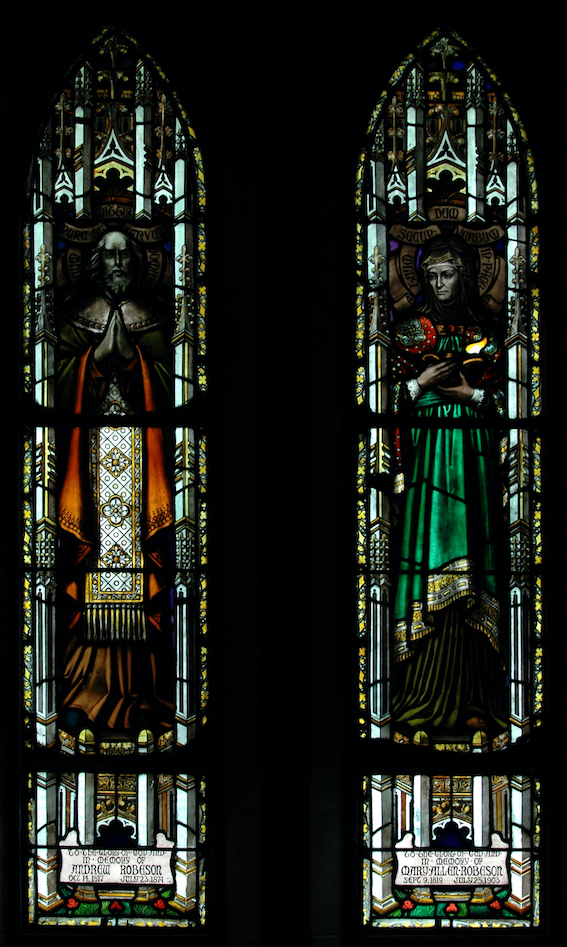
Our lancet windows of Simeon & Anna by Harry Eldridge Goodhue were given in 1905 by Alice Robeson Van Rensselaer. Photo by JG Bullitt.

The Gospel of Luke provides us one of the most beloved hymn texts in Christian history, the Nunc Dimittis or the Song of Simeon. It has been sung as part of daily evening-prayer services since at least the 4th century. The Song of Simeon has its grounding in the words of consolation and comfort in the book of Isaiah, written many centuries before,  when restoration and redemption were also sorely needed. Simeon sings a song of praise to God and then a song of blessing upon the young family. It’s a curious blessing, though, not one that I would want for my baby. It’s a blessing that predicts that the child is destined to create conflict and violence. If I had my baby in my arms and someone offered that blessing, I think I might turn away.

That’s when Anna the Prophet takes over. Luke makes sure that we know that she is a prophet before we know her marital status or her advanced age. Like Miriam of the Exodus in the wilderness, Deborah of Ephraim, Hulda of Jerusalem, or Mariann of Washington, D.C., Anna of the Temple was divinely inspired to see and bravely speak truth about both what is, and what is possible. Anna is the only woman in the New Testament who is named a prophet. The name Anna means grace or favor. (It’s the Greek version of the Hebrew name Hannah.) Luke’s emphasis is on her character and devotion. Unlike Simeon, her words aren’t recorded, but are described as praising the Holy One and speaking about Jesus to all who were looking for the redemption of Jerusalem, a city that was sorely oppressed by the brutality of the Roman Empire.

Anna was from the Tribe of Asher. That makes her “the only Jewish character in the New Testament who is said to belong not to one of the southern tribes of Judah or Benjamin, or the priestly tribe of Levi, but to one of the northern tribes of Israel.” [1] Asher was the eighth son of Jacob, and Asher means lucky, bearer of good fortune or salvation. Why did Luke include those details? Surely Anna was long gone by the time Luke was writing his Gospel three generations after the death of Jesus. Why were these details important to Luke’s audience at the end of the first century? Why do we need to know that Anna believed that Jesus would be the redemption of Jerusalem? Could we not just take Simeon’s word for it? Luke apparently did not think the presentation story was complete with just Simeon. It’s possible that Simeon represented the inhabitants of Judah and Anna, the Tribe of Asher, who represented exiles in the diaspora and hoped for return, reunion. [2] Luke’s first-century community of Jesus followers was in the diaspora in the north,  probably Syria or Turkey.

With both Simeon and Anna, the story includes male and female, inhabitants of the land and the exiled, the northern and the southern tribes of Israel, who are being restored in Jesus to be a light to all of the nations, which is another way of saying a light to the Gentiles. You might not know that “Judaism generally taught that salvation was for all people, not only for Jews.” [3] There’s another thing that Anna represents, in contrast to Simeon. Upon seeing the infant Jesus, Simeon’s song announced his dismissal in peace. Anna’s response is that she began to praise God and spread the word about the child to all who were looking for the redemption of Jerusalem, which means city of peace. Not only was Anna a prophet; she was the earliest New Testament evangelist. Her spreading the word of Jesus at the beginning of Luke’s Gospel is one bookend, and the other is the evangelism of Mary Magdalene and the other women who witnessed the empty tomb at the end of the Gospel. 

So Simeon saw the infant Jesus and retired, but Anna got back to work. She might have been old in age, but she was young in hope. [4] Apparently she didn’t waste any time on folks who were not looking for restoration or redemption. She spread the word to those who were looking. The good news about her words not being recorded is that it leaves room for our imagination about what she said. That kind of holy imagination used to read between the lines in the Bible is called midrash.

If you were going to use your holy imagination to read between the lines in this story, what do you think Anna said? What would you say if you were Anna? What would you say about Jesus to people who seem to be searching for restoration or redemption, looking for respect for the dignity of every human being, for liberation from oppression? What words of hope do you have for people looking for relief and reconciliation, for a city of peace, for a world of peace? Could you point them, even bring them, to a place where their dignity would be respected? If you were a person searching for restoration or redemption, what would you hope someone like Anna would say to you about Jesus? What words or signs would give you hope for peace in this city, or in this world, or even in your heart? Richard Rohr wrote, “People who sincerely search will touch upon the same truth in every age and culture. The direction is always toward more love and union – in ever widening circles.” [5]

You know, restoration and redemption were not just needed in the time of the prophet Anna; they are sorely needed now. The dignity of every human being is not yet universally respected. By including the story of Anna the Prophet, hearers of Luke’s Gospels learn that it is never too late see a sign of hope, nor to start spreading the word of hope. None of us is too old to be young in hope,  too far gone to be reunited with the Love of God, nor too old to shine the light of Christ in dim places.

Rabbi Shire and I were talking with folks from the parish and the synagogue about building up our moral courage in the year ahead to resist whatever is unjust, untruthful, or unloving. I mentioned our individual and shared resources of attention, prayer, time, money, and being in community with one another. When I finished that list, Rabbi Shire added that observing Sabbath is a form of resistance, not only about refraining from productivity, but experiencing refreshment and delight. Oh, we are so fortunate to have Rabbi Shire as our Rabbi-in-Residence. And I’m reminded of a poem by author and illustrator Loryn Brantz, which my daughter Sarah shared with me. 

In a time of hate
Love is an act of resistance.
In a time of fear
Faith is an act of resistance.
In a time of misinformation
Education is an act of resistance.
In a time of poor leadership
Community is an act of resistance.
In a time like this
Joy is an act of resistance.
Resist. Resist. Resist. 


  1. Richard Bauckham, Gospel Women: Studies of the Named Women in the Gospels, (Grand Rapids: Wm. B. Eerdmans Publishing,  2002), p. 77.
  2. Ibid., pp. 77-107.
  3. A.J. Levine’s note in the Jewish Annotated New Testament (New York: Oxford Press, 2011), p. 102-3.
  4. Thanks to Edith Dean for this phrase in All of the Women of the Bible (HarperSanFrancisco, 1955), p. 174
  5. https://cac.org/daily-meditations/widening-circles-2018-08-12/


[8]

More so Among us

Epiphany 3C, 26 January 2025. The Very Rev. Pamela L. Werntz

Nehemiah 8:1-3, 5-6, 8-10. Do not be grieved; the joy of the Lord is your strength.
1 Corinthians 12:12-31a. We were all made to drink of one spirit.
Luke 4:14-21. Today this scripture has been fulfilled in your hearing.

O God of love, grant us the strength, the wisdom and the courage to seek always and everywhere after truth, come when it may, and cost what it will.


It’s been a week, hasn’t it? I’ll remind you of what we do when times are terrible, frightening, angering, sorrowful: we stick together and we stay close to the scriptures. They were written in times of deep distress, and they are our guiding lights. I’m talking about the actual scriptures, the first and second testaments of our Bible, which testify to loving our neighbors as ourselves.

Today we hear Luke’s story of the beginning of Jesus’ ministry. The four Gospel writers were very careful about how they began their accounts of the beginning of Jesus’ ministry. They all agreed that Jesus’ public ministry began after John the Baptist was arrested by Herod. Like siblings, each Gospel writer’s account about where and how Jesus’ public ministry began is different.  Mark tells of Jesus exorcising an unclean spirit in the synagogue in Capernaum. Matthew’s first story of Jesus’ ministry is about a large body of teaching, which he addressed to the crowds on a mountain. John’s story of his ministry begins with the water-to-wine extravaganza at the wedding in Cana. And Luke tells about Jesus’ visit to his home synagogue in Nazareth.

Jesus, Luke says, was filled with a spirit of holiness, the same spirit of holiness that would fill his followers after his death. Luke says that it was Jesus’ custom to attend synagogue on the Sabbath. When the scriptures were handed to him, he read Isaiah’s proclamation of freedom: freedom from hunger, illness and disability, poverty, prison, debt, freedom and all kinds of oppression. It’s more of a mash-up than a direct quote from Isaiah, but certainly the spirit of Isaiah is as Jesus reports. Isaiah was proclaiming the end of the Babylonian exile. According to Luke, Jesus was proclaiming that his ministry, too, was going to be about liberation, about freedom. At the core of his ministry was (and still is) a powerful ethic of love, of compassion and mercy, forgiveness and reconciliation, nonviolence and well-being, shalom. It is the same ethic that is at the heart of the Torah, the Prophets, and the Writings. I usually don’t think of myself as a conspiracy theorist, but I do believe that all good things come from Love, which is another name for God. My conspiracy theory is that Love is the Way, the only Way.

It’s interesting to me to think about this in light of Nehemiah’s story of the return of the Hebrew people from exile and slavery in Babylon. Having returned to Jerusalem, they have gathered at the eastern gate of the city, where the water flowed from a spring. Nehemiah says they wept when they heard the word of the Holy One. They wept, the water flowed from the springs in their eyes, perhaps because they realized how far from free they had been in Babylon. Perhaps they realized how far from free they still were even though they were back in familiar territory. Perhaps they wept for all that had been lost. And the religious leaders – Ezra, Nehemiah, and the Levites – respond to their mourning with an instruction to celebrate!

Don’t mourn, celebrate, because rejoicing in the Holy One is the source of your strength. This day is sacred. You are God’s sacred people. Don’t mourn over the past. (You know, stop hoping for a better past.) Go eat and drink, and share what you have with whoever has nothing prepared.

Now, you might have noticed that verses 4 and 7 are missing from our reading from Nehemiah this morning. Maybe you even guessed that I would tell you, because I usually do! Those two verses contain long lists of names. Perhaps they’re left out in deference to lesson readers everywhere, but I wish they hadn’t been omitted. Verse 4 lists the names of the people who stood with Ezra as he read the sacred text. Nehemiah says that Ezra was standing with eleven others on a wooden platform, which had been made for the purpose. He was standing with his leadership team.  [1] And then in verse 7 is a list of thirteen additional people who were there to help the congregation to understand the sacred text, because it was hard to understand.  [2] Let’s not miss the idea that the scripture has always been challenging to understand and that Ezra had a very large leadership team helping to proclaim freedom from oppression!

It’s interesting to me to think about freedom in light of Paul’s teaching about the body of Christ. As members of the body, he says, Christians are not free to disregard the value of another part of Christ’s body, or member, even if that member is weak or seems less important. Every part is important, Paul says. The eye must not say to the hand, “I have no need of you.” The ear must not say, “Because I am not an eye, I do not belong to the body.” 

The reason that Paul was writing about this to the people in the church in Corinth was that they were arguing with each other about who was most important. We know that in the olden days, sometimes people in churches didn’t like each other, didn’t respect one another’s opinions or sufficiently regard one another’s dignity. In the olden days, sometimes people who were a part of the church behaved very badly toward one another. (Can you imagine?) In the early church, some people thought that other people shouldn’t be members of the church, or sometimes people felt that they themselves didn’t belong or didn’t really fit in! Paul was trying to teach them that everyone is important, and everyone belongs, even members who are weaker, less honored, or less respected than others. Paul was giving a pep talk about what it means to be a part of a team:  one body with many members with a variety of gifts, who have great need of one another, despite ideas to the contrary.

Paul was using the metaphor of a body to say that some parts are more noticeable or may seem more important than others, but every part is important. Every part deserves compassion and respect. Think for a moment about what compassion and respect mean. Now think for a moment about what you would say if I went around the room and asked each one of you what you think of as the strongest part of your body, and what the weakest part or the least-likable part of your body is. Think for a moment about what you might do differently if you started treating the weakest or least-likable part of your body with more compassion and respect. Maybe it’s your hair, belly, upper body, legs, nose, teeth, hands, or feet? I feel certain that each one of us has at least one body part that could use more compassion and respect.

 Now think of Emmanuel Church as a body with lots of parts. Think for a moment about what you would say if I went around the room and asked each one of you who you think are the most honored, popular, or influential Emmanuelites and who are the least honored, popular, or influential? Think for a moment about how much stronger our body at Emmanuel would be if we treated the least honored, popular, or influential members with greater respect. Maybe when you thought about it, you thought to yourself, “Actually I think I’m one of the least honored, popular, or influential Emmanuelites.” Maybe you thought, “I’m not sure I’m even considered an Emmanuelite.”  (Well I can tell you that you are today by virtue of your presence with us this morning, whether you are here physically or virtually, because that’s how it is around here.) Think for a moment about how much stronger our body at Emmanuel Church would be if you treated yourself and everyone else with greater compassion and respect, and if everyone else treated you with greater compassion and respect. 

I think starting with yourself and your parish community is what is called practicing religion. Emmanuel Church is where we practice greater self- and communal compassion and respect so we can do it out there. Even if you are already a very compassionate and respectful person, I guarantee that you can do something today that is even more compassionate and respectful than usual. Even if, and maybe especially if, you’re feeling a little cranky, less than comfortable, or nervous, you too can do something that is compassionate and respectful. Maybe it’s toward someone in your immediate family, someone who you don’t usually think about or try to avoid, someone you love but don’t agree with or understand, or someone you don’t even know and may never see again. So what does that have to do with freedom? Well, if a body is at odds with itself, it is not free. If a stomach is grumbling, for example, or an ear is aching, the whole body suffers. If people in the church are grumbling or aching, the whole community suffers. When we’re suffering, we’re not free to pay attention to the needs of others, to help get other people free.

I want to interject something about focus because when the news is as overwhelming as it has been lately, it’s tempting to give into despair or to just tune out and shut down. One antidote is to pick one issue to focus on and to act on it; take a step in the direction of advocacy and support. If the first step is too hard, break it down into smaller steps.

Helping get other people free is our job as Christians, because Christians are the body of Christ. If, as Luke says, Jesus Christ was filled with a spirit of holiness to fulfill the scriptures, to set people free, then, as the body of Christ filled with the same spirit, we Christians have inherited the same responsibility. We have the same call, invitation, and challenge to express the compassion and respectfulness that are manifestations of true holiness. Today we have opened the scriptures that proclaim freedom: freedom from hunger, illness, disability, poverty, prison, debt, harassment, and all kinds of oppression. Today we are called to rejoice in the source of our strength and share what we have with those who have no provisions for a celebration. Today let’s do what we can to make sure that this scripture is fulfilled in our hearing. Not just in the distant past and not in some unforeseeable future. Today, let’s see how it could be more so among us.


  1.  Mattithiah, Shema, Anaiah, Uriah, Hilkiah, and Maaseiah on his right hand; and Pedaiah, Mishael, Malchijah, Hashum, Hash-baddanah, Zechariah, and Meshullam on his left hand
  2.  Jeshua, Bani, Sherebiah, Jamin, Akkub, Shabbethai, Hodiah, Maaseiah, Kelita, Azariah, Jozabad, Hanan, and Pelaiah


Ponder these words in your heart!

Christmas 2C. 5 January 2025. The Very Rev. Pamela L. Werntz

Jeremiah 31:7-14 “their life shall become like a watered garden”
Ephesians 1:3-6, 15-19a “I do not cease to give thanks for you as I remember you in my prayers.”
Luke 2:41-52 “I must be in that belonging to my Father.”

O God with us, grant us the strength, the wisdom and the courage to seek always and everywhere after truth, come when it may, and cost what it will.


We are lingering in Christmastide for one more day. Epiphany is coming, but not quite yet! The Gospel of Luke contains the only story of the boyhood of Jesus in the Bible, and it baffles Biblical scholars. We know that ancient biographies commonly told stories of heroes in their youth to demonstrate that there were signs of greatness early on. There are some fantastic stories about Jesus’ magical powers as a young boy that didn’t make the cut when the scriptural canon was being negotiated. None of the other three Gospels, which did make it into the Bible, have any stories from Jesus’ youth; and Luke’s intention is not clear.

Is Luke demonstrating that Jesus was just like other heroes, fulfilling a divine promise that was clear to others in his boyhood? Or was Luke demonstrating that Jesus was NOT like the others because he didn’t start out knowing everything? Is this a story that demonstrates Jesus’ human-ness early on? Was he a child prodigy, learning from and asking questions of the teachers in the temple? Or was the young Jesus an ordinary adolescent, not telling his parents where he was, doing something quite dangerous, getting separated from his family, worrying them sick for the better part of a week? The answer to any of these questions could be, “Yes.”

Luke seems to be using a literary convention that matters to him and to his cosmopolitan audience to conclude his two-chapter prologue. In this little passage, however, he works in three important ideas that he wants the hearer to understand about Jesus, which found in  his Gospel.

First, in the verses just before today’s portion, Luke goes to great lengths to describe the preparation for the ceremony of Jesus’ circumcision, his dedication in the temple, the devout and righteous blessing of Simeon, and the praise of God for Jesus from the prophet Anna. We’ll hear that story on February 2 for the Feast of the Presentation. The passage ends with, “When they had finished everything required by the law of the Lord, they returned to Galilee, to their own town of Nazareth.” Then Luke says that every year Jesus’ family went up to Jerusalem for the festival of Passover. We know that Jews living within about fifteen miles of Jerusalem were expected to go to the temple three times a year: for Passover, the Feast of Unleavened Bread; for Shavuot, the Feast of Weeks (we call it Pentecost); and for Succot, the Feast of Booths. But Nazareth was more than four times that distance away. The image presented of the temple in Jerusalem by Luke is very positive, and Jesus’ parents are presented as very devout. 

Second, Jesus’ parents search and find him sitting among the rabbis, learning from them, asking questions, and demonstrating his own understanding of scripture. Here is a thoroughly Jewish Jesus, well-educated and well-grounded in his religious tradition. When Jesus asks his mother why she was searching for him, his question, literally translated, reads, “Did you not know that I must be in that belonging to my father?” This is the dramatic center of the story and these are the first words that Jesus speaks in the Gospel of Luke. The Greek words do not include the word house as in, “Did you not know that I must be in my Father’s house?” (NRSV), nor do they include the word business as in, “Did you know that I must be about my Father’s business?” Nor does the Greek include any indication of a proper noun (no reason to capitalize the word father). Much is made about the tension between Joseph as father and God as father, and that can be there, but not necessarily. The word father is the same, so there’s no reason to believe that what Jesus is doing doesn’t belong to Joseph as well. That Jesus must be ‘in that belonging’ to his father can mean in that Jewish tradition, or in that educational Jewish dialogue. Amy-Jill Levine points out that Father’s House is a common term in the Torah, but not used to describe the temple in Jerusalem. According to Luke, the point is that Jesus was really devoutly Jewish.

A third thing to think about in this passage is a theme Luke takes up again and again: the theme of losing, searching, and finding within an expansive idea of family. Here is a story of Jesus not being in close enough contact with his parents to know that they were leaving or to let them know that he was staying; we don’t really know which. All we know is that Mary and Joseph assumed that he was with their departing caravan, and they didn’t realize he wasn’t until they were a whole day’s journey away. If this sounds implausible to you, it’s either because you don’t come from a large, extended, chaotic family, or your family has a much better grip than most. In my family of origin, I think each one of us four children got lost or left behind at least once on a family trip. Each adult thought that a particular child was with another adult or being watched by older kids. It’s a wonder we all made it out of childhood alive!

The theme of losing, searching and finding gets reprised in Luke (in stories that only appear in Luke) in the parables of the lost sheep and the lost coin and of the prodigal son. Later in this Gospel Jesus rejoices about a rich man named Zacchaeus promising to give half of his possessions to the poor and pay back four times the amount if he has defrauded anyone of anything. Jesus says in response to Zacchaeus, that the Son of Man came to seek out and to save the lost. The theme of family gets defined and redefined in stories about leaving home, or not being welcome at home. It is in Luke that Jesus’ disciples let him know that his mother and brothers are searching for him and he famously replies, “My mother and my brothers are those who hear the word of God and do it.” This is hugely comforting to people who have left or been rejected by their families of origin because of their understanding or misunderstanding of who (and Whose) they are. 

Jesus’ wider definition of belonging is Good News to any who need, or long, to be welcomed into a more expansive, a more inclusive household of God. In Luke, Jesus employs an ever-larger definition of family, a definition of belonging and beloving that doesn’t depend on biology or inheritance, but on adoption by grace of those who listen deeply and behave lovingly toward one another. In Luke it’s clear that love makes a family. Maybe getting a glimpse of the idea that we belong and are beloved in the household of God is gift enough for this twelfth day of Christmas; or maybe it’s more than we could have thought to ask for.

At Emmanuel, I often think of the cantata as our fourth reading as well as our musical sermon. Today’s cantata text picks up the themes of losing, finding, and belonging to Jesus; or maybe it’s more about Jesus belonging to us, promising not to leave us bereft and panicked. Here we are all invited to identify with Mary searching for her dearest Jesus, her desire and joy. Here Jesus responds that he can and will always be found in the Love of God, in the love that is God. One of my colleagues, Steve Garnaas-Holmes wrote this in his poetry blog, Unfolding Light.[1] While it’s called, “Losing Jesus,” it’s more about finding Jesus.

Sometimes it feels like we’ve lost him.
Even so soon after Christmas
the magic is gone.

But we find him eventually
in the true temple:
not some place of special power or mystique,
but that sacred place within.
Where is the temple
but in that silence in the holy of holies
in you?

When you can’t find the Holy One
you may be looking too far afield.

Treasure these words and ponder them in your heart.


  1. www.unfoldinglight.net