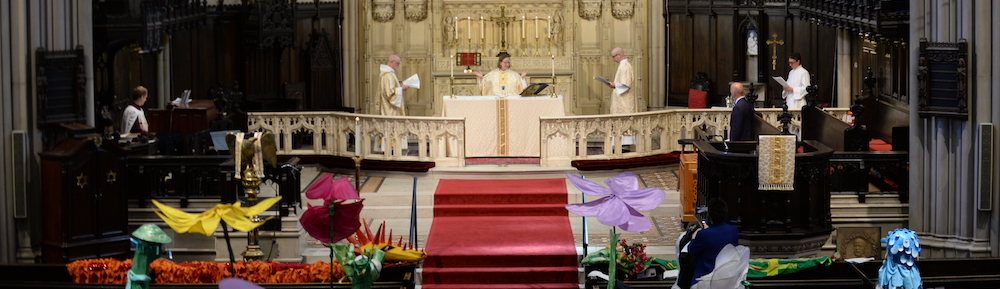
We are all one.

Proper 5C, May 18, 2025.  The Very Rev. Pamela L. Werntz

Acts 11:1-18. The spirit told me…not to make a distinction between them and us.
Revelation 21:1-6. I am making all things new…to the thirsty I will give water as a gift.
John 13:31-35. I give you a new commandment, [in order] that you love one another.

O God of all, grant us the wisdom, the strength and the courage to seek always and everywhere after truth, come when it may, and cost what it will.


We are celebrating the baptism of Bodie Richard Coulon this morning, so we’ll all be invited to review what our Church teaches about baptism and we’ll be invited to renew our own baptismal vows. Today is a great day for a baptism because our scripture lessons describe beautiful visions of well-being. 

The book of Acts says that while Peter was in a trance of prayer, he had a life-changing dream that revealed to him that there is no distinction between “them” and “us.” In other words, he came to understand that when it comes to the redeeming urge or work of the Holy One, (also known as Jesus Christ for Christians), there is no Jew or Gentile, no free or slave, no male and female, no gender binary; no insiders and outsiders, all people are one. While there are always those in the center and those on the margins, those with more power and those with less, those of us who have and use more than our fair share of the world’s resources and those who do not have their basic needs met, we are all one. Peter realized that he should not be hindering the work of God by deciding who is inside and who is outside of God’s reach. Here’s where Christians often get tripped up, deciding what is godly and what is not. The measure of godliness is love. As our former Presiding Bishop Michael Curry is fond of saying, “if it’s not about love, it’s not about God.” Of course it gets complicated, but that’s where we start. If it looks like there are competing interests that all have to do with love, we might need to enlarge or expand our view. We might need to look at the situation from 30,000 feet where differences between us become imperceptible, because we are all one.

The Revelation to John of Patmos also came through meditation, during which he experienced a vision of the Divine, setting right everything the Roman Empire was getting completely wrong. Exiled on the Island of Patmos, John visualized the Holy One at home among mortals — the Eternal dwelling secure among them. John saw grief and weeping and pain ending – his own and his people’s — and everyone who is thirsty having enough to drink. Sometimes I think that our own vision of the realm of God is limited, constrained by our own lack of thirst for water from the spring of the water of life. John of Patmos’ vision was of God with us (which is what Emmanuel means) – and, building on Peter’s insight, “us” means everyone. There is no them. We are all one.

The Gospel of John envisions a time when Jesus’ followers are known by and known for their love. These few verses are sandwiched between a hard place of Judas leaving to arrange for Jesus’ arrest, and a rock (Peter) whom Jesus predicts will deny even knowing him three times before the rooster signals the dawn. The glory and love Jesus is talking about are set right in the midst of the most painful betrayal and agonizing denial described in all of Christian scripture.

What do glory and love mean here in this dreadful spot? The root of the word “glory” (dox – as in doxology) means appearance as in manifestation. Doxology is language of manifestation. [2] Our word paradox means different from or in contrast to (para) how something seems or appears (dox).

Orthodox means right or correct appearance or manifestation. So the beginning of our Gospel lesson could be translated, “Now the Son of Humanity has appeared and God has appeared in him. If God has been made manifest in him, Gods-very-self will also appear in him and will appear in him right away.” Glorification is an appearance or manifestation of the Holy One in this case, here in the midst of the worst scenario imaginable to Jesus’ followers. 

There are other translation issues. “Children,” Jesus says. (The word “little” isn’t there in the Greek–just children – maybe in the sense of tender and naïve, not fully matured or wizened?) “I am with you only a little,” Jesus says. He says, “You will look for me, and where I am going you cannot come.” In the verse just following our reading, Jesus clarifies – you can’t follow me now, but you will follow afterwards – so it’s sad, but not permanently sad.

Then John the Evangelist’s account has Jesus talking about how he has previously said something to “the Judayoi” – rendered “Jews” in our NRSV. (That has become permanently sad, because, of course they were all Jews. I say permanently sad because our scripture translations continue to incite violence against Jews.) Judayoi here could either be translated Judeans (in contrast with Galileans) or understood as anachronistic and antithetical to Jesus’ life and witness. For our reading today, I translated it “people” to distinguish between Jesus’ public preaching and his teaching in this intimate setting the evening he was arrested. Whenever I encounter this passage, I trip over the line about “a new commandment, that you love one another.” And I always think, that’s not a new commandment. The Torah teaches that we must love our neighbors as ourselves and we must provide tangible care for the strangers or aliens in our midst. Why is loving being called a new commandment? My answer is, it’s not. 

The command here is not “to love one another.” A closer translation is, “A new command I am giving to you in order that you may love one another, just as I loved you in order that or so that you may love one another.” The word “should” is another  translator’s opinion. The new commandment that Jesus has given in the portion just before this reading is to wash one another’s feet. Serve one another, care for one another. Get your hands dirty – risk contamination, risk becoming unclean in service to one another. As far as I know, the command to wash one another’s feet, assuming a posture of kindness, of presence, of service, behaving as if we are all servants of one another, is a new command. There are Torah instructions to wash one’s own hands and feet. There is customary hospitality to offer water and a place to wash, and when available, servants to help. But Jesus takes a towel and kneels down and washes his followers’ feet and then tells them to do that for one another. Wash the muck off of one another’s feet. That’s the new commandment. 

The purpose is to demonstrate your love for one another. Just as I have loved you, in order that you have love for one another. This is how people will know that you’re Jesus followers – when you demonstrate your presence, your kindness, your service for one another. Jesus says, “in order that, or so that, you love one another” three times. That’s how we know he really means it. It also means it probably wasn’t happening. If it had been happening, there wouldn’t be any need to write it down and to emphasize it by saying it three times. I mean, no one says three times “I’m giving you this new mop so that you will wash the floor” if the floor is already washed, right? And of course, it’s hard enough to do this for our family and friends. Jesus teaches that we must perform humble acts of presence, kindness and service for our enemies as well. Jesus has just washed the feet of the one who would betray him and the one who would deny even knowing him.

There are times in the history of Christianity when Christians have been known for our works of presence, kindness, and service. There are times when Emmanuel Church is and has been known for our works of presence, kindness, and service. But building a beloved and beloving

community doesn’t happen without intentionality and work, especially in difficult times. Listen to Tertullian’s description of church practice in the good old days of the early second century of the common era: “On the monthly day… each puts in a small donation; but … only if he [or she] be able: for there is no compulsion; all is voluntary. These gifts are…piety’s deposit fund. For [funds] are not taken thence and spent on feasts, and drinking-bouts, and eating-houses, but to support and bury poor people, to supply the wants of [those] destitute of means and parents, and of old persons confined now to the house; such, too, as have suffered shipwreck; and if there happen to be any [slaving] in the mines, or banished,…or shut up in the prisons…. it is mainly the deeds of a love so noble that lead many to put a brand upon us. [“Christian” was a derogatory name.] See, they say, how they love one another, …they… do not hesitate to share …earthly goods with one another. All things are common among us but our wives. [it really says that]…. Whatever it costs, our outlay in the name of piety is gain, since with the good things of the feast we benefit th[ose who are] needy.” Tertullian didn’t quite get the lack of distinction between us and them (which can be encouraging for us!), but he beautifully described what it means to act like a Jesus follower. His vision is true to my experience when we are functioning well. 

When we are functioning well, we are actively engaged in behaviors that are encouraging those who are afraid, nourishing those who are hungry, healing those who are suffering, forgiving those who are guilty, redeeming those who have been undervalued, freeing those who are stuck or imprisoned, inspiring those who are dispirited, protecting those who are most vulnerable, reviving those who are tired. When we are functioning well, our service is mutually beneficial; we are both giving and receiving, and we are trustworthy people in a trustworthy community. [4] The work of Christian community, as Brother Curtis Almquist has said, is the three-step work of moving from “judgment of others to compassion for others to identification with others.” When we are functioning well, we are practicing radical empathy as our flag outside says. When we are functioning well, we are all one.

You know, baptism is a ritual of identification with others, others who are not necessarily of our own choosing, a bigger community than our own families and friends. Baptism is not only for or about the person being baptized; it’s for and about the whole church represented by this gathering today. This morning Bodie’s baptism means he will be identified as Christian, and as he grows up, I pray that he will join in the work of serving others as well as appreciatively receiving the service of others as gifts and signs of love. I pray that love will always animate his life. I pray that whenever he finds himself between a hard place and a rock, in the midst of betrayals or failures, ignorances or misunderstandings, he will have a community of people who will help him to turn away from cynicism, sarcasm, and fear, and move toward authentic and deeply respectful relationship with the Divine and with others. I pray that love will always show him that we are all one.


  1. Galatians 3:28.
  2. Leftbehindandlovingit.blogspot.com, April 18, 2016.
  3.  Tertullian, Apologeticus, Ch. XXXIX (http://www.ccel.org/ccel/schaff/anf03.toc.html#P253_53158)
  4.  Jesse A. Zink, Faithful, Creative, Hopeful (New York: Church Publishing, 2024), p.162.

Wake up! Rise up!

Easter 4C, May 11, 2025.  The Very Rev. Pamela L. Werntz

Acts 9:36-43. He gave her his hand and helped her up.
Revelation 7:9-17. He will guide them to springs of the water of life.
John 10:22-30. It was winter.

O God of life, grant us the strength, the wisdom and the courage to seek always and everywhere after truth, come when it may, and cost what it will.


During Eastertide, our lectionary offers no lessons from the First Testament. The effect, I think, is to overemphasize a break between Jesus’ followers and Jesus’ religious heritage. Instead, we have passages from the Acts of the Apostles’ romantic accounts of the beginnings of Christianity, written toward the end of the first century about “the good old days.” Today it’s Peter raising Dorcas from the dead with a line that is almost exactly the same as what Jesus said to raise Jairus’ daughter from the dead: arise or wake up, come alive! In other words, Peter was ministering just like Jesus. I love line, “he gave her his hand and helped her up.” Continue reading

Behave as if it were true!

Easter 3C, May 4, 2025.  The Very Rev. Pamela L. Werntz

Acts 9:1-6(7-20). “Go, for he is an instrument whom I have chosen.”
Revelation 5:11-14. And the four living creatures said, “Amen!”
John 21:1-19 . Come and have breakfast.

O God of resurrection, grant us the wisdom, the strength and the courage to seek always and everywhere after truth, come when it may, and cost what it will.


We are well on our way into the Great Fifty Days of Easter, the extended Feast of the Resurrection. I love that the Church calendar gives 40 days for Lent, but 50 days for Easter because Easter is harder. Lent is easier for many of us – we know our need for increased focus on penitence, discipline, prayer, study, and our need for mercy. Many of you tell me that Lent is your favorite church season. On the other hand, a season of increased focus on resurrection – on rising from the dead, trips people up, especially when the news of what’s going on in the world is so bad. (I’ll tell you something. It was bad for the earliest Jesus followers too.)  Continue reading

Risen

Easter 2C, April 27, 2025.  The Very Rev. Pamela L. Werntz

Acts 5:27-32. Jesus, whom you had killed by hanging him on a tree.
Revelation 1:4-8. To him who loves us and freed us from our sins by his blood.
John 20:19-31. Peace to you…peace to you…peace to you.

O God of love, grant us the wisdom, the strength and the courage to seek always and everywhere after truth, come when it may, and cost what it will.


Blessed are you who come to church on the Sunday after Easter, in spite of a trifecta of truly terrible theological ideas that get repeated every single year on this day, no matter what.  The first is from Luke the Evangelist in the Acts of the Apostles, where Peter accuses the high priests of having Jesus executed.  The second is from John the Divine in Revelation, that Jesus’ death was a blood sacrifice required for atonement with God. And the third is from John the Evangelist disparaging doubt. We will hear some good and comforting news today from the prophet Isaiah, but you’ll have to wait to hear it until after communion. These are four texts (the first three from the New or Second Testament, and then the text from Isaiah in the Old or First Testament) that do not support the fallacious idea that the God of the Old Testament is a God of wrath and the God of the New Testament is a God of love. I cannot say often enough that the God of Jesus is the God of Israel, and there is plenty of love from God in the First Testament and plenty of wrath in the Second Testament, but Christians tend not to hear or read scriptures in a way that facilitates our comprehension. Continue reading

Feast of Love

Lent 4C, March 30, 2025.  The Very Rev. Pamela L. Werntz

Joshua 5:9-12. The Lord said to Joshua, ‘Today I have rolled away from you the disgrace of Egypt.”
2 Corinthians 5:16-21. So we are ambassadors for Christ, since God is making his [sic] appeal through us.
Luke 15:1-3, 11b-32. Now all the tax collectors and sinners were coming near to listen to him. And the Pharisees and the scribes were grumbling.

O God of mercy, grant us the strength, the wisdom and the courage to seek always and everywhere after truth, come when it may, and cost what it will.


I’m not going to ask for a show of hands, but I wonder how many of you ever complained about someone else’s bad behavior? (I have too.) And I wonder when you complained, did you want an answer? (I have too.) I think it’s important to know that Jesus tells this story of the man who had two sons in response to the complaint that Jesus welcomes sinners. The story is part of Jesus’ answer to others complaining about his habit (or practice) of hanging out with people who behave badly. The complainers, according to Luke, were some of Jesus’ colleagues. And the complaint was that Jesus welcomed sinners – people who were dangerously out of step with the well-being of the community, people who were unclean, unethical, unlawful, just plain gross — and not only did Jesus welcome them, he even ate with them. Simply put, the complaint was, that’s foolish, that’s not right, and, for those who were jealous, that’s not fair.

That was the complaint, and Jesus’ response in the Gospel of Luke was to go on a kind of parable tear. In rapid succession, he told them about a shepherd finding a lost sheep, a woman finding a lost coin, and then this story of the man with two sons. Then he went right to a parable about a dishonest manager and then one about a rich man and Lazarus and it all ends with an instruction to forgive another disciple as many as seven times a day – which may be a clue as to just what kind of folks his disciples were and how often they needed to be forgiven!

This story, right in the middle of this cluster of parables, is the story that assures parents that for thousands of years, some siblings have been doing things that are not “right” and other siblings have been complaining “it’s not fair”. There’s the son who is reckless and wasteful but then has the incredibly bad luck of finding himself living in a land that has a famine – and most of us know stories of people whose lives seem to bounce between bad choices and bad luck – and some of us have been there ourselves. There’s the son who is steady and responsible, working the land all the years that his younger brother was gone, no extravagant parties – not even a roasted goat to celebrate with his friends. But, since the father had already given him the land, he was working his own land. He was working like a slave for something he already had. Actually his father no longer had a goat to give, because all the goats belonged to the older son. And most of us know stories of people whose lives seem burdened with responsibilities that they faithfully, and sometimes begrudgingly, sometimes resentfully attend to – and some of us have been there ourselves. That son worked so hard for so long that all his muscles, even the muscle of his heart had become hard. 

And most of us know stories of parents who do crazy things for their children. Here it’s the father, who divided his property prematurely. (In the Greek, the word for property literally is his “whole life” — the means of his subsistence.) He did something that was extremely foolish and even reckless. He endangered the well-being of himself and the rest of his family. Once his property was divided he had no way to ensure that he and the rest of his household would be provided for. His sons had no obligation whatsoever to provide for his care in a legal sense. Legally he was dead to them. If both sons had done what the younger son did, the father and the household would have been out of luck. And yet the father was overwhelmed with joy at the return of his younger son, and he replied to his older son’s “not fair” complaint, “son you are always with me, and all that is mine is yours.” And the father was not just feeding and clothing his returning son, he was honoring him.

The parables that Jesus told were powerful because of their ability to surprise and disturb. And they were subversive enough that they made people with military and economic power mad enough to want Jesus killed. Our challenge with hearing parables that are as familiar as this one is that we think we know what they mean. And often it’s what we learned in Sunday School, and we never go deeper. Many of you know something about sibling rivalry first hand (and the rest of you probably have seen it). Many of you know something about parenting – either from being a parent or watching other people be parents. So many people listen to this story and can imagine, “I’m that guy.” Many people listen to this story from the perspective of one of the characters. 

So I want you to imagine something a little differently than usual. I want you to go deeper. I want you to imagine that every one of the characters in this parable is a part of you. Every single one of us has each of the three characters inside of us. Each one of us has a part which makes bad choices and has bad luck. And, each one of us has a part which works hard and is judgmental about others who make worse choices or have better luck. And each one of us has a part that is called to be the foolishly loving one who goes out to forgive the stumbling self and goes out to appreciate the dutiful self. I want you to imagine that this story Jesus is telling is all about the capacity for joy and forgiveness inside of you as well as among you in the wider community.

And here is something that is surprising and scandalous. We have no proof that the younger child reformed and stayed home. We only know that this (grown) child tried to begin again and that the trying itself – the showing up — was enough for the loving parent – and that he was forgiven. We have no assurance that the hard-working, stay-at-home child ever repented of his jealousy and resentment but we know that his father went out to greet him too and to plead with him to join the party. His father reminded him that his inheritance was intact if he wanted it. We have no proof that the father was not stung time and again by both of them, or that he ever understood and took responsibility for his own recklessness in prematurely dividing his property. We only know that the parent understood the struggles of his sons and didn’t seem to be particularly interested in inheritance. He wasn’t particularly interested in accounting for the iniquities. We don’t know the long-term results, but what this parable suggests is surprising and actually pretty scandalous for people as results-oriented as we tend to be. 

If this parable is a glimpse into life fully lived in the gratitude, generosity, and grace of Love, or what Luke calls, “the realm” or “the kingdom,” then it may be about calling out from the depths to return and reaching into the depths to forgive. The younger son is not rejected. The older son is not rejected. In fact, in the parable, Jesus rejects the idea of one person (or one group) being rejected at the expense of another. The realm of God is universal, not particular. [1] It is big enough and wide enough to accommodate the foolish, the not-right and the not-fair. In the end, all in the story share all that there is.

As Paul says in the Epistle this morning, “in Christ God was reconciling the world, not counting their trespasses against them.” The Redeeming Urge of Love (the Christ) is reconciling the world, with no accounting of trespasses or sins. We have been entrusted with this message of reconciliation. We are ambassadors for Christ – that Redeeming Urge of Love. It is our responsibility to spread the Word, and to take care not to get lost in self-righteousness. Eugene Peterson likens the sin of Christian self-righteousness to iatrogenic illness – illness inadvertently caused by healthcare, like a staph or c diff infection picked up while being treated in a hospital. The sin of Christian self-righteousness can be inadvertently picked up in church. When we believe that we are the only ones, for example, who know how worship should be, how sermons should be, how prayers should be, how music should be, how mission or outreach should be. 

Peterson writes, that the best protection against the sin of self-righteousness is an acute awareness of our lost condition in which we so desperately and at all times need a Savior, because “as long as we hold on to any pretense of having it all together, we are prevented from deepening and maturing in the Christian faith….as long as we avoid recognition of our lostness we are prevented from experiencing the elegant profundities of foundness…as long as we insist on maintaining safe moral grids in which we always know where we stand (and where everyone else stands!) in poses of self-sufficiency, we disenfranchise ourselves from the company of the found sheep, the found coin, the …found brother and the celebrating angels.” [2] And we refuse to attend the party.

In an invitation to move from alienation to reconciliation – the father of the two sons seeks to reconcile them. This story calls us to reconcile, to re-call that we are members of The Body of Christ – members of God’s Body. We belong to one another. In the story hear the words, “this son of yours…this brother of yours” – they belong to each other. I’m reminded that the Greek word that gets translated “devil,” comes from the root that means to separate, to tear apart. The temptation is separation, alienation from one another, one’s own self, and God. A number of years ago when the presiding bishop of the Evangelical Lutheran Church in America, Elizabeth Eaton said that she believes if hell exists, it’s empty. But this is a story (for me) about why hell might not be empty – and it’s because the folks that are there put themselves there and refuse to come out.

The Biblical value being asserted in this story is completeness of the group – wholeness even across profound differences.[3] When the older brother complains bitterly, the father responds not with judgment, but with compassion: “you are always with me and all that is mine is yours, come to the party.” The parable doesn’t choose between the sons, but urges both to attend the celebration.[4] The parable says, go into the celebration. Whoever we are, whatever we’ve done, wherever we’ve been, we belong to one another. We are to be reconciled to one another, so come to the feast of Love.


  1.  Bernard Brandon Scott, Hear Then the Parable (Minneapolis:  Fortress Press, 1989), p. 125.
  2. Peterson, pp. 88-89.
  3.  The Chautauquan Daily, August 18, 2011 chqdaily.com interview with Amy-Jill Levine.
  4.  Bernard Brandon Scott, Hear Then the Parable: A Commentary on the Parables of Jesus (Minneapolis: Fortress Press, 1990), p. 125.

Show what love looks like!

Lent 2C, March 16, 2025.  The Very Rev. Pamela L. Werntz

Genesis 15:1-12, 17-18. I am your shield.
Philippians 3:17-4:1.  He will transform the body of our humiliation.
Luke 13:31-35.  How often have I desired to gather your children together as a hen gathers her brood under her wings.

O God whose glory is always mercy, grant us the strength, the wisdom and the courage to seek always and everywhere after truth, come when it may, and cost what it will.


Today’s choice of a Gospel text for the second Sunday in Lent always strikes me as a little jarring. It’s jarring to begin the first week of Lent with Luke’s account of Jesus before his ministry began, resisting temptations in the wilderness, and then skip over miles of travel, teaching and healing all around the Galilee and beyond, to the middle of the Gospel of Luke, at the end of chapter thirteen. (Next week the scheduled portion is back at the beginning of chapter 13.) The slow, almost leisurely pace of Jesus’ ministry in Luke with magnificent story-telling, prayer and Sabbath meals is completely eclipsed in our Lenten readings from Luke’s Gospel. Our lectionary saves all those stories for the summer. Continue reading