
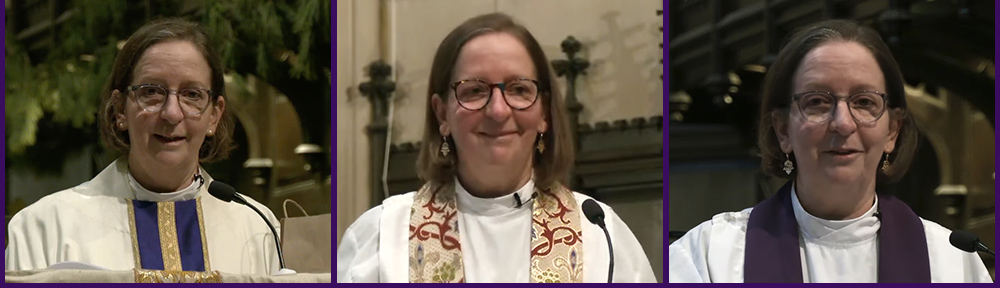
A Bold and Generous Return

Proper 23C, October 13, 2013; The Rev. Pamela L. Werntz

Jeremiah 29:1, 4-7  Seek the welfare of the city where I have sent you into exile, and pray to the Lord on its behalf, for in its welfare you will find your welfare.
2 Timothy 2:8-15 The word of God is not chained.
Luke 17:11-19 Then Jesus asked, “Were not ten made clean? But the other nine, where are they?”

O God of sacred story, grant us the strength, the wisdom and the courage to seek always and everywhere after truth, come when it may, and cost what it will.

This sermon is going to include a list-making exercise.  So you might want to have a pen or pencil ready – or your notes page on your smart phone will do also. If we were a parish that had a sign with this week’s sermon title listed out front, I’d call this sermon, “In Defense of the Other Nine.” Ten lepers yelled out to Jesus to have mercy on them. Jesus told them to go and show themselves to the priests. He didn’t say “okay, I do have mercy.” He didn’t say “great is your faith.” He didn’t say, “not my job,” but he also didn’t touch them – there’s nothing to suggest that he even got near them. They kept their distance, the story says. They shouted out asking for mercy. He said, “Go and show yourselves to the priests,” he says. “Go on.” Continue reading

Tuning

Proper 22C, October 6, 2013; The Rev. Pamela L. Werntz
Lamentations 1:1-6 Her priests groan, her young girls grieve, and her lot is bitter….nobody goes to church any more.
2 Timothy 1:1-11 I am reminded of …a faith that first lived in your grandmother Lois and your mother Eunice…rekindle the gift of God that is within you.
Luke 17:5-10 The apostles said to the Lord, “Increase our faith!”

O God of all, grant us the strength, the wisdom, and the courage to seek always and everywhere after truth, come when it may and cost what it will.

I have some show and tell for you today. While my helpers are passing out mustard seeds, I want to say something about the cantata placement today. This cantata was written to bracket the sermon. So we are offering it today as Bach intended. Thanks to everyone who made the complicated logistics work. I love that phrase “as Bach intended.” It’s not completely as Bach intended though – because Bach also intended that the pitch be higher, the lights be dimmer, the preacher to be a man and for the sermon to last for at least 45 minutes (which sounds like some good nap time)! I don’t think you’re going to have time for a nap this morning. Continue reading

Experience the thrill!

Proper 20C, September 22, 2013; The Rev. Pamela L. Werntz

Jeremiah 8:18-9:1 The summer is ended and we are not saved.
1 Timothy 2:1-7 First of all, I urge that supplications, prayers, intercessions, and thanksgivings be made for everyone.
Luke 16:1-13 I am not strong enough to dig and I am ashamed to beg.

O God of love, grant us the strength, the wisdom and the courage to seek always and everywhere after truth, come when it may, and cost what it will.

Welcome to this grand sanctuary, this haven of beauty. Welcome to this magnificent community, whose mission is to welcome you, no matter how long you’ve been here, and wherever you are on your spiritual journey, even and especially if you are not in such a good place on your spiritual journey! Welcome to a gathering of people that will love you just the way you are and will love you too much to let you stay that way! Welcome to church in the Back Bay, which often turns out to be very hard to get to, in bad weather and in good weather! Welcome to a worship service in which the readings are usually challenging and sometimes confounding, the prayers of the people are often disturbing, and the music is reliably sublime! Welcome to a church long on questions and short on answers, and yet, a church where one beggar can always show another beggar where to get some bread. Continue reading

Come to the party!

Proper 19C; September 15, 2013; The Rev. Pamela L. Werntz

Jeremiah 4:11-12, 22-28 My people…are skilled in doing evil but do not know how to do good.
1 Timothy 1:12-17 But I received mercy.
Luke 15:1-10 This fellow welcomes sinners and eats with them.

O God of love, grant us the strength, the wisdom and the courage to seek always and everywhere after truth, come when it may, and cost what it will.

Our Gospel reading from Luke contains two well-known stories as a preamble to the granddaddy of all parables – the prodigal son.  But we won’t hear the prodigal son story next week – it will get skipped because it got read in church this past Lent.  I’d bet most of you know it, though.  These stories of the lost sheep and the lost coin build up to the story of the lost son.  For those of us who attended ChurchSchool as little children, they are among the first stories that we learned.  I was thinking about this the other day and remembered how when I was a child, getting lost was a clear and present danger for me.  So these stories were very reassuring.

One of my earliest memories is leaving my backyard at the age of two, to go toward a woman I thought was my mother, far off in the distance.  But as I got closer to her, like a mirage, she turned out not to be my mother and so I kept looking, wandering further away, across a busy street, more and more confused and distraught.  As I reflected on this, from my middle-aged vantage point, I realized that I was both the lost one and the seeker.  But mostly now I am the self-righteous one who grumbles, what on earth was my mother doing that she left me unsupervised in the back yard in the first place? Continue reading

Ship of Fools

Proper 18C, September 8, 2013; The Rev. Pamela L. Werntz

Jeremiah 18:1-11 Then I will change my mind.
Philemon 1-21 Though I am bold enough in Christ to command you to do your duty, yet I would rather appeal to you on the basis of love.
Luke 14:25-33 So therefore, none of you can become my disciple if you do not give up all your possessions.

O God of Love, grant us the strength, the wisdom and the courage to seek always and everywhere after truth, come when it may, and cost what it will.

So how about those readings? We have a vision of God as an evil potter, angry and manipulative; a story of a runaway slave being sent back to his owner; and an admonition about being fit to follow Jesus only if one hates family and life itself and is willing to give up all one’s possessions. I’m just going to focus just on the Gospel because it’s more than enough!

I will start with two confessions. The first confession is that part of me hears our Gospel reading and thinks, “great, we are all off the hook – let’s end church early today and go out and enjoy this beautiful morning because none of us can be Jesus’ disciples!” And then I recall the late Archibald Epps, one time dean of students at Harvard College and stalwart member of Christ Church, Cambridge, shaking his finger at me and scolding me for making fun of Holy Scripture (that really happened). And next, I remember that it is an enormous honor to stand in this pulpit and I’d better do my best to live up to it. That leads to the second confession: the more difficult the reading, the more likely I am to go to the ancient Hebrew and Greek to see if a different translation will provide illumination. I should do both every single week, but I don’t. It takes a lot of time because I’m not a fast translator, and translation exercises are best done in conversation with other translators. Continue reading

Begging Your Freedom

Proper 17C, September 1, 2013; The Rev. Pamela L. Werntz

Jeremiah 2:4-13 Be appalled, O heavens, at this be shocked, be utterly desolate…for my people have committed two evils.
Hebrews 13:1-8, 15-16 Let mutual love continue….Do not neglect to show hospitality to strangers.
Luke 14:1, 7-14 “He told them a parable.

O God of our help, grant us the strength, the wisdom and the courage to seek always and everywhere after truth, come when it may, and cost what it will.

Once upon a time, in the olden days, according to the prophet Jeremiah, the people of God found fault with God and started following worthless idols. Once upon a time, a long time ago, people forgot how beloved and beautiful they were. In other words, they lost their sense of identity as people made in the image of Love, and they forgot their mandates to love. They started following everything but love. (For anyone who has never heard me preach, I want to start by telling you that one of the best Biblical names for God is Love, and I always appreciate the opportunity to substitute the word Love for the word God.) When the people lost the way of Love, they lost their sense of worth, their sense of glory. When they stopped remembering that they were beloved, they stopped behaving as if they were beloved. There’s a word play in the Hebrew that gets lost in translation: Ba-al means worthless or no profit, and Ya-al means benefit or value or worth. Continue reading

Love Dogs

Proper 12C, July 28, 2013; The Rev. Pamela L. Werntz

Hosea 1:2-10 In the place where it was said to them, “You are not my people,” it shall be said to them, “Children of the living God.”
Colossians 2:6-19 Do not let anyone disqualify you.
Luke 11:1-13 Everyone who asks…everyone who searches…everyone who knocks.

O God of everyone, grant us the strength, the wisdom and the courage to seek always and everywhere after truth, come when it may, and cost what it will.

In our Hebrew Scripture lesson for this morning, Hosea – a prophet of Israel – is crying out against the people of Israel for breaking the covenant by not listening to God alone – a covenant that requires full-bodied attentiveness to the Holy One of Israel. Idolatry and whoredom, in ancient Hebrew, are the same word – the same thing. Fidelity to the Holy One of Israel is expected, and the people have been seeing other gods. They have been engaged in lewd living, moral defection, improper intercourse with other deities. The lesson begins with, “When the Lord first spoke within Hosea, Hosea heard, ‘find a wife who is seeing other gods – because you’ll not be able to find one who is not seeing other gods – everyone in the land is doing it.’” Continue reading

Listening to Loving

Ninth Sunday after Pentecost (11C), July 21, 2013; The Rev. Pamela L. Werntz

Amos 8:1-12: “Hear this, you that trample on the needy, and bring to ruin the poor of the land.”
Colossians 1:15-28: “Jesus Christ is the image of the invisible God.”
Luke 10:38-42: “There is need of only one thing.”
O God, grant us the strength, the wisdom and the courage to seek always and everywhere after truth, come when it may, and cost what it will.

As I wrestled with the news events of the last week and our readings for today (or perhaps as they wrestled with me), I realized that there were several sermons I wanted to preach this morning. One sermon would be about the prophet Amos’s strong critique of his people’s dependence upon military power, for his people’s grave injustices in social and economic interactions, for their repugnant immorality, and their shallow religious devotions. One sermon would be about the hymn text reading from Colossians, which, if sung to a majestic chorale tune or set in a Bach cantata chorus, would make many of us smile instead of squirm. And one sermon would be about the Gospel of Luke’s extremely well-known story of Jesus’ visit with Martha and Mary and how often it is used to pit one sister against another sister. In each sermon I would somehow find a way to add my voice to the public conversation about racism in our society, remembering our parish conversation about racism one month ago when we gathered in the parish hall to talk about Patrick Cheng’s latest book, Rainbow Theology. Continue reading

Just What We Need

Sixth Sunday after Pentecost (8C), June 30, 2013; The Rev. Pamela L. Werntz

1 Kings 2:1-2,6-14: “Please let me inherit a double share of your spirit.”
Galatians 5:1,13-25: “You were called to freedom…through love become slaves to one another.”
Luke 9:51-62: “Follow me.”
O God of perfect freedom, grant us the strength, the wisdom and the courage to seek always and everywhere after truth, come when it may, and cost what it will.

You know, I nearly always begin a sermon or homily with that bidding. My daughter Laura once noted that it helps me find my preacher voice. It’s my paraphrase of a prayer attributed to Phillips Brooks, who was ordained to the priesthood in 1860, the same year that Emmanuel Church in the City of Boston was established. Later, he was the bishop of Massachusetts, after he had served as rector of the downtown parish that then moved during his Episcopacy to Emmanuel’s backyard in Copley Square – what’s the name of it? It’s a prayer that one of my most important preaching mentors at Immanuel-on-the-Hill Church in Alexandria, Virginia, always said before he preached and I decided long before I was ordained to adopt it as my own. Sometimes I think that I don’t pray it as much as it prays me. And it’s the “cost what it will” part that rings through our scripture readings today in my ears. Continue reading

Tell what God has done for you!

Fifth Sunday after Pentecost (7C), June 23, 2013; The Rev. Pamela L. Werntz

1 Kings 19:1-15a: “What are you doing here Elijah?”
Psalm 42: “deep calls to deep”
Galatians 3:23-29: “there is no longer Jew or Greek, there is no longer slave or free, there is no longer male and female for all of you are one.”
Luke 8:26-39: “Return to your home and declare how much God has done for you.”
O God of Love, grant us the strength, the wisdom and the courage to seek always and everywhere after truth, come when it may, and cost what it will.

This morning we have, in my humble opinion, too much on our plates when it comes to great readings of scripture. So in my sermon I am going to try some of everything. I’m going to say something about all three readings. In the story of Elijah – whose name literally translated is “my god is [the Holy One]” Eliyahu in Hebrew, is running from the law. Israel’s much-maligned Queen Jezebel, working with foreign allies for peace and prosperity for her people, had had enough of the insurgent Elijah and she sent a messenger to tell him that his days were numbered. Her fury had to do with the large public demonstration Elijah staged to show the power over nature of the god whose Name is too holy to pronounce. Elijah’s god produced much needed rain to end a deadly drought and famine. But then in a hideous display of aggression, Elijah had all 450 of the prophets of the losing god Baal seized and killed. Continue reading