
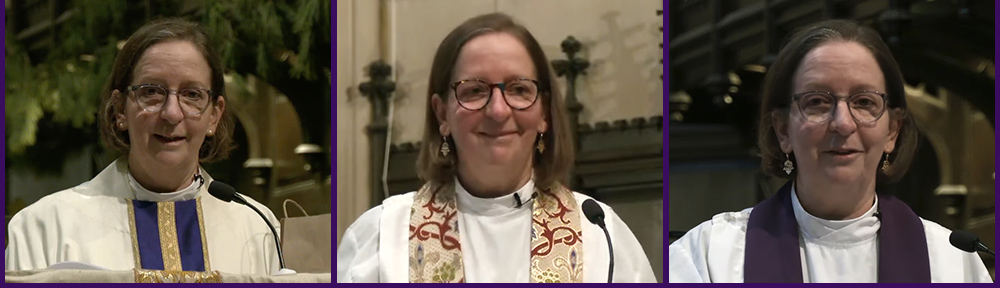
How Sorrow Turns to Joy

Easter 3A, 23 April 2023. The Very Rev. Pamela L. Werntz

  • Acts 2:14a, 36-47. For the promise is for you, for your children, and for all who are far away.
  • 1 Peter 1:17-23.  Love one another deeply (or constantly) from the heart.
  • Luke 24:13-35. Were not our hearts burning within us?

O God of our aching and burning hearts, may we have the wisdom, the strength, and the courage to seek always and everywhere after truth, come when it may and cost what it will.


In today’s Gospel portion, we heard the Easter story of two on the road to Emmaus – one named Cleopas and the other is unnamed, which allows me to understand that the other was a woman. It’s a beautiful account of the art of resurrection, about how, even when we doubt it, we don’t understand it, we can’t imagine it, and we certainly are not looking for it, we might come to recognize that the Risen Lord can be walking along with us when we are overcome with grief and deeply afraid. The Risen Lord can be right in front of us without our knowing it. The Risen Lord can be in the midst of us when we share our food. Before I go further down this Road to Emmaus, however, I must go back to our first reading from the Acts of the Apostles. Continue reading

Look for things that go right.

Easter (A), 9 April 2023. The Very Rev. Pamela L. Werntz

  • Jeremiah 31:1-6. I have loved you with an everlasting love.
  • Colossians 3:1-4, 5-15. When Christ who is your life is revealed, then you also will be revealed with him in glory.
  • Matthew 28:1-10. Go and tell.

O God of new life, grant us the wisdom, the strength, and the courage to seek always and everywhere after truth, come when it may and cost what it will.


I wish you could see yourselves, the way you look from this pulpit; you look beautiful! I was hoping that you would be here, and I am so glad that you are. I’m glad for those of you who are with us via live-stream, too, even though I can’t see you! Thank you for celebrating Easter with Emmanuel Church! Welcome to those of you who are here for the first time, those of you who have been here more times than you can count, and  all of you who are somewhere in between. Continue reading

Depth Perception

Lent 4A, 19 March 2023. The Very Rev. Pamela L. Werntz

  • 1 Samuel 16:1-13. The Lord said to Samuel, “How long will you grieve over Saul?”
  • Ephesians 5:8-14.Rise from the dead, and Christ will shine on you.
  • John 9:1-13, 28-38.  So that God’s works might be revealed in him, we must work the works of [the One] who sent me while it is day; night is coming when no one can work.

O God of Love, grant us the strength, the wisdom, and the courage to seek always and everywhere after truth, come when it may, and cost what it will.


Today’s lessons hold special power for me; they were the appointed readings for a pivotal moment in seminary, when I was learning to grapple with difficult Biblical texts (as it turns out, most Biblical texts are difficult if we’re taking them seriously). They were the appointed readings for my first Sunday as your priest, 15 years ago, when I asked our head usher Steve Babcock to pass out red pencils with the bulletins. I’ll get back to that in a moment. Then three years ago, these were the readings on the first Sunday of the pandemic shutdown, when my wife Joy live-streamed the service on Facebook using her phone. And here they are again, in this strange time being called post-pandemic, but certainly not post-COVID. Continue reading

Thirst

Lent 3A, 12 March 2023. The Very Rev. Pamela L. Werntz

  • Exodus 17:1-7. The people thirsted there.
  • Romans 5:1-11. God’s love has been poured into our hearts through the Holy Spirit.
  • John 4:5-42. Give me a drink.

O God of water and thirst, grant us the strength, the wisdom, and the courage to seek always and everywhere after truth, come when it may and cost what it will.


One theme for the day that I hear in our scripture readings is thirst. Maybe you know Mary Oliver’s poem called “Thirst,” in her book by the same name. [1] When I first read the poem, I heard it in Mary Oliver’s voice; this time around the I hear two voices in dialogue. The first part of the poem seems like the voice of the Samaritan woman.  Continue reading

Workin’ on a World

Lent 2A, 5 March 2023. The Very Rev. Pamela L. Werntz

  • Genesis 12:1-4a. Go from your country and your kindred and your father’s house.
  • Romans 4:1-5, 13-17. Blessed are those whose iniquities are forgiven, and whose sins are covered.
  • John 3:1-17. How can these things be?

O God of grace, grant us the strength, the wisdom, and the courage to seek always and everywhere after truth, come when it may, and cost what it will.


Some Sundays are harder than others to give thanks and praise to God in response to the scripture readings; don’t you think? Perhaps you have an experience similar to mine of knowing these lessons from a standpoint of in-versus-out, us-versus-them, or ours-and-not-yours. Perhaps you’ve heard these lessons as being about tests of who measures up because of what they think or don’t think. If not, just wait for the end of today’s cantata! All this makes people flee religious practice, and for good reason.  As many of you know, rather than skipping over or speeding through scripture that is offensive, off-putting, or terrifying, my Bible teachers taught me that even the worst passages will bear fruit if I slow down and wonder what they have to say to me. It takes some practice (and some nerve) to learn to go from fight or flight to rest and digest. Continue reading

Need

Lent 1A, 26 Feb. 2023. The Very Rev. Pamela L. Werntz

  • Genesis 2:15-17, 3:1-7. You will not die.
  • Romans 5:12-21. But where sin increased, grace abounded all the more.
  • Matthew 4:1-11. Away with you, Satan!

O God all gracious and all merciful, grant us the strength, the wisdom and the courage to seek always and everywhere after truth, come when it may, and cost what it will.


We have just crossed the threshold into the season of Lent in the Church, for period of forty days, not including Sundays (hence our special reception after our service today)! The forty days are set aside for Christians to examine our estrangement from the grace and mercy of the Holy One and to return to right relationship with God and one another. Although each person is called on to do their own Lenten practice, as a congregation we come together for mutual support and encouragement as we go through a this period of intensified self-examination with a call to increased generosity in almsgiving, praying, fasting, and studying scripture. Continue reading

An Auspicious Day

Last Sunday after the Epiphany (A), 19 Feb. 2023. The Very Rev. Pamela L. Werntz

  • Exodus 24:12-18. Come up to me on the mountain.
  • 2 Peter 1:16-21. You will do well to be attentive to this as to a lamp shining in a dark place…until the morning star rises in your hearts.
  • Matthew 17:1-9.  Jesus came and touched them, saying, “Get up and do not be afraid.”

O God of majesty, mercy and mystery, [1] grant us the strength, the wisdom and the courage to seek always and everywhere after truth, come when it may, and cost what it will.


Today is an auspicious day, the last Sunday after the Epiphany, the Sunday we tell the story of the Transfiguration, the story of Jesus and his friends and their majestic, merciful, and mystical mountaintop experience. But if you heard the Gospel lesson last week, you (like me) might still be stuck in the weeds of a different mountain, pondering Jesus’ hard teachings, even after our seminarian Lisa’s marvelous sermon. Last week, we heard Jesus teaching things like: it’s not only murder that violates God’s law (or Love’s rule), it’s being angry with another or insulting another that will make one liable to the flaming trash heap called Gehenna, also known as hell. It’s not only adultery that violates God’s law (or Love’s rule), it’s looking at another person with lust in one’s heart. It’s not just swearing falsely; it’s swearing at all. Although we didn’t hear it last week, what follows is about turning the other cheek, giving away one’s extra cloak, going the second mile, giving to everyone who begs from us, and loving our enemies. Continue reading

How shall we live?

Epiphany 5A, 5 Feb. 2023. The Very Rev. Pamela L. Werntz

  • Isaiah 58:1-12. You will be called the repairer of the breach, the restorer of streets to live in.
  • 1 Corinthians 2:1-16. Those who are spiritual discern all things.
  • Matthew 5:13-20. Do not think that I have come to abolish the law or the prophets.

O God of mercy, salt and light, grant us the strength, the wisdom and the courage to seek always and everywhere after truth, come when it may, and cost what it will.


As tempting as it is to preach about salt and light, I am so struck by Jesus’ teaching that he has not come to abolish the law (that is, Torah) or the prophets (that is Isaiah and the others). Jesus says, “I have come not to abolish but to fulfill. For truly I tell you, until heaven and earth pass away [which, by the way, has not happened yet], not one letter, not one stroke of a letter, will pass from the law.” Just last week a visitor was marveling at the fact that a parish and a synagogue share this sacred space as well as sharing teaching, pastoral care, and outreach. The person said, “But Jews are waiting for the Messiah, right? And Christians believe the Messiah has already come.” I replied that Jews are waiting for the first coming and Christians are waiting for the second coming. We’re all waiting and wondering how (and whether) we will recognize the Messiah. Meanwhile, at 15 Newbury Street, we’re doing what we can to repair the world, which we all agree is in desperate need of healing. [1] Continue reading

Begin wherever you are.

Epiphany 4A, 29 Jan. 2023. The Very Rev. Pamela L. Werntz

  • Micah 6:1-8.  [God] has told you, O mortal, what is good; and what does the Lord require of you but to do justice, and to love kindness, and to walk humbly with your God?
  • 1 Corinthians 1:18-31. For God’s foolishness is wiser than human wisdom, and God’s weakness is stronger than human strength.”
  • Matthew 5:1-12. “Blessed…blessed…blessed.”

O God of the strangest blessings, grant us the strength, the wisdom,and the courage to seek always and everywhere after truth, come when it may, and cost what it will.


When I sat down to write on Friday, I’d just received an alert from the Boston Police Commissioner about anticipating protests in response to the kidnapping and murder of Tyre Nichols by police officers in Memphis earlier this month, as the horrifying body-cam video was about to be released to the public. I’m grateful that the demonstrations have been peaceful in Boston and mostly peaceful around the country. Continue reading

It’s Love that will never abandon.

Epiphany 3A, 22 Jan. 2023. The Very Rev. Pamela L. Werntz

  • Isaiah 9:1-4. For the yoke of their burden…you have broken.
  • 1 Corinthians 1:10-18.  Beyond that, I do not know whether I baptized anyone else. [To me, this is one of the funniest lines in all of scripture.]
  • Matthew 4:12-23.  He saw [them] … and he called them

O God of darkness and light, grant us the strength, the wisdom and the courage to seek always and everywhere after truth, come when it may, and cost what it will.


We’ve returned to the Gospel of Matthew; and so again, our lesson from Isaiah sounds as if it were teeing up the Gospel lesson. To Christian ears, it may even sound as if Isaiah was anticipating Jesus. But, as I said two Sundays ago, Isaiah wasn’t anticipating Jesus any more than Isaiah was anticipating George Frederic Handel. Isaiah wasn’t anticipating Emmanuel Church either, but here we are again! It’s is exactly the other way around. Probably in Antioch of Syria at least two generations after Jesus’ death, Matthew was living and growing in the teachings and stories of Jesus. Matthew’s audience was living with the political, economic, legal, religious, and cultural consequences of Roman imperialism, just as we are living with the consequences of American imperialism. [1] Retelling those teachings and stories about Jesus in a written Gospel toward the end of the first century of the Common Era, Matthew was thinking, “These stories sound so much like the stories that Isaiah told eight-hundred years ago!” Matthew wanted to make sure that his community heard and understood the connections. I want to make sure that my community hears and understands the connections, too. 
Continue reading