
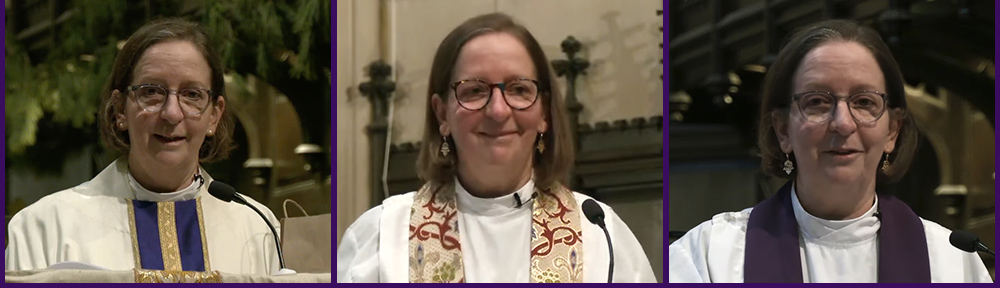
The Realm of God is coming.

Proper 14C, 10 August 2025.  The Rev. Dr. John D. Golenski.

Luke 12:32.  Jesus said to his disciples, “Do not be afraid, little flock.”


The very first time I consciously witnessed a death was the day my dog Jet was fatally injured while chasing a car.  We called him Jet because he was jet black, a fiercely loyal Cocker Spaniel, whom I had cared for since my parents brought him home in a basket.   He was protective of our family in general, but he was truly my dog, patrolling our large yard and garden whenever I went out.  Once in a while,  when I opened the gate, he would fool me and zip through into the street.  For some reason he was convinced that moving car tires posed an existential threat, so he had to chase them away. One summer day when I was eleven, Jet snuck out.  I ran after him trying to distract him from the street traffic, but he must have slipped; somehow he was pulled under the moving tire.  I watched in horror as the car rolled over him.  The driver, a local mother with her infant in the car, ran up to me as Jet limped back to me, collapsed at my feet, and expired. Continue reading

The Peace of God’s Realm

Proper 13 C, 3 August 2025.  The Rev. Dr. John D. Golenski.

Luke 12:13.  “Teacher, tell my sibling to divide the family inheritance with me.”


Whenever I hear this portion of Luke’s Gospel, I am carried back to an eerie parallel in my extended family’s history. One of my maternal uncles, Zephyr (everyone called him “Fee”), one of my mother’s younger brothers, returned from the Second World War in one piece. He had served in the Allied Persian Corridor Logistics Corps, which had built and maintained the route for almost half the lend-lease materiel sent from the US to the Soviet Union. They had helped the Russians to repulse the German invasion of 1941-44. Fee’s parents proudly displayed a photo of the “Big Three” meeting at Yalta. In the background, Fee is standing at attention as one of the honor guards. Continue reading

It’s already in you.

Proper 12C, July 27, 2025.  The Rev. Pamela L. Werntz

  • Hosea 1:2-10.  In the place where it was said to them, ‘You are not my people,’ it shall be said to them, ‘Children of the Living God.’,
  • Colossians 2:6-19. Do not let anyone disqualify you.
  • Luke 11:1-13. Everyone who ask . . . everyone who searches . . . everyone who knocks.

O God of Everyone, grant us the strength, the wisdom and the courage to seek always and everywhere after truth, come when it may, and cost what it will.


I want to preach about the Gospel lesson from Luke, but I cannot leave the reading from Hosea just hanging there! Hosea, a prophet of Israel, was crying out against his people for breaking the covenant by not worshipping The Holy One alone. Idolatry and whoredom, in ancient Hebrew, are the same word – the very same thing. [1The people had promised fidelity to the Holy One of Israel, but they had been seeing other gods. They had been engaged in moral defection, fraud and cheating, improper intercourse with other deities. They have been putting their faith in wealth and other forms of power, engaging in dishonorable and undignified behavior, rather than acting in compassion and with high regard for both neighbors and aliens. (This could be ripped from today’s headlines.) Hosea charged that economic resources were being misused to wage war, and the government was exploiting poor people. When the Lord first spoke within Hosea, Hosea heard, ‘find a wife who is seeing other gods, because you’ll not be able to find one who is not seeing other gods – everyone in the land is doing it…and name your children after a place of a brutal massacre; “no compassion;” and “not my people.” Hosea heard God saying, “because I am not your becoming; I am not your being; I am not your will be.”

Continue reading

What God Has Joined Together

Proper 11C, July 21, 2025. The Very Rev. Pamela L. Werntz

  • Amos 8:1-12. The end has come upon my people Israel.
  • Colossians 1:15-28. Christ Jesus is the image of the invisible God.
  • Luke 10:38-42. She had a sister named Mary, who [ALSO] sat at the Lord’s feet.

O God of mercy, grant us the strength, the wisdom and the courage to seek always and everywhere after truth, come when it may, and cost what it will.


Here we go again with another set of lectionary readings that have been used to advance truly regrettable theologies about women, work, contemplation versus action, and divine judgment. What a combination: the apocalyptic vision of Amos, the cosmic Christ of Colossians, and two sisters whose story has been weaponized for centuries to pit so-called “spiritual” people against those who engage in the messy work of hospitality and care. However, I see glimmers of hope in this collision of texts that seem to speak past each other at first glance. I invite you to hear these passages not as separate little moral lessons, but as a unified testimony written over the course of more than 800 years about divine priorities and what it means to lean into God’s realm. Continue reading

Clarity comes from merciful action.

Proper 10C, July 13, 2025.  The Very Rev. Pamela L. Werntz

  • Amos 7:7-17.  The Lord said to me, Go prophesy to my people Israel.,
  • Colossians 1:1-14.  Grace to you and peace from God.
  • Luke 10:25-37.  But wanting to justify himself.

O God of mercy, grant us the strength, the wisdom and the courage to seek always and everywhere after truth, come when it may, and cost what it will.


The story called “the good Samaritan” is such an iconic story that one doesn’t have to be a church goer to know it. You don’t have to be a Christian to have heard of it or understand something about it. Hospitals, emergency services, counseling services, hotlines, rules of law about limits of liability, award programs, all get called Good Samaritan. This parable, found only in Luke, might be the most famous parable of them all. And with its fame comes the enormous and crushing weight of Protestant Moral Theology, Sunday School lessons, and a hefty dose of Christian anti-Jewish bias. The preaching challenge for me seems formidable because of what we think we already know about this story, and the guilt that has been wired into most of us about seeing people in life’s various ditches and not doing enough or not doing anything at all to help. In my time as a priest, this bible story has provoked in me more confessions and more defensive attempts at self-justification than any other I can think of.

Continue reading

Fullness of Joy

Proper 9C, July 6, 2025.  The Rev. Pamela L. Werntz

  • 2 Kings 5:1-14.  Had taken a young girl captive from the land of Israel and she served Naaman’s wife.
  • Galatians 6:1-16.  If anyone is detected in a transgression, you who have received the Spirit should restore such a one in a Spirit of gentleness….Bear one another’s burdens.
  • Luke 10:1-11, 16-20.  Do not rejoice at this, that the spirits submit to you, but rejoice that your names are written in heaven.

O God of the plentiful harvest, grant us the strength, the wisdom and the courage to seek always and everywhere after truth, come when it may, and cost what it will.


Our Gospel lesson for this morning picks up right after Jesus has told four people who wanted to follow him that they couldn’t. Then Jesus has appointed 70 others to be sent out – meaning Jesus has appointed apostles. Apostle means one sent – as in an agent or ambassador. (According to Luke there were 70 apostles, not 12). The number 70 in the Bible symbolizes comprehensive universality. Jesus appointed the number of all the nations, according to the Torah. In the 10th chapter of Genesis, the ancient “verbal map” of the whole world describes a network of human relatedness, of cousins, if you will, and belonging, an ecumenical vision of belonging that is remarkably, radically inclusive. [1]  The number 70 is also reminiscent of the number of elders appointed by God to help Moses when Moses told God “I alone am not able to bear all this people because it is too heavy for me.”

Continue reading

Handle with prayer!

Christmas 1C, 29 December 2024. The Very Rev. Pamela L. Werntz

  • Isaiah 61:10 – 62:3. I will greatly rejoice in the LORD.
  • Galatians 3:23-25, 4:4-7. So you are no longer a slave but a child, and if a child then also an heir, through God.
  • John 1:1-18. No one has ever seen God. It is God the only Son, who is close to the Father’s heart, who has made him known.

O God of love, grant us the strength, the wisdom and the courage to seek always and everywhere after truth, come when it may, and cost what it will.


Our lectionary, which assigns the prologue to the Gospel of John for the first Sunday in Christmas, baffles me. Since we’re in a Gospel of Luke year, why not the story of the presentation of Jesus as an infant in the Temple eight days after he was born? The answer, I guess, is that story will be read on February 2, which is the Feast of the Presentation. Continue reading

The blessing is in the sharing.

Proper 18B, September 8, 2024. The Very Rev. Pamela L. Werntz

  • Proverbs 22:1-2, 8-9, 22-23. Those who are generous are blessed, for they share their bread with the poor.
  • James 2:1-10 (11-13) 14-17. Mercy triumphs over judgement.
  • Mark 7:24-37. They were astounded beyond measure.

O astonishing God, grant us the strength, the wisdom and the courage to seek always and everywhere after truth, come when it may, and cost what it will.


In my first semester of seminary, I was accepted into a senior seminar taught by Professor Alison Cheek, who was one of the Philadelphia 11. [1] The course had the longest title: “Learning to Teach Small Group Bible Study from a Feminist Perspective.” LTSGBSFP doesn’t make a good acronym, but it sure did help me engage scripture with an unapologetic feminist consciousness. Professor Cheek helped unstop my ears and loosen my tongue! I give thanks to God for her whenever I encounter lessons like the ones we have before us today. Continue reading

Becoming

Proper 13B, 4 August 2024. The Very Rev. Pamela L. Werntz

  • 2 Samuel 11:26 -12:13a.  There were two men in a certain city, one rich, and the other poor.
  • Ephesians 4:1-16.  Speaking the truth in love…promotes the body’s growth in building itself up in love.
  • John 6:24-35. I AM the bread of life..

O God of continual mercy, may we have the wisdom, the strength, and the courage to seek always and everywhere after truth – come when it may and cost what it will.


I will confess to you that when I looked at the Gospel lesson for this Sunday, I wondered if I’d made a mistake starting my vacation tomorrow instead of last Thursday. John’s emphasis on believing and his assertion that whoever comes to Jesus will never be hungry or thirsty are teachings that are complicated for me. I don’t think they were intended to be stumbling blocks, but I find that they often are. So here goes! I’m stumbling forward. Continue reading

Doing the Next Brave & Compassionate Thing

Proper 12B, 28 July 2024. The Very Rev. Pamela L. Werntz

  • 2 Samuel 11:1-15.  As you live, and as your soul lives, I will not do such a thing.
  • Ephesians 3:14-21.  That Christ may dwell in your hearts through faith, as you are being rooted and grounded in love.
  • John 6:1-21. Ego eimi mey phobeisthe.

O God of mercy, grant us the strength, the wisdom and the courage to seek always and everywhere after truth, come when it may, and cost what it will.


Today we hear the two stories that were left out of last week’s Gospel lesson from Mark. For some reason, the lectionary assigns the Gospel reading for today from John’s version. If you’d like a homework assignment, read all six feeding stories in the four Gospels side by side! Given how very different the four Gospels are, the versions of these stories are remarkably similar. Mark’s version is characteristically a little rougher, John’s is more polished. Mark’s Jesus is in the thick of conflict and confusion all along; for John, Jesus’ feet never really touched the ground. The story of Jesus feeding a huge, hungry crowd is one of the most significant stories about Jesus. It’s rare that a miracle story appears in all four Gospels. I still think that the lectionary should have stuck with Mark this week, though, because it’s complicated and confusing to mix and match Gospel stories. It means shifting gears rather wildly from one literary world to another, each with different assumptions, strategies, purposes, and even audiences. [1] Some may wonder whether the repetition and similarities of the feeding stories make them more likely memory and less likely metaphor. I don’t know; but for me, the stories are equally powerful either as memory or metaphor.  Continue reading