Our Art Therapy Intern Kate Solow’s contribution this week is the following image. We look forward to many more.
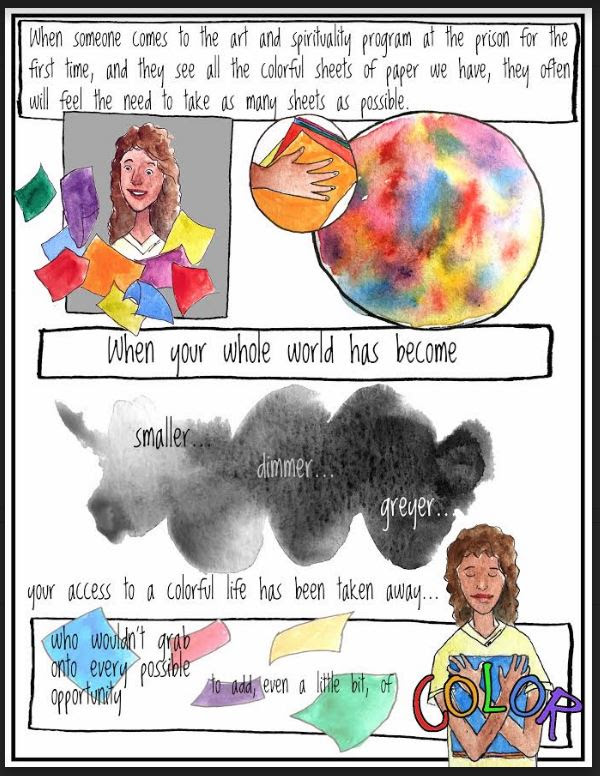

Our Art Therapy Intern Kate Solow’s contribution this week is the following image. We look forward to many more.
One part of my internship at Emmanuel Church is with the Art and Spirituality program at the Suffolk County Correctional Facility. This program provides women housed at the prison with the time and materials to make cards to send to their friends and loved ones. They are provided with images that they can color in, and I have started drawing my own images for them each week. I have made drawings for specific holidays like Halloween and Thanksgiving, images to use for birthday cards, and images for cards that are not for any particular occasion. Continue reading
First Sunday of Advent, Proper 1A, November 27, 2016; The Rev. Pamela L. Werntz
O God of new beginnings, grant us the strength, the wisdom and the courage to seek always and everywhere after truth, come when it may and cost what it will.
And so we begin a new year in the Church. Our ordinary time has been interrupted like the blast of the ram’s horn, by Advent, a season of preparation and repentance. Preparation and repentance can sound like the season of Lent, but Advent is not about the personal so much as it is about institutional, organizational, and communal preparation and repentance (repentance meaning turning around toward God). Our lessons for this Sunday are about a vision of nations waging peace, instructions to the Church that loving is the fulfillment of the law, and a reminder from Jesus that no one knows when the end will be, not even the angels of heaven nor the Son. No one knows except the Author of creation, the Author of Love.
Continue reading
Last Sunday after Pentecost, Christ the King, Proper 29C, November 20, 2016; The Rev. Pamela L. Werntz
Jeremiah 23:1-6 I will raise up shepherds over them who will shepherd them!
Colossians 1:11-20 Making peace through the blood of his cross.
Luke 23:33-43 Forgive them for they do not know what they are doing.
O God of mercy, grant us the strength, the wisdom and the courage to seek always and everywhere after truth, come when it may, and cost what it will.
Perhaps you are wondering what a crucifixion story is doing being read this far away from Holy Week. Today marks the end of our liturgical year. This Gospel lesson is appointed for today because, while we are celebrating the all-embracing authority of God’s Christ, that is, Love’s redeeming urge, and we sing hymns of gratefulness and praise, we can always use a reminder that our King of kings and Lord of lords was executed as a criminal with other criminals. He was friends with criminals while he lived, and then he died with them too. The word that Luke uses for criminal is literally “evil doer.” Our king, our highest earthly authority was executed for sedition – that is, for inciting resistance or disobedience to the government.
Continue reading
Feast of All Saints’, November 6, 2016; The Rev. Pamela L. Werntz
Daniel 7:1-3, 15-18. As for me…my spirit was troubled within me.
Ephesians 1:11-23. So that, with the eyes of your heart enlightened, you may know what is the hope to which he has called you.
Luke 6:20-36. Love your enemies.
Merciful and Generous God, grant us the strength, the wisdom and the courage to seek always and everywhere after truth, come when it may, and cost what it will.
Today we are observing All Saints’ Day in the Church – and we are sacramentally full to the brim with baptisms and Holy Eucharist. Liturgically, our cup is overflowing. Our Eucharistic Prayer will include the names of those in our parish who have died since All Saints’ Day in 2015. After the beautiful Durufle requiem, and before the final blessing, we will pray for our nation, marking the beginning of our election vigil.
Continue reading
Twenty-Fourth Sunday after Pentecost, Proper 26C, October 30, 2016; The Rev. Pamela L. Werntz
O God of Mercy, grant us the strength, the wisdom and the courage to seek always and everywhere after truth, come when it may, and cost what it will. Amen.
Our first reading this morning is from the beginning of the short book of Habakkuk – the prophet. It begins with a title: the oracle, the pronouncement that the prophet saw – although that can also be translated the burden that Habakkuk saw. What Habakkuk saw was indeed a great burden: violence everywhere and a God who seemed not to see the degradation of justice and the utter devastation of well-being, of shalom. Habakkuk has two complaints: 1) God has done nothing to stop the violence so far and 2) it’s about to get worse. In this book, the voice of God is heard, but it’s not particularly good news. Essentially, the response is that the violence is due to the greed of the people and the failure to recognize the Holy One. The violence is understood by Habakkuk as the Holy One’s punishing response, rather than simply a predictable consequence that breaks Love’s heart. Continue reading
Twenty-Second Sunday after Pentecost, Proper 24C, October 16, 2016; The Rev. Pamela L. Werntz
Jeremiah 31:27-34 I will put my law within them, and I will write it in their hearts, and I will be their God and they will be my people…they shall all know me.
2 Timothy 3:14-4:5 Carry out your ministry fully.
Luke 18:1-8 Jesus told his disciples a parable about their need to pray always and not to lose heart.
O God of our hope, grant us the strength, the wisdom, and the courage to seek always and everywhere after truth, come when it may and cost what it will.
Many of you know that I was away last week for my middle daughter’s wedding. It was a lovely and joyous opportunity for my extended family to gather. One of the many blessings of my family’s gatherings, for holidays or for ceremonies, is seeing four generations of siblings and cousins all together, and noticing how similar they all are in appearance and expression. Then I returned to Emmanuel on Tuesday, in time to get ready for the Yom Kippur Kol Nidre service, and I had a chance to recall that one of the blessings of being in an interfaith family, like the interfaith family Emmanuel Church and Central Reform Temple make together, is sharing in one another’s holiday celebrations, and seeing and hearing the ritual and theological relatedness of our traditions, how similar our traditions are in appearance and expression. Continue reading