
Weeds or No Weeds

Fifth Sunday after Pentecost, Proper 9A, July 9, 2017; The Rev. Pamela L. Werntz

Genesis 24:34-38, 42-49; 58-67. Please give me a little water from your jar to drink.
Romans 7:15-25a. For I do not do the good I want, but the evil I do not want is what I do.
Matthew 11:16-19, 25-30. Take my yoke upon you and learn from me.

O God with us, grant us the wisdom, the strength and the courage to seek always and everywhere after truth, come when it may, and cost what it will.


Some of the earliest Sunday School lessons I remember learning were from a class taught sitting in the weeds when I was about six years old. (When we sat down in a little circle, the weeds were over our heads.) The first scripture verse I learned was Psalm 122: “I was glad when they said unto me, let us go into the house of the Lord,” and my teacher told us that we were sitting in the house of the Lord. My dad was the pastor of a congregation that worshipped outdoors at a farm in the summer, which was a welcome respite from the gritty urban ministry that characterized the rest of the year. I remember the weather being steamy and hot and I remember being struck by how many bugs there were in the house of the Lord. That’s what came to me as I reflected on our Gospel lesson for this morning. It’s summertime and we’re in the weeds, and I’m still struck by how many things bug us in the house of the Lord. Continue reading
And that’s not all.

The Fifth Sunday after Pentecost, Proper 8B, June 28, 2015; The Rev. Pamela L. Werntz

2 Samuel 1:1, 17-27. Greatly beloved were you to me. Your love to me was wonderful, passing the love of women.
2 Corinthians 8:7-15. In order that there may be a fair balance…’the one who had much did not have too much and the one who had little did not have too little.
Mark 5:21-43. Do not fear, only believe.

O God of Healing and Restoration, grant us the strength, the wisdom and the courage to seek always and everywhere after truth, come when it may, and cost what it will.


What a week. What a week of so many tears. Tears of sorrow, of anger and despair, tears of amazement, tears of joy and relief, and tears of hope and brave determination. The people of Charleston, South Carolina are still burying the nine faith-filled people massacred in Emanuel African Methodist Episcopal Church a week ago last Wednesday while they were praying together and studying the Bible. The families of the martyrs have declared forgiveness for the shooter. They are continuing to testify and demonstrate that love is stronger than hate, and more powerful than death. Wednesday Bible Study went on as scheduled this past week with about 100 people jammed into the room where so much blood had been spilled the week before. Pastor Pinckney’s lesson the week before had been about the parable of the sower. Pastor Goff’s lesson the week after was about the power of love – full of parables from both Hebrew and Christian Testaments that reportedly had the people in that gathering laughing and crying at the same time. What powerful seeds of love are being sown by Mother Emanuel. And that’s not all. Continue reading

Reasons to Rejoice

The Third Sunday of Advent, 3B, December 14, 2014; The Rev. Pamela L. Werntz

Isaiah 66:1-4, 8-11. To give them a garland instead of ashes.
1 Thessalonians 5:16-24. Rejoice always, pray without ceasing.
John 1:6-8, 19-28. This took place in Bethany across the Jordan where John was baptizing.

O God of hope, may we have the wisdom, the strength, and the courage to seek always and everywhere after truth – come when it may and cost what it will.


One of the benefits of sharing sanctuary and programs, families and friendships, with a synagogue is that we are regularly called out of theological complacency when it comes to our Christian scripture and Church tradition’s references to Jews – or Levites, priests from Jerusalem, high priests, Sadducees, scribes, or Pharisees. I changed the word Jews in our Gospel lesson to Judeans by way of putting a speed bump in our path, not because Judeans is necessarily the best translation of Judaios here, but because I want us all to slow down a little bit when we listen to this reading. John the Evangelist (that is, John, the Gospel writer) begins his version of the story of Jesus with tension between “the Jews” and Jesus in a way that the other three Gospel writers do not. For John the Evangelist, the tension started before Jesus even appeared on the scene. It’s not exactly clear to scholars who John means when he writes Judaios. He’s certainly not talking about all Jews or all Judeans even at the time, since Jesus and his followers were all Jewish. He may be contrasting Judeans and Galileans, but most likely he’s writing about some of Jerusalem’s religious authorities.[1] He clearly has an ax to grind that the other Gospel writers do not have. The Gospel of John uses the term Judaios some sixty-four times compared with six in the Gospel of Mark, five in Matthew, and three in Luke.[2] It seems that John, who was writing in the late first century, is caught up in a late-first-century conflict, which he is applying retroactively to the first part of the first century. I wonder if John is using the word the way some of us refer to “the police,”  “the military,” or “the government,” when we are angry or despairing in the midst of struggle. I don’t know John’s intent, but I do know that we cannot let it slide. Continue reading

1998

  • August 1. Nancy Granert began as organist.
  • Building Chair David Carlson wrote a grant proposal to the Mass. Historical Commission, which awarded us a $100K matching grant for restoration of the Lindsey Chapel.
  • Scenes of The Proposition with Kenneth Branagh as priest were filmed at Emmanuel.
  • Mary Eliot (Pat) Jackson served as junior warden with John Hsia as senior warden.  She edited Emmanuel News from 2000-01.

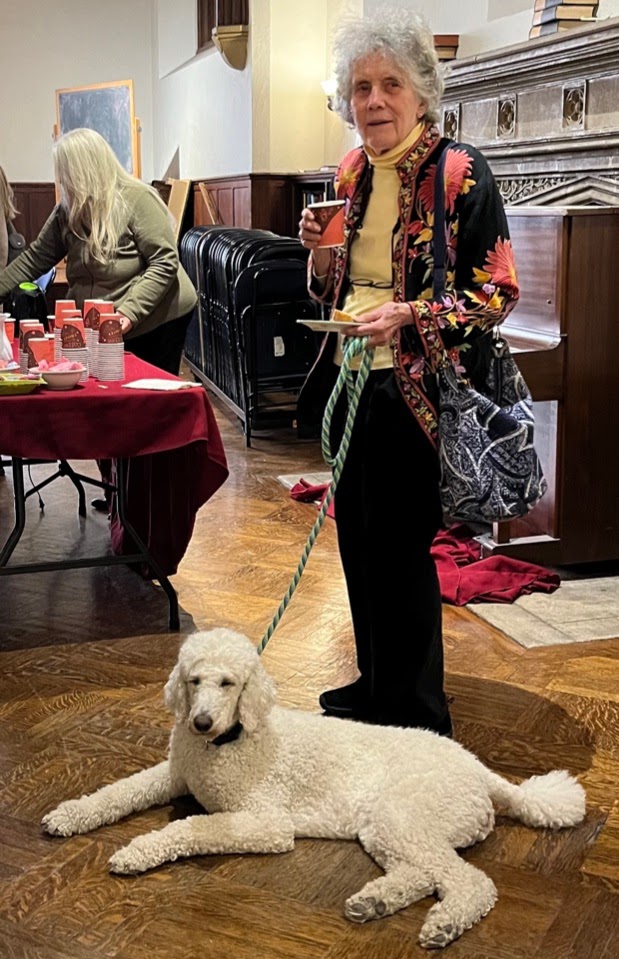
Mary Eliot (Pat) Jackson with her poodle Zephira in 2025